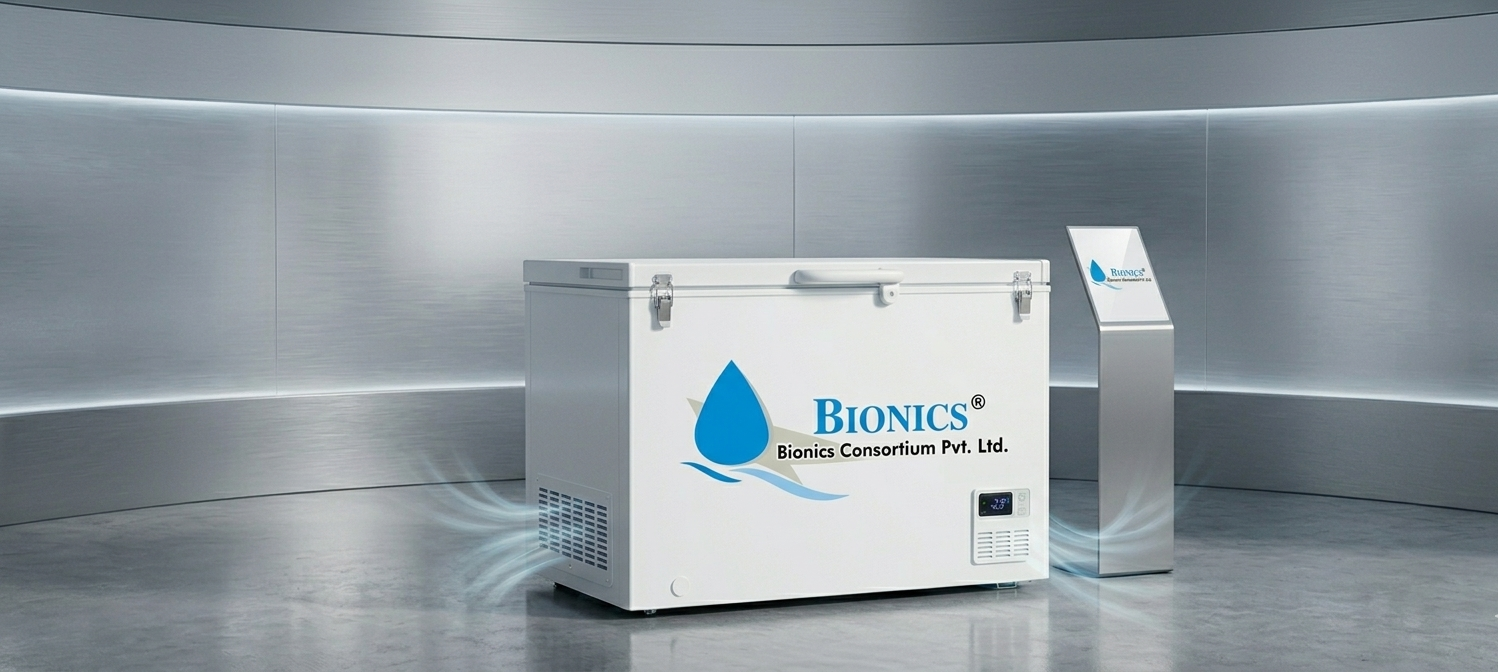
The significance of cold storage cannot be emphasized more where the storage of temperature-sensitive materials is concerned, in labs, hospitals, pharma companies, food processing companies, and other industries. Among the numerous refrigeration equipment developed to ensure low temperature stability, one of the most common is the deep freezer.
Whatever the case may be whether it is biological material, vaccines, chemicals, laboratory products, frozen foods, or any other industrial products which demand low temperature maintenance, selecting the right kind of deep freezer can make a significant difference to your process efficiency.
This buyer's guide provides you insights on deep freezer types, temperature ranges, sizes, applications, energy usage, pricing considerations, and many other factors.
The deep freezer is a type of fridge that keeps the temperature much lower than in ordinary fridges. In contrast to regular freezer units which are included in domestic fridges, deep freezers were specifically developed for storing items under consistently low temperatures.
Deep freezers are commonly used in:
Their primary purpose is to preserve products by slowing biological activity, preventing degradation, and extending storage life.
Understanding the available deep freezer types helps users select equipment that aligns with their storage requirements.
Laboratory deep freezers are meant to be used for scientific and clinical purposes, hence they have advanced features and temperature controls that are precise.
Applications include:
Key features:
Commercial deep freezers can be found being used in shops, hotels, food processing plants, restaurants, and supermarkets.
Applications include:
Key features:
Chest-style units open from the top and offer excellent cold retention.
Advantages:
They are similar to normal refrigerators except that they have compartments for storage.
Advantages:
Although both systems operate at low temperatures, their intended applications differ significantly.
|
Feature |
Laboratory Deep Freezer |
Commercial Deep Freezer |
|
Primary Use |
Scientific Storage |
Food Storage |
|
Temperature Accuracy |
High Precision |
Standard Precision |
|
Monitoring System |
Advanced |
Basic |
|
Data Logging |
Available |
Limited |
|
Compliance Requirements |
Strict |
Moderate |
|
Alarm Protection |
Advanced |
Basic |
|
Storage Materials |
Samples, Vaccines, Reagents |
Food Products |
Laboratories require accurate temperature maintenance and sample protection, while commercial facilities focus on product preservation and storage capacity.
Deep Freezer Temperature Range Explained
Temperature range is one of the most important specifications when selecting a deep freezer.
|
Type |
Temperature Range |
|
Commercial Deep Freezer |
-10°C to -25°C |
|
Laboratory Deep Freezer |
-20°C to -40°C |
|
Biomedical Deep Freezer |
-40°C to -86°C |
Different products require different storage conditions.
For instance:
Incorrect selection of temperature range may cause issues.
Capacity selection should be based on current storage needs and future expansion plans.
|
Capacity |
Suitable For |
|
100–200 Litres |
Small laboratories |
|
200–400 Litres |
Clinics and educational institutions |
|
400–600 Litres |
Medium-scale laboratories |
|
600–800 Litres |
Hospitals and research facilities |
|
800+ Litres |
Industrial and commercial operations |
Going for a higher capacity will save you money in case you need to upgrade your freezer later on.
Consumption of energy is crucial since it directly impacts operational expenses.
Facts That Influence Energy Consumption
Deep freezers utilize innovative insulating materials along with effective refrigeration system designs that consume minimum amounts of energy while ensuring temperature consistency.
While many consumers believe that these terms denote similar machines, there are actually differences between them.
|
Feature |
Deep Freezer |
Chest Freezer |
|
Definition |
General category |
Specific freezer design |
|
Temperature Capability |
Wide range |
Typically standard freezing |
|
Applications |
Scientific and commercial |
Mainly food storage |
|
Configurations |
Upright or chest |
Chest only |
|
Temperature Precision |
High |
Moderate |
A chest freezer is a type of deep freezer, whereas a deep freezer may include several configurations and performance levels.
Before purchasing, evaluate the following specifications.
|
Specification |
Importance |
|
Temperature Range |
Storage suitability |
|
Capacity |
Storage volume |
|
Compressor Type |
Performance and durability |
|
Controller Type |
Temperature accuracy |
|
Alarm System |
Sample protection |
|
Insulation Thickness |
Energy efficiency |
|
Interior Material |
Hygiene and durability |
|
Power Consumption |
Operating cost |
|
Backup Features |
Safety and reliability |
|
Warranty Coverage |
Long-term value |
Deep freezer pricing varies depending on capacity, temperature range, construction quality, and monitoring capabilities.
|
Temperature Ranges |
-20°C, -40°C, -60°C & -80°C |
|
Model |
Horizontal and Vertical Models are available |
|
Controller |
Touch Key Pad with LCD Panel |
|
Thermostat |
Computerized Thermostat |
|
Alarm |
Audio & Visual Alarm System |
|
Refrigerant |
CFC Free Refrigerant |
|
Body Construction |
Double Wall Body with Polyurethane Insulation |
|
Doors |
Solid Doors |
|
Interior Doors |
Single or Double Doors with Tempered Glass |
|
Outer Shell of the Freezer |
Mild Steel Body with Powder Coated Surface |
|
Finishing |
(Stainless Steel Body Finishing is optional) Body of Freezers Internal Parts Stainless Steel 316/304 Grades |
Optional Equipment |
IQ, OQ, PQ Documentation- Seven Days Circular Graph Plotter- RS232/RS485 Communication Interface for Temperature, Time & Date- Graph Plotter- Stainless Steel Body of the Freezer- Casters for Easy Movement of Freezers- Voltage Stabilizer Power Input Requirement 220-240 volts/50Hz Single |
To buy a deep freezer, it is not enough to just compare prices alone.
Utilize Application Requirements
Identify whether the application involves:
Select the right temperature requirement that suits the materials stored inside.
Buy according to the long-term capacity requirement.
Ensure good service support to maintain continuous operation.
The BionicsRO range features superior cold storage units built to cater for the rigorous demands of labs, research institutes, hospitals, and other users.
Engineered for consistent cooling and dependable temperature stability.
They are made from top-notch materials for durability.
Easy-to-use interfaces allow for temperature measurement and regulation.
Engineered for reduced energy consumption without sacrificing efficiency.
Various models available to fit different needs.
Each unit passes through rigorous quality control before delivery.
Dedicated support and assistance help customers maximize equipment performance.
Tailored configurations are available for specialized laboratory and industrial applications.
From laboratory freezers, commercial freezers, biomedical freezers to specialized cold room solutions, BionicsRO provides consistent performance with technical expertise.
Get in Touch With BionicsRO Now!
✓ Technical consultancy services
✓ Customized capacity availability
✓ Advanced temperature control system
✓ Affordable pricing structure
✓ Excellent after-sales service
Get in touch with our team today to find the right deep freezer solution for your laboratory, healthcare facility, research center, or commercial operation.
The acquisition of a deep freezer represents an essential consideration for entities that require safe and cool storage solutions. Whether used for maintaining biological specimens or drugs in laboratories or for facilitating commercial food production, there is a need to select a deep freezer based on various considerations.
Some of the key elements that one should take into account when making a purchase include temperature ranges, storage capacity, energy consumption, and other application-related factors.
If your entity needs reliable and effective cold storage equipment, BionicsRO is here to provide you with premium-quality deep freezers that will suit all of your needs perfectly.
Applications of deep freezers include storing temperature sensitive items like biological materials, vaccines, medicines, food materials, chemicals and so on.
The temperature range for deep freezers may differ depending upon the type of deep freezers and the range could be anything between -10°C and -86°C.
If one wants to use deep freezers for laboratories, then deep freezers having an alarm system and a temperature control mechanism would be preferable.
The watt capacity of deep freezers may also be affected by many other considerations.
It will depend upon the current as well as future requirements of the consumer.
Yes, the deep freezers can also keep vaccines.

Connect with us for your business enquiries. Generally, we respond within a day.