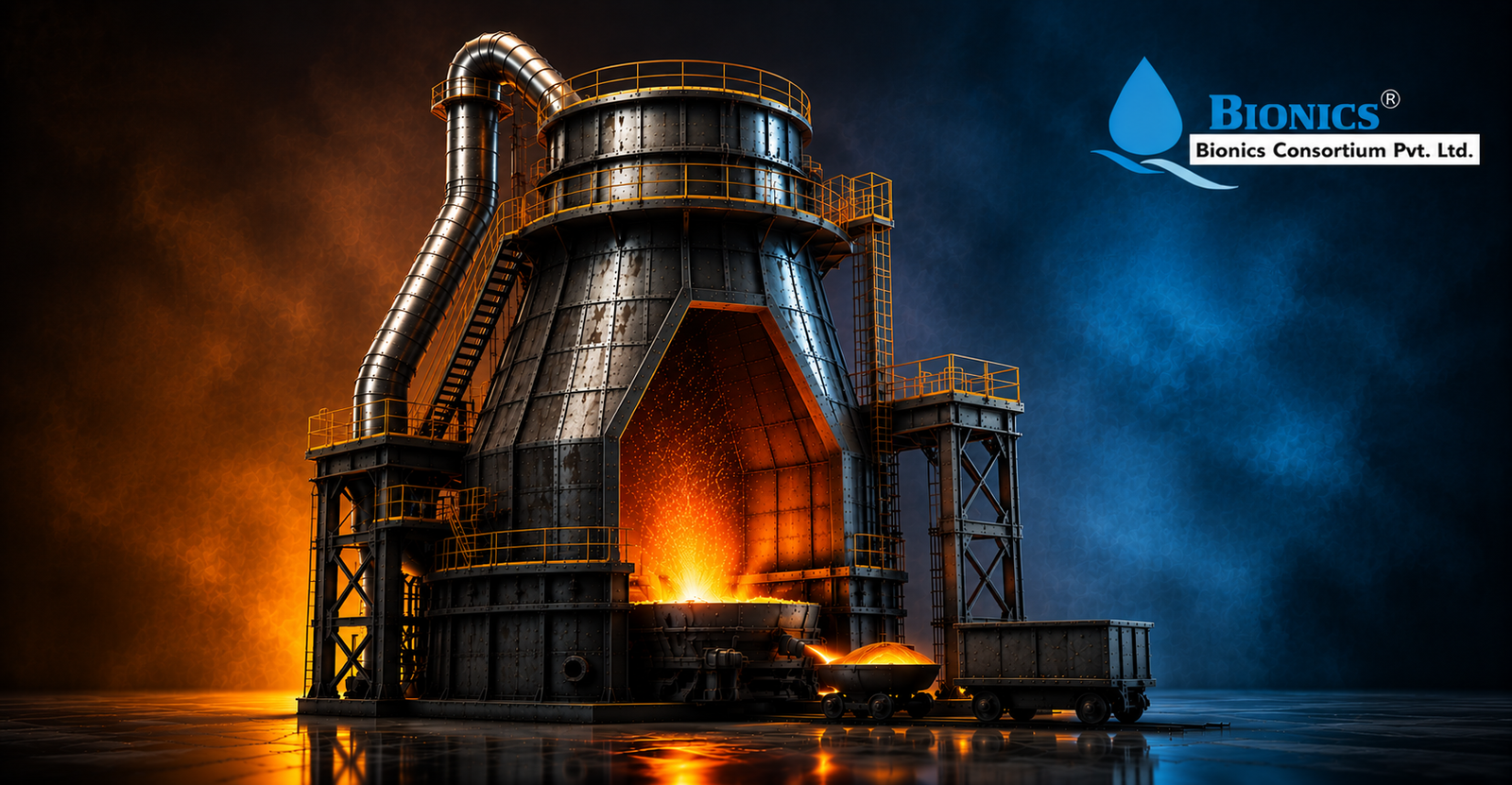
The blast furnace diagram is among the best learning resources available on the process of making iron out of iron ore. If you are a student, engineer or an industrialist, the labelled blast furnace diagram will help you learn every step involved in the process of producing iron from ore.
At BionicsRO, we are the most reliable industrial and laboratory solutions providers in Pan India. Here we present to you a comprehensive guide on the diagram of a blast furnace, its components, principle of operation, blast furnace atmosphere and applications.
Blast furnace is an industrial furnace that makes use of coke and limestone to produce molten iron from iron ore. Blowing hot air into the furnace through the tuyeres enables temperature exceeding 1800°C, which results in chemical reactions that release pure iron from other elements.
For additional information about world steel production and the use of the blast furnace, you can consult the World Steel Association, which is an authoritative source on the steel industry.

Some key features that would be found on a blast furnace labelled diagram are listed below.
Charging hopper
Connection to hot blast stove
Every component of a blast furnace serves a specific purpose which makes the working of the furnace safe and efficient. A labelled diagram is always studied by engineering students.
A simple diagram is very useful for beginners because it deals with the basics without technical details.
Another frequent query is: blast furnace atmosphere?
The blast furnace atmosphere is the reducing atmosphere containing carbon monoxide (CO). CO takes away oxygen from the iron oxide resulting in pure iron formation. In case of no such reducing atmosphere, the iron would not be extracted.
The components of the blast furnace atmosphere include:
The composition varies in different parts of the furnace due to the varying temperature and chemical reactions. It is crucial to maintain a proper atmosphere to get quality pig iron.
The learners often raise the issue, blast furnace atmosphere is called:
The appropriate answer is reducing the atmosphere since carbon monoxide takes oxygen from iron ore in the process of reduction. Such a chemical atmosphere is one of the crucial aspects in terms of blast furnace effectiveness.
Blast Furnace Diagram Working Process
The normal Blast Furnace diagram has four working zones as follows:
Ore, coke, and limestone are added continuously at the top of the furnace.
Carbon monoxide acts upon the iron oxides and reduces them to metallic iron.
Iron melts at the temperature greater than 1800°C, whereas limestone melts into slag because of the mixture of impurities.
Molten iron is collected at the hearth bottom while slag floats over the molten iron.
Many people search for methods of making a blast furnace as part of education.
For an industrial blast furnace, the following will be needed:
Blast furnaces need to work under very high temperatures, and thus they should be handled only by professional industrialists.
Apart from searching for the furnace recipe, many players also look for blast furnace recipe Minecraft.
A blast furnace in Minecraft requires:
This recipe gives us a blast furnace that is more effective in smelting the ores than a normal furnace.
The specifications of a blast furnace vary depending on the production capacity and industrial application. However, most modern blast furnaces share the following standard specifications:
|
Specification |
Typical Range |
|
Furnace Height |
30–80 meters |
|
Internal Diameter |
8–15 meters |
|
Operating Temperature |
1,500°C–2,200°C |
|
Fuel Used |
Coke (with pulverized coal injection in some plants) |
|
Raw Materials |
Iron Ore, Coke, Limestone |
|
Furnace Atmosphere |
Reducing atmosphere rich in Carbon Monoxide (CO) |
|
Main Products |
Pig Iron and Slag |
|
Daily Production Capacity |
1,000–15,000+ tonnes |
|
Primary Applications |
Steel Manufacturing, Iron Production, Heavy Engineering |
|
Working Principle |
Chemical reduction of iron ore using high-temperature gases |
BionicsRO also provides laboratory equipment for research, testing, and industrial applications.. The knowledge of these specifications in connection with the blast furnace diagram makes the ironmaking process easier to understand.
The applications of blast furnaces include:
All these industries require blast furnaces to produce iron in a constant and large scale.
There are many benefits to learning the blast furnace diagram, such as:
Regardless of whether you learn the simple blast furnace diagram or the labelled blast furnace diagram, your understanding of the iron making process will become easy.
We at BionicsRO are dedicated to offering reliable industrial and laboratory solutions throughout Pan India. We have our reputation built on the basis of quality, technical expertise, and customer service. We specialize in delivering reliable products that cater to today’s industrial needs.
BionicsRO Contact Information
Are you searching for a reliable solution provider for industrial as well as laboratory applications throughout India. At BionicsRO we provide reliable customer support services and superior quality products for industries, research laboratories as well as educational institutes. For more information, contact BionicsRO.
The blast furnace diagram is one that shows the structure and process of operation of a blast furnace.
A blast furnace is used for making pig iron from iron ore.
The blast furnace atmosphere is a reducing atmosphere that contains carbon monoxide.
It is known as a reducing atmosphere.
Limestone is used for forming slag along with impurities.
Charging hopper, throat, stack, belly, bosh, tuyere, hearth, slag hole, and molten iron hole.
The temperature of the lower part is more than 1800°C.
It is a very basic diagram which shows its major components and process.
5 Iron Ingots,
3 Smooth Stone Blocks, and
1 Furnace .
It is still the most effective process of iron manufacturing.

Connect with us for your business enquiries. Generally, we respond within a day.