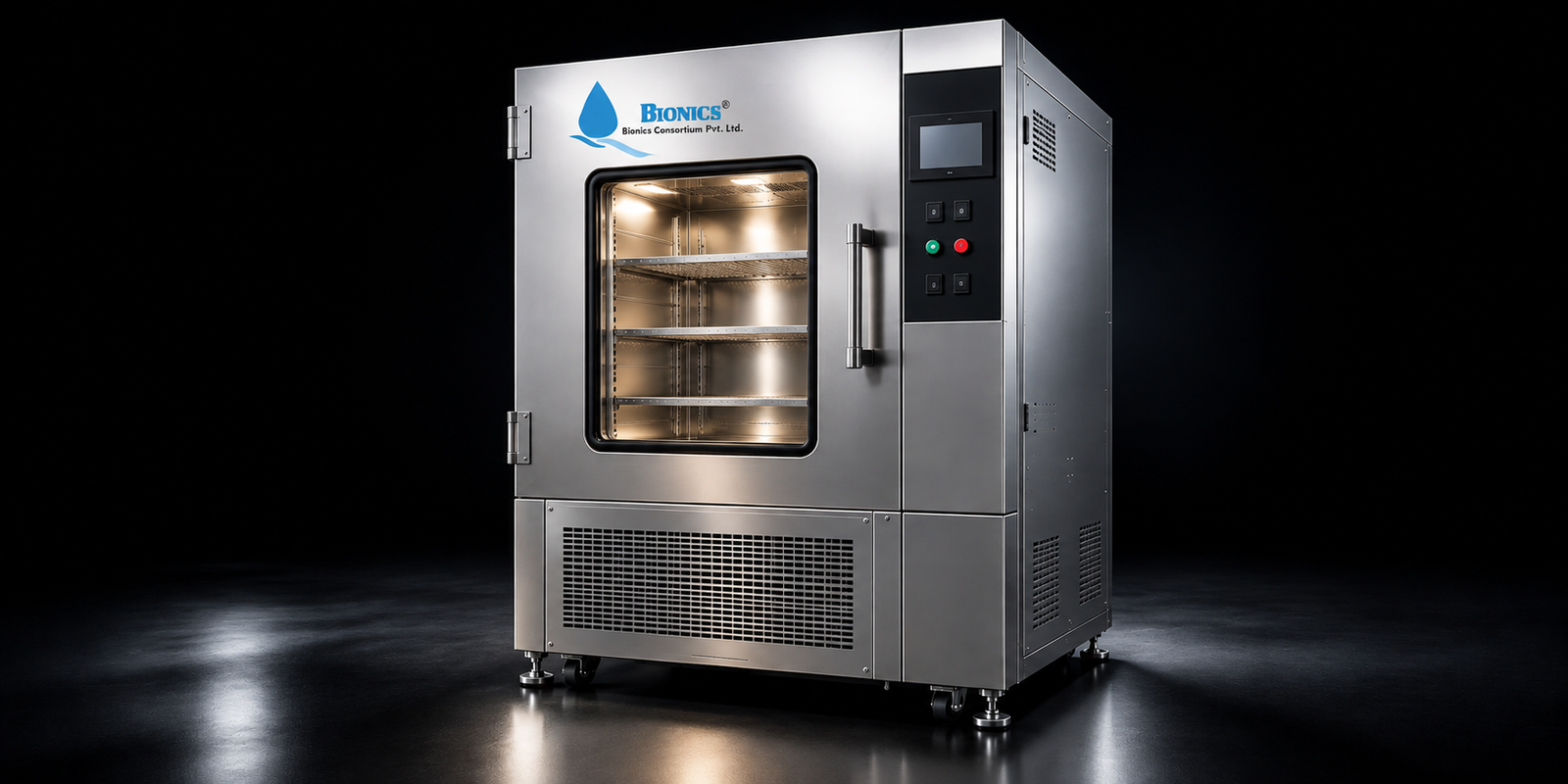
Quick answer: A humidity chamber is an insulated, refrigerated enclosure that holds temperature and relative humidity (RH) at set values so samples can be tested or stored under repeatable conditions. Typical laboratory models run 10°C to 60°C, with 40% to 90% RH controlled inside a 20°C to 50°C band. Bionics Consortium builds humidity chambers for pharma, food, packaging and materials testing, with 26 years of manufacturing behind them.
Buyers want conditions that stay where they were set. Bionics Consortium designs and manufactures its chambers in-house and has done so for 26 years. We are the manufacturer, not a reseller, so engineers can discuss insulation, humidifier choice and controller logic directly.
A humidity chamber is an insulated cabinet with its own refrigeration, heating, humidification and air circulation. A controller reads a temperature probe and an RH sensor, then switches those systems to hold both values for hours, days or months. It is the core humidity chamber for laboratory use in stability studies, packaging validation and moisture-sensitive material testing. A unit documented for regulated shelf-life studies is usually called a stability chamber; the hardware is closely related, while alarms, data integrity features and paperwork differ.
Temperature and humidity interact, since air with a fixed moisture content shows a different RH at every temperature. The chamber must manage both together.
Achievable RH depends on temperature. Humidity is controlled only between 20°C and 50°C, so a chamber rated 10–60°C does not offer every temperature and RH combination.
Standard reach-in humidity chamber machine configuration; the quotation datasheet is the controlling document.
|
Parameter |
Standard specification |
|
Capacity (reach-in) |
150 L to 1500 L; walk-in built to project size |
|
Temperature range |
10°C to 60°C |
|
Humidity range |
40% to 90% RH, controlled between 20°C and 50°C only |
|
Temperature accuracy |
±0.5°C at setpoint |
|
Humidity accuracy |
±3% RH at setpoint |
|
Uniformity (spatial) |
Established by mapping; value stated on model datasheet |
|
Humidification |
Stainless steel steam generator |
|
Interior / exterior |
SS 304 / powder-coated mild steel or stainless steel |
|
Insulation |
CFC-free PUF with enclosed door gasket |
|
Controller |
Microprocessor or PLC, colour display, programmable profiles |
|
Safety |
Over-temperature and low-water cut-off, alarms |
|
Data |
USB or Ethernet logging; optional validated software |
|
Power |
230 V, 50 Hz single-phase standard; other voltages and 60 Hz on request |
Accuracy is closeness to setpoint; uniformity is spatial variation. ICH storage tolerances are ±2°C and ±5% RH, so both should sit well inside them.
Humidity chamber price in India depends on capacity, refrigeration system, humidifier type, controller and data package, interior material, and qualification documents. Walk-in chambers cost many times more than reach-in units.
|
Criteria |
Compact reach-in |
Large reach-in |
Walk-in |
|
Typical use |
R&D, material testing |
QC stability, packaging validation |
Bulk storage, large sample sets |
|
Capacity |
150 L to about 500 L |
About 500 L to 1500 L |
Custom |
|
Construction |
Single cabinet |
Single cabinet, multiple shelves |
Modular insulated panels |
|
Documentation |
Calibration certificate |
Calibration, IQ/OQ on request |
Calibration, IQ/OQ, mapping |
Pharmaceutical: ICH Q1A(R2) covers climatic zones I and II: long-term 25°C/60% RH, intermediate 30°C/65% RH, accelerated 40°C/75% RH. For India (Zone IVa) and Zone IVb, WHO stability guidance applies, typically 30°C/65% and 30°C/75% RH long-term. Food: shelf-life studies. Packaging and textiles: conditioning. Electronics: damp-heat exposure. Agriculture: seed storage.
Regional notes for export buyers
Confirm voltage, frequency and regulations in writing before dispatch.
Many pages omit accuracy and uniformity figures, price drivers and regional power details. This guide answers them before you enquire.
Send your temperature and RH conditions, sample volume, site voltage and frequency, and documentation needs. Our engineers will reply with a specification-led quotation, configured for export where needed. Contact Bionics Consortium to buy a humidity chamber.
A stability chamber is a humidity chamber documented for regulated shelf-life studies, with tighter alarms, audit trails and qualification paperwork.
Standard reach-in models run 10°C to 60°C, with 40% to 90% RH controlled between 20°C and 50°C.
Price depends on capacity, refrigeration, humidifier, controller and documentation. Share your volume and conditions for a quotation.
ICH Q1A(R2) covers zones I and II: 25°C/60% RH long-term, 30°C/65% intermediate, 40°C/75% accelerated. WHO guidance adds 30°C/65% and 30°C/75% RH for zones IVa and IVb.
Yes. Voltage and frequency are set at order stage: 230 V/50 Hz India, 240 V/50 Hz Oman, 220 V/60 Hz common in Saudi Arabia, 120 V or 208–240 V/60 Hz USA.
At least annually, or per your quality system, using traceable references. Repeat mapping after relocation, major repair or sensor replacement.
Steam is the usual choice: fast response, stable at high RH, and no droplets or minerals reaching samples.
Demineralised or distilled water, to limit scale in the steam generator and sensor drift.
It depends on volume, load and setpoint. Small units typically settle within a few hours; larger or loaded chambers take longer.
Scope is agreed in the quotation: typically an operation manual and calibration certificate, with IQ/OQ and mapping support on request.

Connect with us for your business enquiries. Generally, we respond within a day.