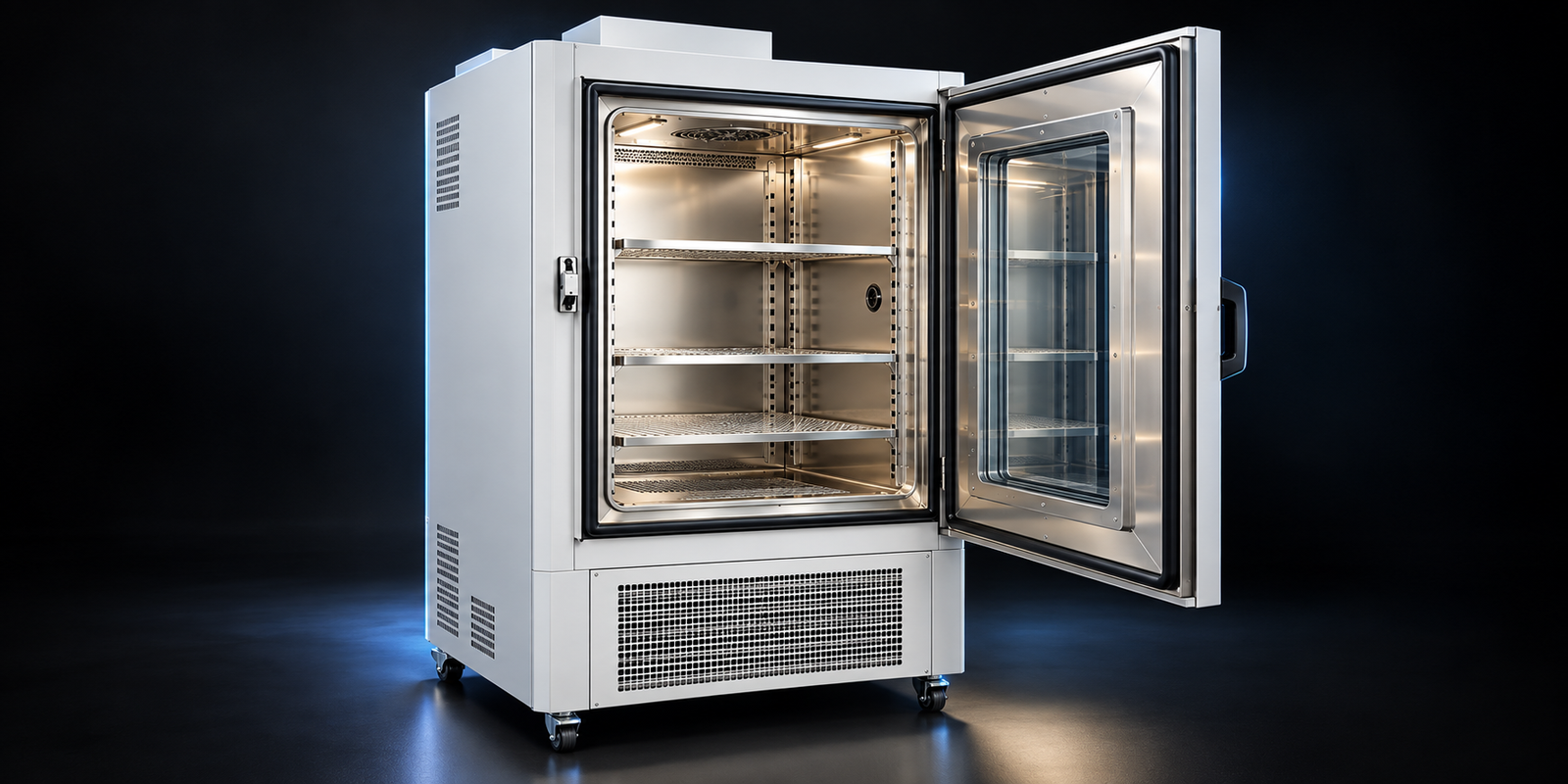
Quick answer: A Laboratory Chamber is an enclosed, insulated unit that holds temperature, and usually humidity, at a set point so samples can be stored, stressed, or tested under repeatable conditions. Buyers choose by temperature and humidity range, uniformity, usable volume, and the standard the work must satisfy, such as ICH Q1A(R2) for stability studies.
A Laboratory Chamber sits behind many routine decisions: whether a tablet formulation survives 24 months of shelf life, whether a polymer cracks after thermal cycling, whether a reagent kit tolerates a Gulf summer in transit. Bionics Consortium manufactures Laboratory Chamber equipment for pharmaceutical, materials, food, and research laboratories. This guide covers how the equipment works, what belongs on a specification sheet, and how to compare options before requesting a quote.
A Laboratory Chamber is a controlled-environment cabinet that combines a refrigeration and heating system, a humidification and dehumidification path, an air circulation system, and a controller that closes the loop on sensor readings. Depending on configuration it may be called a stability chamber, humidity chamber, climatic chamber, or environmental test chamber. The differences lie mostly in range, ramp rate, and documentation, not in the basic concept.
Temperature control combines resistive heaters with a compressor-based refrigeration circuit. The controller, usually PID-based, modulates both to avoid overshoot. Humidity is added by a steam generator or water-bath evaporator and removed by cooling air across an evaporator coil below its dew point. A fan circulates air through the workspace so temperature and humidity are even across shelves. Calibrated Pt100 RTD sensors and a capacitive humidity sensor feed back to the controller. Alarms, data logging, and an independent over-temperature cutout protect samples if something fails.
Pulling humidity down at low temperatures is the hard part, because coil frosting limits performance. This is why published humidity ranges are always tied to a temperature band, and why you should read the operating envelope chart, not just the headline numbers.
Typical configurable ranges are listed below. Confirm exact values against the model datasheet.
|
Parameter |
Typical specification |
|
Temperature range |
+5 °C to +60 °C (stability); wider on test-grade models |
|
Humidity range |
20% to 95% RH (within a defined temperature band) |
|
Temperature uniformity |
±1 °C to ±2 °C at set point |
|
Humidity accuracy |
±3% to ±5% RH |
|
Usable volume |
150 L to 1,500 L (walk-in on request) |
|
Interior material |
SS 304 / SS 316 |
|
Insulation |
PUF or mineral wool |
|
Controller |
PID touchscreen, programmable, with data logging |
|
Safety |
Over-temperature cutout, door alarm, power-failure recovery |
|
Power |
Single phase or three phase, depending on volume |
|
Compliance support |
IQ/OQ/PQ documentation, calibration certificates |
No honest number exists without a configuration. Cost is driven by volume, humidity capability, refrigeration design, stainless steel grade, software and validation scope, and shipping. Request a quote against a written specification so offers are comparable.
|
Criterion |
Standard model |
Stability-grade model |
Test-grade (wide-range) model |
|
Main use |
General storage, incubation |
ICH stability studies |
Stress and cycling tests |
|
Temperature range |
Narrow |
Moderate |
Wide, with fast ramp |
|
Humidity control |
Optional |
Standard |
Standard |
|
Documentation |
Basic |
IQ/OQ/PQ, mapping |
Application-specific |
|
Relative cost |
Lower |
Mid |
Higher |
Regional factors matter when you buy a Laboratory Chamber for a laboratory outside its country of manufacture:
Bionics Consortium is the manufacturer, so questions on design, build quality, and service go to the team that built the unit, not through a reseller. Ask us for datasheets, mapping reports, calibration traceability, and validation protocols before you commit. Every claim in our quotation should be verifiable in a document you can hold.
Send us your temperature and humidity range, required volume, supply voltage, destination country, and applicable standard. We will respond with a specification sheet and the documentation available for that configuration. Contact Bionics Consortium to request a quote or a product demonstration.
The chamber stores samples at a constant temperature and humidity for stability testing, stress testing, storage, and quality analysis. The pharmaceutical laboratory uses it to determine shelf life, and the materials laboratory uses it to analyze aging of products under high/low temperature and humidity conditions.
Determine the volume of the sample and space necessary for proper ventilation. You should not load the shelves more than 70-75% of their capacity. In case of future workload increase, select the larger size because reloading the chamber filled with samples will affect its recovery time.
ICH Q1A(R2) lists long-term 25 °C/60% RH, intermediate 30 °C/65% RH, and accelerated 40 °C/75% RH. Which ones apply depends on your climatic zone and product, so confirm against current guidance and your regulator before configuring.
Yes. A chamber can hit its setpoint at the sensor yet drift several degrees at the shelf corners. Uniformity decides whether every sample sees valid conditions, which is why mapping data should accompany any chamber used for regulated work.
Dehumidifying relies on cooling air below its dew point, and at low temperatures coils freeze. Steam or water-based humidification also has limits at the extremes. Always read the operating envelope chart instead of the single maximum RH value.
Expect a calibration certificate for the sensors, a factory test report, and a manual. For regulated users, request IQ/OQ/PQ protocols and temperature and humidity mapping support. Ask for these in writing before purchase, not after delivery.
Most labs calibrate temperature and humidity sensors annually, with more frequent checks for critical studies. Your quality system, not the manufacturer alone, sets the interval, and calibration should be traceable to national standards.
It can if specified correctly. Voltage and frequency differ across India, the Gulf, and the USA, and 50 Hz versus 60 Hz affects motors and compressors. State your supply and phase when requesting a quote so the unit is built for it.
Volume, humidity capabilities, temperature range, stainless steel quality, controller/software capabilities, documentation for validation purposes, and destination of shipment. Two quotations are comparable only when the written specification is the same, so let's start by defining that.
The interior should be cleaned regularly, pure water needs to be used in the humidifier, door gasket has to be inspected, the condenser needs to be free from dust, and alarms have to be logged in on a regular basis.


Connect with us for your business enquiries. Generally, we respond within a day.