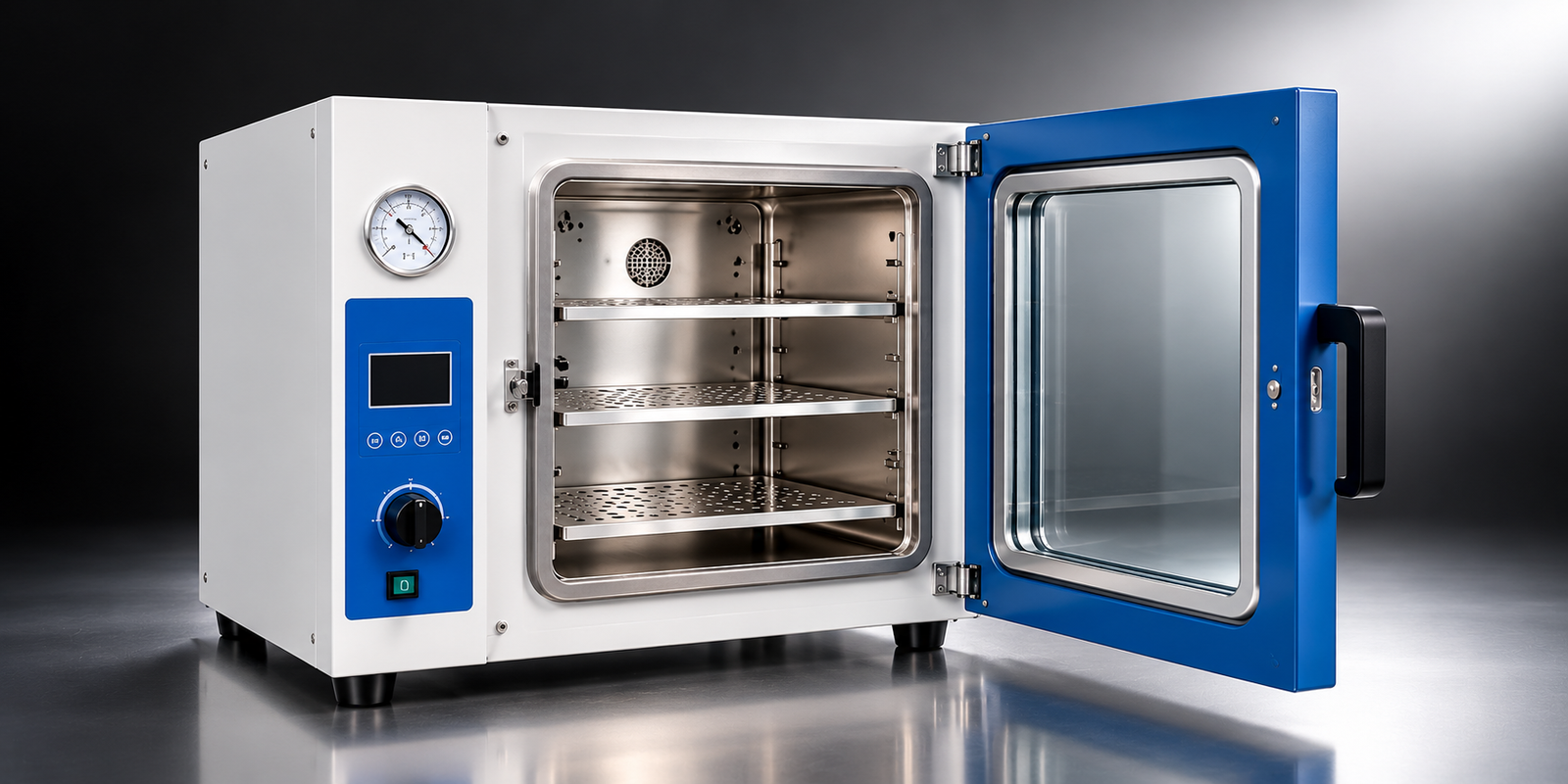
Quick answer: A laboratory circulators manufacturer builds temperature-control units that heat or chill a liquid and pump it through an open bath or an external instrument at a fixed set point. Bionics Consortium manufactures heating and refrigerated circulators with stainless steel baths and PID control for research, pharmaceutical, food and testing laboratories in India and export markets.
If your lab runs a rotary evaporator, a viscometer, a jacketed reactor or a set of sample tubes that must sit at exactly 37 °C for six hours, the circulator is the instrument that decides whether your readings can be trusted. Bionics Consortium, a Delhi-based manufacturer with 26 years of experience in laboratory equipment, builds laboratory circulators for labs that need stable temperature and a clear specification sheet before they place an order. This guide covers how the machine works, which specifications matter, how to choose between variants, and what to check before you buy.
A laboratory circulator is a bath with a heater, a sensor, a controller and a pump. The pump moves temperature-controlled liquid either around the bath itself (internal use) or out to an external vessel and back (external use). A manufacturer, as opposed to a trader, fabricates the tank, selects the heater and pump, wires and programs the controller, and tests the finished unit. That matters when you need a non-standard tank depth, a different supply voltage or a particular fitting size, because a manufacturer can change the build instead of forwarding your request to someone else.
Two families cover most laboratory demand. Heating circulators work from a few degrees above room temperature upward. Refrigerated circulators add a compressor circuit so the bath can sit below ambient, which is what jacketed reactors, viscosity baths and condenser loops usually need.
The working cycle is a closed feedback loop. A PT100 sensor reads bath temperature and sends the value to a microprocessor PID controller. The controller compares it with the set point and switches the heater through a solid-state relay, adjusting the on-time many times per minute rather than simply turning the heater on and off. This is why a properly tuned unit does not swing several degrees around the target.
The pump matters as much as the heater. It agitates the liquid so there are no warm and cold pockets, and it drives flow to external applications. A weak pump gives good stability at the sensor but poor uniformity at the sample, which is a common reason two baths with the same stated accuracy behave differently on the bench.
In a refrigerated model, a compressor, condenser and evaporator coil remove heat from the bath. The controller balances cooling against a small amount of heating to hold the set point. The bath fluid has to suit the range: water works for roughly 5 °C up to the mid-90s °C, a water-glycol mixture handles sub-ambient work, and silicone oil is used when you go above 100 °C, where water would evaporate and add load on the heater.
Two terms are often confused. Temperature stability is how much the temperature fluctuates over time at one point. Temperature uniformity is how much it differs between points in the bath. Ask for both figures.
The table below lists the configuration ranges Bionics Consortium works with. Final values for any order are confirmed in the written quotation.
|
Parameter |
Heating circulator |
Refrigerated circulator |
|
Temperature range |
Ambient +5 °C to 150 °C |
-20 °C to 100 °C |
|
Temperature stability |
±0.1 °C |
±0.2 °C |
|
Display resolution |
0.1 °C |
0.1 °C |
|
Sensor |
PT100 |
PT100 |
|
Controller |
Microprocessor PID |
Microprocessor PID |
|
Bath volume options |
5, 10, 20, 30 L |
5, 10, 20, 30 L |
|
Pump |
Pressure/suction, adjustable flow |
Pressure/suction, adjustable flow |
|
Bath material |
Stainless steel 304 |
Stainless steel 304 |
|
Safety |
Over-temperature and low-liquid cut-off |
Over-temperature and low-liquid cut-off |
|
Supply (India) |
230 V, single phase, 50 Hz |
230 V, single phase, 50 Hz |
|
Quality system |
ISO 9001:2008 certified manufacturer |
ISO 9001:2008 certified manufacturer |
Work through these points in order and most selection mistakes disappear.
Pricing for laboratory circulators depends on bath volume, whether the unit is refrigerated, pump specification, controller type and any customisation. A heating-only unit costs noticeably less than a refrigerated one of the same volume. Share your range, volume and application and request a written quote; avoid comparing quotations that do not state stability and cooling capacity.
|
Criterion |
Immersion circulator |
Heating bath circulator |
Refrigerated circulator |
|
Typical range |
Ambient +5 °C to 150 °C |
Ambient +5 °C to 150 °C |
-20 °C to 100 °C |
|
Works in your own vessel |
Yes |
No, uses its own tank |
No, uses its own tank |
|
External circulation |
Limited |
Yes |
Yes |
|
Sub-ambient operation |
No |
No |
Yes |
|
Footprint |
Small |
Medium |
Largest |
|
Relative cost |
Lowest |
Moderate |
Highest |
|
Best suited to |
Existing tanks, teaching labs |
Routine baths, sample incubation |
Reactors, condensers, viscosity work |
If you only need a gentle heated bath for tubes and flasks and no pump-driven loop, a laboratory water bath may be the simpler and cheaper choice. Move to a circulator when you need external flow or tighter control.
Pharmaceutical and biotech: dissolution baths, enzyme assays and stability sample conditioning, where a defined temperature has to be documented. Food and beverage: viscosity testing, fat and oil analysis, and sample prep. Chemical and materials: jacketed reactors, rotary evaporator condensers and polymer testing. Universities and research institutes: shared baths that serve many users and therefore need robust controllers.
Region changes the specification more than most buyers expect. For Pan-India installations, 230 V, 50 Hz is standard, but power quality varies by site, so a stabiliser is sensible. In the Gulf (Saudi Arabia, UAE, Oman), lab rooms and plant rooms can run hot, which cuts the capacity of an air-cooled condenser, so state your room temperature at the time of enquiry. Supply voltage also differs: tell us the local voltage and frequency so the unit ships configured for it. For the USA, 120 V, 60 Hz is the usual laboratory supply and needs to be specified at order stage.
Bionics Consortium manufactures its equipment; it is not a reseller. The company has 26 years of manufacturing experience, holds ISO 9001:2008 certification as stated on its website, and lists government and institutional names such as DRDO, ISRO, WHO and UNICEF among its listed-in organisations. Its published figures include more than 47,000 products sold and a presence in more than 16 countries. For a buyer, the practical meaning is this: one source for the tank, controller and pump, a team that can modify a build, and export packing handled by the people who made the unit. The ISO 9001 quality management framework is worth reading if you want to understand what such a certificate does and does not cover.
Product pages for this category often stop at a one-line temperature range. Common gaps are: no distinction between stability and uniformity, no cooling capacity at working temperature, no guidance on bath fluids, nothing on voltage or climate for export buyers, and no question list a buyer can use. This page puts those into the specification table, the selection steps and the FAQs, so a procurement team can shortlist without a long email chain.
If you are ready to buy laboratory circulators or want a specification checked against your application, contact the Bionics Consortium team. Share your temperature range, volume and destination, and ask for the documents that ship with the unit, including the manual and test report. You can also call +91 91111 65391 or write to sales@bionicsro.com.
A laboratory circulator heats or chills a liquid and pumps it through a bath or external vessel to hold a set temperature, using a PT100 sensor and PID control.
A manufacturer fabricates the tank, fits the heater, pump and controller, and tests the finished unit. Bionics Consortium builds these in-house, so specifications can be customised.
Price depends on bath volume, refrigeration, pump flow and controller type. Heating-only models cost less than refrigerated ones. Share your requirements for a written quotation.
Choose heating if all set points stay above room temperature. Choose refrigerated if you need sub-ambient temperatures or must remove heat from a reaction.
Heating models typically run from ambient +5 °C to 150 °C. Refrigerated models run from -20 °C to 100 °C. Final ranges are confirmed in the quotation.
Use treated water from about 5 °C to the mid-90s °C, water-glycol for sub-ambient work, and silicone oil above 100 °C. Avoid tap water because it scales the tank.
Stability is how much temperature varies over time at one point. Uniformity is how much it differs between points in the bath. Ask for both values.
Yes, if the refrigeration system is sized for the site. Hot room air lowers condenser capacity, so share your ambient temperature when you enquire.
Indian units run at 230 V, 50 Hz. Export units can be configured for local supply, such as 120 V, 60 Hz for the USA. State voltage and plug type at enquiry.
Send your temperature range, bath volume or external load, bath fluid, site voltage, ambient temperature, destination country and quantity.

Connect with us for your business enquiries. Generally, we respond within a day.