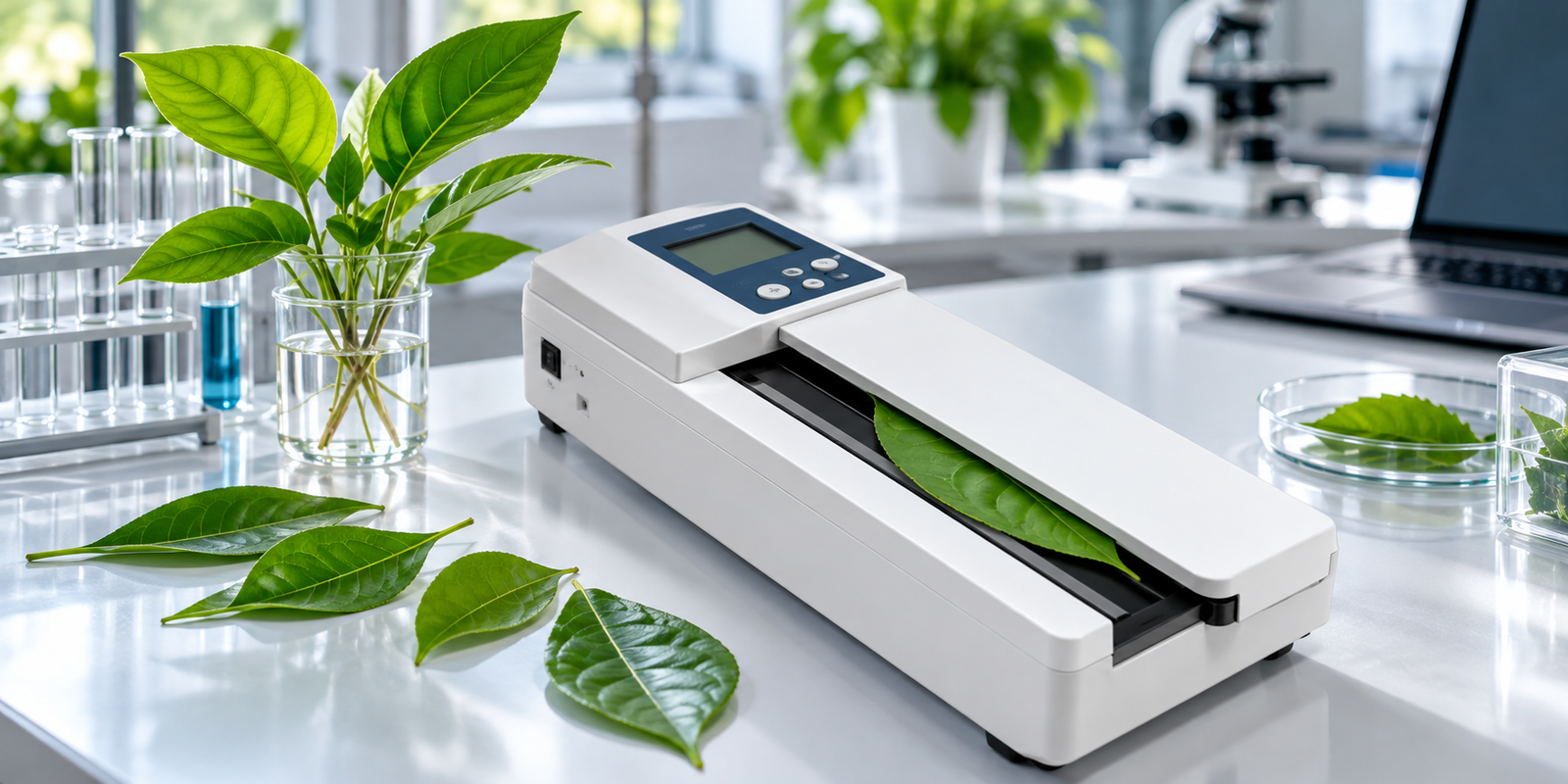
Quick answer: A leaf area meter manufacturer is a non-destructive optical instrument that measures leaf area, length and width, normally in cm², by scanning or laser sensing. Bionics Consortium manufactures leaf area meters for plant science laboratories and supplies them in India and abroad. Price depends on scanner type, maximum leaf size, software and destination.
A leaf area meter manufacturer replaces tracing leaves on graph paper with a reading in seconds. Bionics Consortium manufactures the Leaf Area Meter for agricultural universities, crop research farms and plant physiology laboratories, and ships it across India and to export markets. This guide explains how the instrument works, which specifications matter before you buy a leaf area meter, how the main types differ, and what to ask any leaf area meter manufacturer or supplier before ordering.
A leaf area meter manufacturer measures the surface area of a leaf without cutting or damaging it. Depending on the model it also reports leaf length, width, average leaf area, perimeter and shape factor. Area is shown in square centimetres. Researchers use these values to estimate leaf area index, compare varieties, and track how a crop responds to water, nutrient or heat stress across a season.
Most laboratory models use image-based scanning. The leaf lies on a transparent surface or passes through a scanning channel while an LED source lights it and a sensor captures its silhouette. Software counts the pixels inside the leaf boundary and multiplies that count by the calibrated area of one pixel. Length and width come from the extreme points of the outline; perimeter comes from the edge trace.
Accuracy therefore rests on three things: calibration, contrast between leaf and background, and how flat the leaf lies. Curled or folded leaves under-read.
Handheld laser meters work differently. You draw a wand along the leaf while a low-energy laser and a motion sensor record leaf width at each position, and the unit integrates those slices into an area. This suits field work where leaves must stay on the plant.
|
Parameter |
Specification |
|
Model |
BST-LM101 |
|
Measured Parameters |
Leaf area, leaf length, leaf width |
|
Units of Measurement |
mm, cm, inches |
|
Measuring Principle |
Optical scanning |
|
Scanning Speed |
400 mm/s |
|
Accuracy |
Within ±2% |
|
Display |
16 characters × 2 lines LCD |
|
Battery |
6 V rechargeable battery |
|
Continuous Operation |
Approximately 12–15 hours |
|
Computer Interface |
USB interface with cable |
|
Data Storage |
Internal memory for measurement data and images |
|
Data Transfer |
Transfer of measurement data and images to computer |
|
Instrument Type |
Portable handheld leaf area meter |
|
Applications |
Plant physiology, agronomy, ecology, plant pathology, entomology and plant research |
Leaf size and shape. Check the maximum leaf length and width the window accepts. Broad crop leaves and narrow grass blades or conifer needles behave differently, and many instruments have a minimum measurable width, so ask for it in writing if you work with narrow samples.
Detached or attached leaves. Scanner types generally need a detached leaf. If you must measure the same leaf repeatedly through a growth period, a handheld laser type is the better fit.
Data handling. For trials with hundreds of leaves, look for onboard storage and spreadsheet-compatible export so nobody retypes numbers.
Power and environment. Field teams need battery operation. Laboratory users need a supply matched to local voltage.
Leaf area meter price. Price depends on scanner type, maximum leaf size, software, accessories and shipping destination. Portable units generally cost less than laser systems and computer-interfaced scanners. We quote against your specification, stating warranty, Incoterms and spares, rather than publishing a list price that would mislead.
|
Criterion |
Portable scanner type |
Computer-interfaced bench type |
Handheld laser type |
|
Best for |
Routine detached-leaf work, teaching labs |
High-volume trials with software analysis |
Field measurement, repeat readings on live plants |
|
Sample handling |
Detached leaf inserted |
Detached leaf placed on scan surface |
Wand moved along leaf |
|
Data output |
Onboard display, storage |
PC software, Excel-compatible export |
Onboard storage, transfer to PC |
|
Field use |
Yes, if battery powered |
Mostly laboratory |
Yes |
|
Relative cost |
Lower |
Mid |
Higher |
India. Agricultural universities and crop institutes measure leaf area during kharif and rabi trials. Instruments here run on single-phase 230 V, 50 Hz mains.
Middle East (UAE, Saudi Arabia, Oman). Greenhouse and controlled-environment programmes for vegetables and date palm work use leaf area to tune irrigation under high heat. Dust exposure makes protective storage and cleaning of the scan window part of routine care.
USA and Canada. Buyers typically need equipment configured for 120 V, 60 Hz supply and will check documentation against their own institutional import rules.
Southeast Asia and Africa. Humid, tropical field stations favour battery-powered portable units that can be carried between plots.
Across regions, forestry teams use the same data to study canopy structure, and environmental researchers use it to link leaf development to pollution or climate stress.
Many listings for a leaf area meter give no resolution, accuracy figure, minimum leaf width or calibration method. Before you order from any leaf area meter supplier, ask for those four items in writing, plus warranty terms and who services the unit after dispatch. A manufacturer can answer all of them directly. If the answers are vague, treat the quoted price as incomplete.
Ready to buy a leaf area meter? Contact Bionics Consortium with your sample type, volume and destination, and our team will send a specification sheet, price quotation and available certificates and documentation. Email: sales@bionicsro.com | Phone: +91 91111 65391
It measures leaf area, length, and width quickly and non-destructively.
Price varies by model and specifications. Contact Bionics Consortium for a quotation.
The BST-LM101 provides accuracy within ±2%.
Yes, if the sample meets the instrument's measurable size requirements.
Yes. The BST-LM101 provides a USB interface for computer data transfer.
Yes. It uses a 6 V rechargeable battery with approximately 12–15 hours of operation.
Yes. It is suitable for routine plant research and laboratory applications.
Contact Bionics Consortium with your application and requirements to request a quotation.

Connect with us for your business enquiries. Generally, we respond within a day.