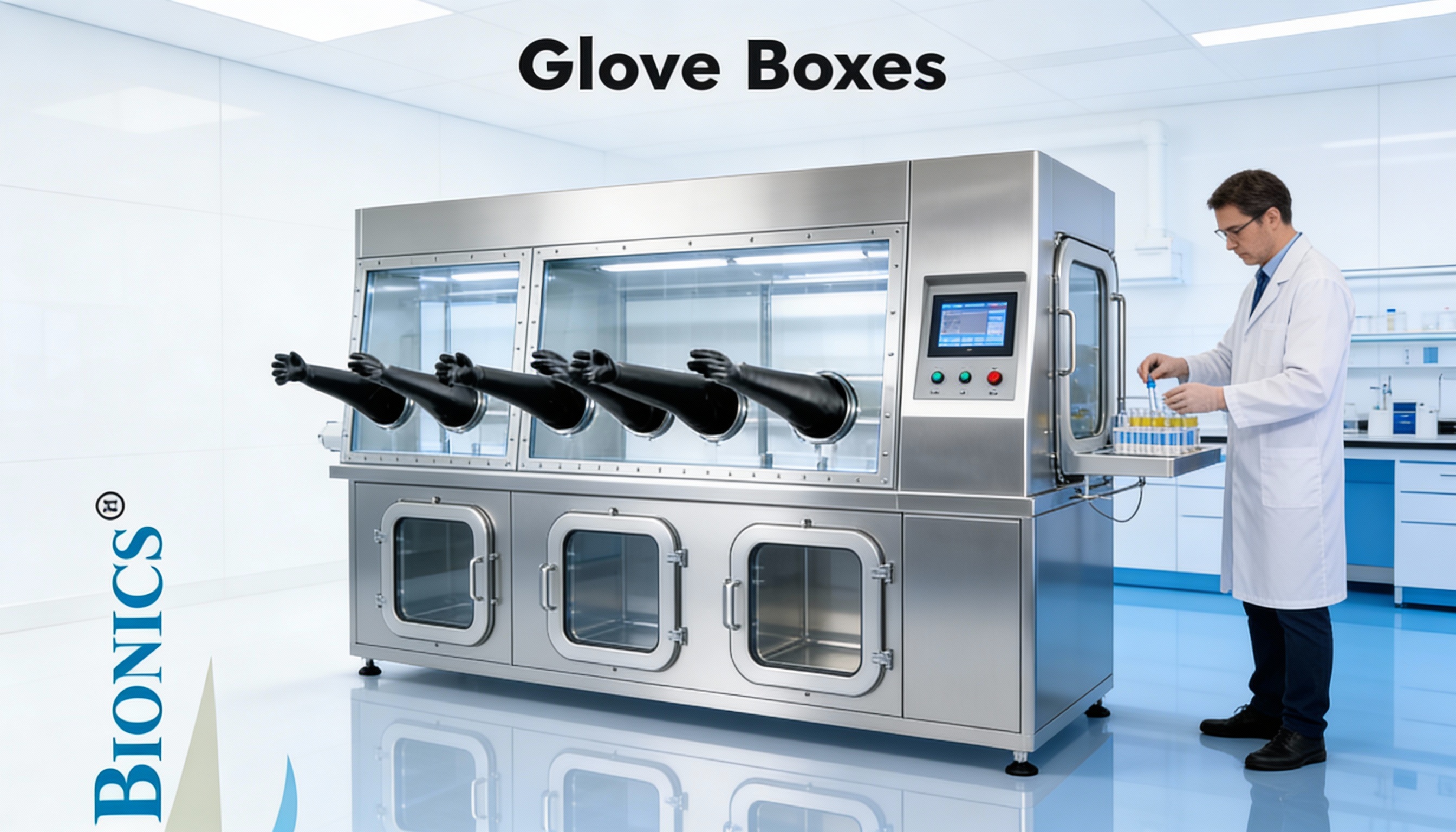
Laboratories are filled with sensitive and hazardous tools along with highly reactive chemicals. Operator safety becomes paramount at such places. Laboratory glove boxes play a very important role in maintaining a controlled environment along with safeguarding. the operator's hands. Certain sensitive specimens need protection from contamination in laboratories. This is also effectively taken care of with the help of lab gloves. From small tasks to bigger ones like nuclear applications, these gloves form an important part of laboratory equipment and are being used in almost all medical facilities, labs, hospitals, etc.
Read on to know all about laboratory glove boxes in the following blogs. We will also cover the types, uses, and parameters that affect the laboratory glove box price.
A lab Glove Box, or a laboratory glove box, is an enclosed structure that allows one to handle materials in a controlled way. The box comes with built-in gloves that remain attached to the box, letting the operator handle specimens and other materials without actually touching them. A lab box with gloves does the following:
Depending on the application requirement, the glove box can perform in positive pressure, negative pressure, or vacuum conditions.
Lab gloves are vital because they provide:
Different laboratory tasks require different types of glove boxes. Here are a few types and their uses.
As the name suggests, this type of glove box creates an oxygen-free environment/moisture-free environment by using gases like nitrogen and argon. They can easily work with materials like lithium and other reactive materials.
Common applications:
These boxes work under negative pressure so as to avoid any leakage. They protect the handler from toxic substances.
Common applications:
The sole focus of containment glove boxes is to prevent hazardous substances from leaving the box and entering the laboratory environment. Generally, they are used for working with radioactive substances.
Common applications:
Many researches involve anaerobic organisms (who live in the absence of oxygen) in their process. Anaerobic glove boxes are used in such situations, as they create an oxygen-free environment.
Common applications:
When the specimens or samples need to be handled in a vacuumed environment, vacuum glove boxes are used.
Common applications:
|
Type of Lab Glove Box |
Atmosphere Control |
Best For |
Key Features |
|
Inert Gas Glove Box |
Nitrogen / Argon |
Air-sensitive materials |
Low oxygen & moisture levels |
|
Isolation Glove Box |
Negative pressure |
Toxic substances |
User protection |
|
Containment Glove Box |
Sealed environment |
Hazardous materials |
High safety containment |
|
Anaerobic Glove Box |
Oxygen-free |
Microbiology |
Supports anaerobic organisms |
|
Vacuum Glove Box |
Pressure-controlled |
Specialized research |
Vacuum capability |
Here are the key parts of a lab box with gloves.
Here are some of the applications of lab glove boxes. Let us have a look:
Apart from the abovementioned applications, lab glove boxes are used in electronics industries, for nuclear research, and during academic research.
The Laboratory Glove Box price depends on the following factors:
Whether you handle air-sensitive substances, toxic materials, or biological specimens, lab glove boxes find a wide usage and are extremely important. They protect the handlers and provide a sense of security.
If you are looking for a high-quality lab glove box, let Bionics Consortium take care of your procurement needs. The platform is known for providing best-in-class glove boxes and other laboratory equipment. Contact us today.
A lab glove box is used to safely handle hazardous or sensitive materials in a controlled environment.
They are commonly made of stainless steel, acrylic, or polypropylene, depending on application needs.
It prevents direct contact with harmful substances and controls exposure to gases or particles.
Type, size, material, automation level, and purification systems influence the price.
Yes, many manufacturers offer customized glove boxes based on laboratory requirements.

Connect with us for your business enquiries. Generally, we respond within a day.