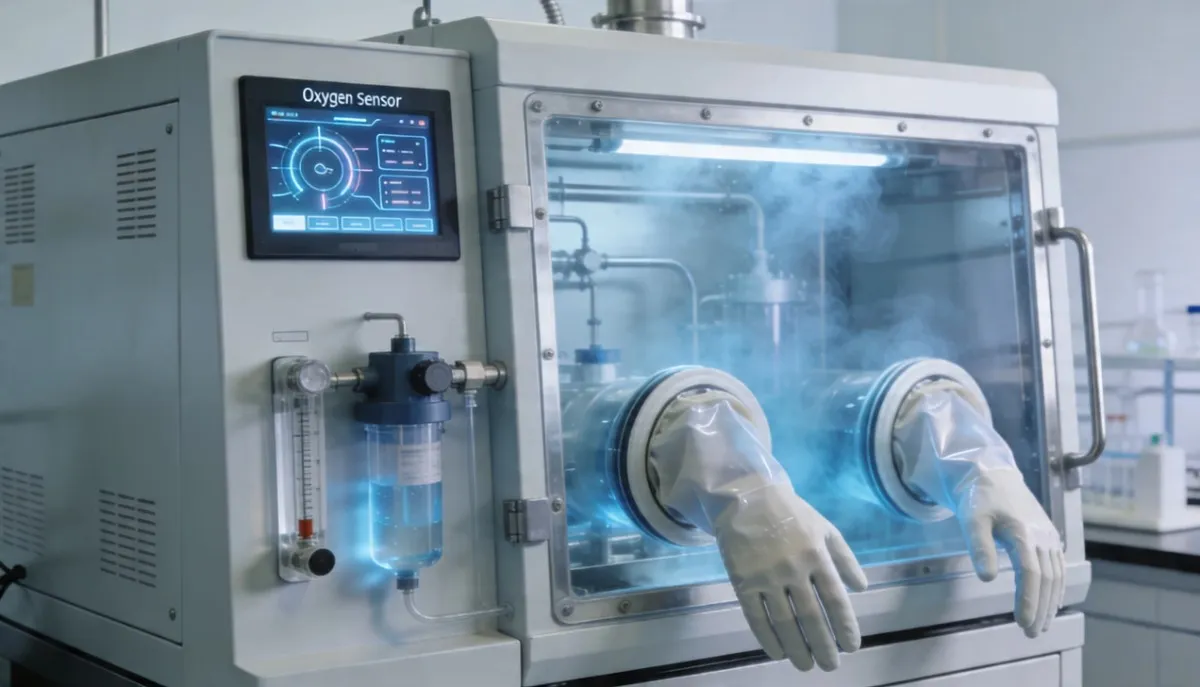
Precision-controlled environments are necessary in industries where the smallest quantity of oxygen or moisture is able to affect quality. In this regard, the glove boxes are very important. Glove boxes are commonly used in research laboratories, pharmaceuticals, electronics and chemical industries to enable operators to work with sensitive materials in a controlled and closed environment.
Knowledge of the glove box working principle enables the user to understand how such systems are able to keep the oxygen levels at an extremely low level and preserve the integrity of the products. In this blog, we shall discuss what a glove box is, its types, how oxygen is monitored and regulated and its applications in real life.
A Glove Box is a closed container that is used to perform manipulation on objects under controlled conditions. It has in-built gloves that allow the operator to operate with materials in the chamber without direct contact with the outside air.
An ordinary laboratory glove box is comprised of:
These systems are necessary in cases where handling of oxygen-sensitive or hazardous substances is involved. There are numerous Glove Box Manufacturers in India who come up with highly developed systems that can be utilised for industrial and laboratory purposes.
Glove boxes are available in various configurations depending on their uses. The most common ones are listed below:
Removes oxygen and moisture using nitrogen or argon as inert gases. Recommended in the case of reactive chemicals.
Pumps out and evacuates all air with vacuum pumps and then forces into the system an inert gas.
Maintains controlled amounts of oxygen and humidity for special processes.
Lightweight and transparent, typically in teaching laboratories or simple experiments.
The stainless steel glove box will be used to store the fingerprints.
Major glove box suppliers offer these variations depending on definite requirements of users and industry standards.
‘Bionics Consortium is a company that deals with the provision of high-quality environmental test chambers and laboratory equipment. As a company that highly values innovation and accuracy, Bionics develops and produces sophisticated testing systems serving numerous industries, including pharmaceuticals, electronics, automobiles, and research laboratories. We have been providing this service to industries for more than 25+ years with ISO certification. The company has a diverse product line that includes salt spray chambers, environmental chambers, laboratory chambers, humidity chambers, and laboratory indicators, among other related products. All the products are designed to provide accurate, reliable, and consistent performance to ensure that clients obtain optimal testing performance. The customer-oriented strategy and emphasis on quality have made Bionics remain a reliable partner to the companies that want reliable and efficient laboratory solutions.’
The essence of a glovebox is to ensure that there is no oxygen or low oxygen content in the chamber. We can work out how this works in detail:
The glove box is completely airtight. This ensures that no external air (with a concentration of about 21% oxygen) gets into the chamber.
Inert gases such as nitrogen or argon are used to purify the chamber. This is done by driving out oxygen and moisture present indoors.
The purification system constantly circulates gas within the glove box in order to keep the conditions the same.
A low positive pressure is ensured within the chamber to stop the outside air from seeping in.
Several glove box dealers in India provide systems that have automated controls to achieve constant functionality with minimal human intervention.
Here is another blog you might be interested in.
High Performance Filtration and Drying Equipment Procurement Guide
The level of oxygen should be monitored in order to make sure that the system works well. This is done in the following way:
An oxygen sensor has a high level of sensitivity and is fitted inside the glove box. The detectors are able to sense the oxygen levels down to parts per million (ppm).
The new glove boxes have modern displays with real-time oxygen concentration. This enables operators to keep a check on conditions.
When the amount of oxygen surpasses a predetermined limit, an alarm is issued by the system. This is to avoid destruction of delicate materials.
Sophisticated computers record the oxygen level information to be analyzed and to maintain quality.
Top Glove Box Exporters in India incorporate smart monitoring systems that are more reliable and safe.
Did you know? “Origins in the Nuclear Age The laboratory glove box was developed in the 1940s during the Manhattan Project. Scientists needed a way to handle radioactive and toxic materials without direct exposure — and the sealed glove box was born out of sheer necessity.”
It is not sufficient to monitor but also to regulate. This is the way that glove boxes keep the oxygen levels low:
The recirculating gas is run over purification columns which contain materials such as:
In case of an increase in oxygen, the system automatically injects the inert gas to dilute and eliminate the extra oxygen.
The gases are reused via filters to ensure purity without wasting a lot of gas.
Modern glove boxes have leak detection methods to detect and repair any leakages in the chamber.
In high-end use, reliable glove boxes are made to keep oxygen levels less than 1 ppm.
Fun Fact: “The "Junk Drawer": Modern glove boxes are often just a repository for forgotten fast-food napkins, old receipts, and a tire pressure gauge.”
The following table talks about the technical specification of the glove box.
| Parameter | Specification Description |
|---|---|
| Construction Material | Stainless steel or acrylic body with corrosion-resistant finish |
| Chamber Type | Airtight sealed enclosure with single or multiple workstations |
| Glove Ports | Butyl or neoprene gloves with leak-proof sealing rings |
| Oxygen Level Control | Maintains ultra-low oxygen environment with high precision sensors |
| Moisture Control | Integrated moisture removal system using desiccants or molecular sieves |
| Gas Type | Compatible with inert gases such as nitrogen or argon |
| Gas Purification System | Closed-loop circulation with oxygen and moisture removal columns |
| Pressure Control | Positive pressure with adjustable regulation system |
| Airlock System | Single or double airlock chamber for safe material transfer |
| Viewing Window | Transparent acrylic or toughened glass panel for clear visibility |
| Control System | Digital display with touch panel or PLC-based automation |
| Sensor Type | High-sensitivity oxygen and humidity sensors |
| Circulation System | Continuous gas recirculation with built-in blower |
| Filtration System | Multi-stage filtration for contaminant removal |
| Leak Rate | Designed for minimal leakage with high sealing efficiency |
| Power Supply | Standard electrical supply compatible with industrial setups |
| Safety Features | Alarm system for oxygen/moisture rise and pressure imbalance |
| Mobility | Fixed or portable design depending on application |
| Customisation | Available as per laboratory or industrial requirements |
| Application Compatibility | Suitable for pharmaceuticals, electronics, chemical research, and more |
The application of glove boxes in various industries can be explained by the following reasons:
Applied in dealing with oxygen-sensitive drugs and compounds.
Critical in the production of lithium-ion batteries, moisture and oxygen should be low.
Prevents reactions with air during experiments.
Provides safe handling of radio-active materials.
Applied in modified atmosphere packaging to increase shelf life.
Numerous glove box dealers offer tailored solutions to these special applications.
The following are some of the advantages of a glove box:
Did you know? “Used on Moon Rocks! When Apollo astronauts brought lunar samples back to Earth in 1969, NASA used glove boxes to examine them in sterile conditions — both to protect scientists from the unknown material and to protect the samples from Earth's atmosphere.”
When selecting a glove box, consider:
Qualified Glove Box Suppliers provide systems that have sophisticated functionalities that meet industry demands.
While selecting the right size of a glove box, there are some major factors needed to see before finalizing. Here are some:
When you are in the market to have a system, it may be tedious to go through the list of glovebox dealers in India. You need to find glove box suppliers who not only supply the hardware but also offer after-sales services of catalyst regeneration and sensor calibration.
The emergence of glove box manufacturers in India, like Bionics Consortium has led to increased accessibility of high-end research. These manufacturers make sure that the leak rates are low and that the incorporation of sensors is smooth.
Here are some of the reasons:
Here are the most asked questions related to glove boxes.
The glove box working principle is something that any person who has to work in controlled environments should understand. Glove boxes are well-regulated to maintain the oxygen level by use of airtight construction, inert gas purging, advanced sensors and purification systems.
These systems are crucial in ensuring safety, accuracy, and quality of products whether in research laboratories or in large industries. Modern laboratory glove box systems are increasingly efficient, automated and user friendly with the development of technology.
Selecting the appropriate system among reputable glove box exporters in India guarantees the reliability and best performance of your particular application over the long-term. Bionics Consortium is the best platform.
If you are thinking of investing in a glove box, then Bionics Consortium is the right choice. The brand also deals in cleanroom equipment, laboratory ovens, glove boxes, leaf area meters, and much more. For further information, Contact Us Now.
Yes, many glove box manufacturers in India like Bionics Consortium, offer customized designs based on application requirements.
Here is the list of materials that are used in the making of a glove box:
Here is the list of gases:
Here is the list of components:
Typically, oxygen levels are maintained below 10 ppm, and in high-precision applications, even below 1 ppm.
Bionics Consortium provides the best-quality glove box in India. They provide best-in-class glove boxes and other laboratory equipment.


Connect with us for your business enquiries. Generally, we respond within a day.