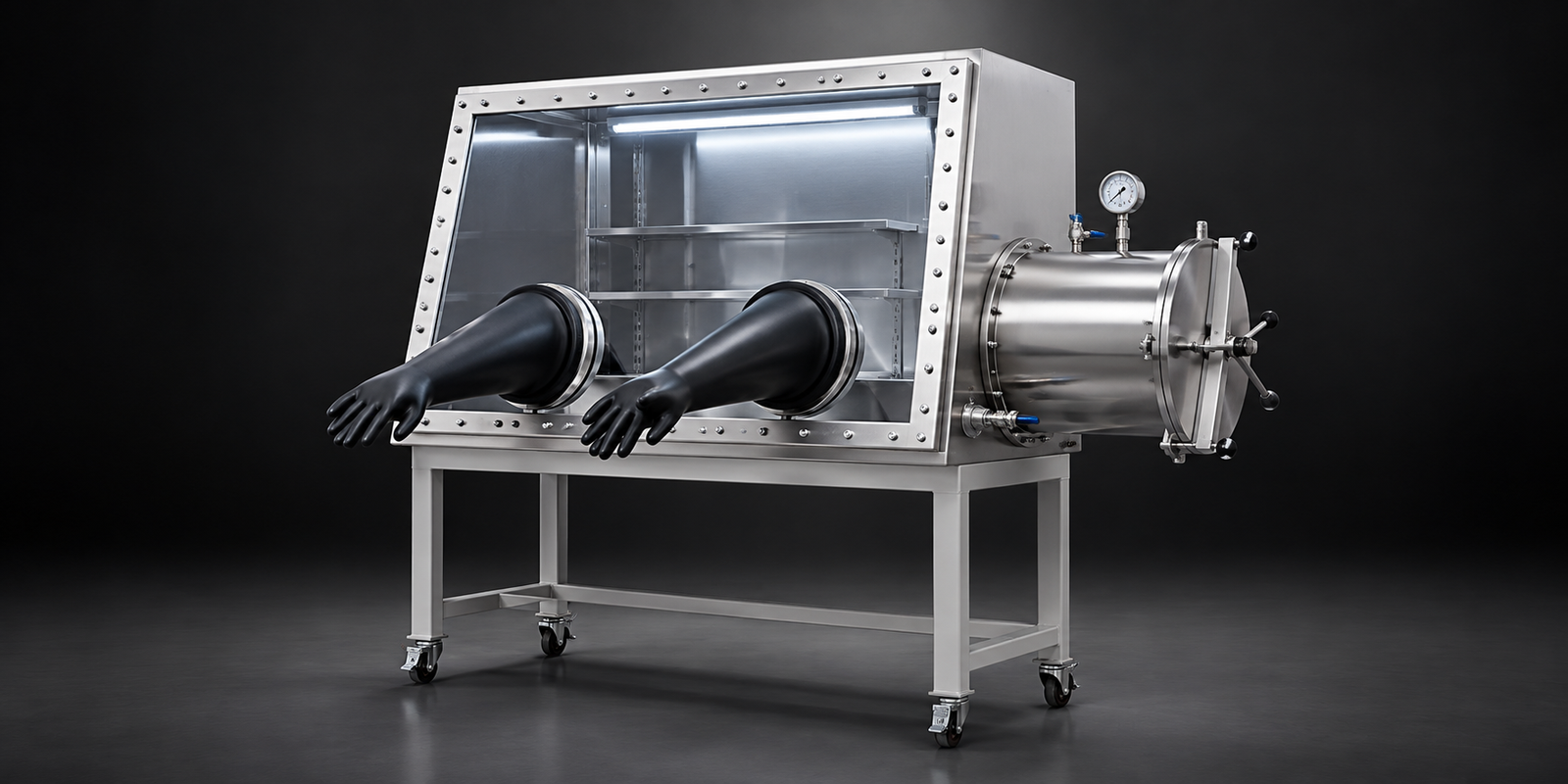
Quick answer: The Glove Box Working Principle guide is containment plus purification. A gas-tight chamber holds nitrogen or argon at slight positive pressure while a blower circulates that gas through a purifier that removes oxygen and moisture. Purifier-equipped units can reach below 1 ppm of each, depending on sealing, gloves and usage. An antechamber lets materials in without admitting air.
Handling lithium battery materials, organometallic compounds or moisture-sensitive actives in open air ruins samples quickly. Bionics Consortium is a laboratory and cleanroom equipment manufacturer with 26 years of manufacturing experience. This guide explains the glove box working principle guide behind our glove box range, then covers specifications, selection, safety, glove box price in India and what to ask a supplier.
A glove box (dry box) is a sealed enclosure in which materials are handled in isolation from the room through glove ports. Most units add a transparent window, an antechamber and sensors for pressure, oxygen and moisture.
Purification runs continuously because gloves are permeable. Texas A&M's JoVE module cites about 59 ppm per hour impurity rise in a two-glove box, and up to 500 ppm per hour with active use, when the gas is not being cleaned.
Saturated beds are regenerated with heated hydrogen-in-inert gas, typically 5% H2 in N2; Penn State's JoVE protocol and EPFL's guidelines both use this level or below. University safety guidance classes N2/H2 mixtures above 5% and Ar/H2 above 3% as flammable. Follow your unit's manual and:
Regeneration intervals range from about monthly in heavy use to every 3 to 6 months in light use.
Not all solvents harm the purifier equally. Thiols, phosphines, halogenated compounds, amines and sulphur compounds can poison the copper catalyst, some irreversibly (Purdue guidance; JoVE). Molecular sieves also adsorb solvent, which uses up water-removal capacity. Isolate or switch off circulation during such work, keep bottles capped and wipe spills.
Final values are confirmed in your quotation.
|
Parameter |
Typical configuration |
|
Chamber material |
SS 304 or SS 316 welded shell |
|
Window |
Safety glass or polycarbonate |
|
Working gas |
Nitrogen or argon |
|
Oxygen / moisture |
Below 1 ppm with active purifier |
|
Pressure |
Slight positive, controller-regulated |
|
Glove ports |
2 or more, 6 in or 8 in, butyl or neoprene gloves |
|
Antechamber |
Small and/or large, vacuum-purge |
|
Monitoring |
Oxygen and moisture sensors, pressure gauge |
|
Vacuum |
Dedicated vacuum pump |
|
Power |
Single-phase, specified at order |
Regeneration gas should match the working gas.
The US Department of Energy's HRP training aid describes stainless steel as essential for high-purity systems because its non-porous surface gives low leak rates, while acrylic is chosen for visibility and lower cost. In one manufacturer's published tests with a purifier, stainless-lined boxes held oxygen as low as 0.2 ppm and moisture 1 ppm (oxygen permeation under 0.16 ppm/min, ISO 10648-2), against 0.4 and 2 ppm for fibreglass-lined boxes.
|
Criterion |
Acrylic chamber |
Stainless steel chamber |
|
Sub-ppm work |
Not recommended; ask for leak-test data |
Achievable with purifier |
|
Chemical resistance |
Limited; solvents can craze acrylic |
High |
|
Visibility |
Excellent |
Window only |
|
Cleaning |
Moderate |
Easy, non-porous |
|
Cost |
Lower |
Higher |
|
Best for |
Dry purge tasks, teaching |
Research, QC, long-duration work |
|
Criterion |
Glove box |
Fume hood |
|
Purpose |
Isolates sample from air |
Protects operator from vapours |
|
Air-sensitive work |
Yes |
No |
|
Atmosphere |
Inert gas |
Room air drawn through |
|
Handling |
Through gloves |
Open sash |
Use a glove box when air or moisture damages the sample; use a fume hood when the hazard is vapour exposure.
Cost depends on chamber size and material, purifier capacity, sensor grade, antechamber count and automation. One Indian supplier listing on IndiaMART shows about ₹14 lakh for a 200 L controlled-atmosphere unit, so treat prices as indicative and request a quotation against a written specification.
Industries: battery and fuel-cell research, organometallic chemistry, thin films and semiconductors, hygroscopic or pyrophoric powders, pharmaceutical development.
Regional specification points (nominal grid values; confirm at your site):
Share site ambient temperature and humidity at enquiry, since they affect purifier cooling and gasket life. Import conformity rules such as SASO/SABER depend on product category and HS code, so check requirements per consignment.
Related equipment: Laminar Air Flow Cabinet, Laboratory Incubators.
Send your target ppm level, working gas, chamber size, application and solvents used. We will return a written specification and quotation, with documentation on request. Contact us or see the glove box page.
Purifier-equipped stainless units are commonly specified below 1 ppm. Actual levels depend on leak rate, glove condition, solvent use and antechamber discipline.
It depends on size, material, purifier and automation. Indicative listings start in the lakhs for controlled-atmosphere units. Send your specification for a written quotation.
Choose stainless for sub-ppm or solvent-exposed work. Acrylic suits short dry-purge tasks and teaching where visibility matters more than purity.
Choose a glove box when air or moisture damages the sample. A fume hood protects you from vapours but does not exclude air.
Nitrogen suits most work. Choose argon for lithium metal, nitrogen-binding metal complexes or arc and high-temperature processes.
Yes, with controls. Thiols, phosphines, halogens and amines can poison the catalyst, so isolate circulation, cap bottles and wipe spills.
From roughly monthly in heavy use to every 3 to 6 months in light use. Rising oxygen or moisture readings indicate saturation.
A 5% hydrogen-in-nitrogen mixture is the common standard. Vent exhaust to a fume hood or building exhaust and follow the manual.
India uses 230 V/50 Hz, Oman 240 V/50 Hz, Saudi Arabia 220 to 230 V/60 Hz and the USA 120 V/60 Hz. Confirm at order.
Target ppm, working gas, chamber size, glove ports, antechamber size, solvents used, site power and ambient conditions.


Connect with us for your business enquiries. Generally, we respond within a day.