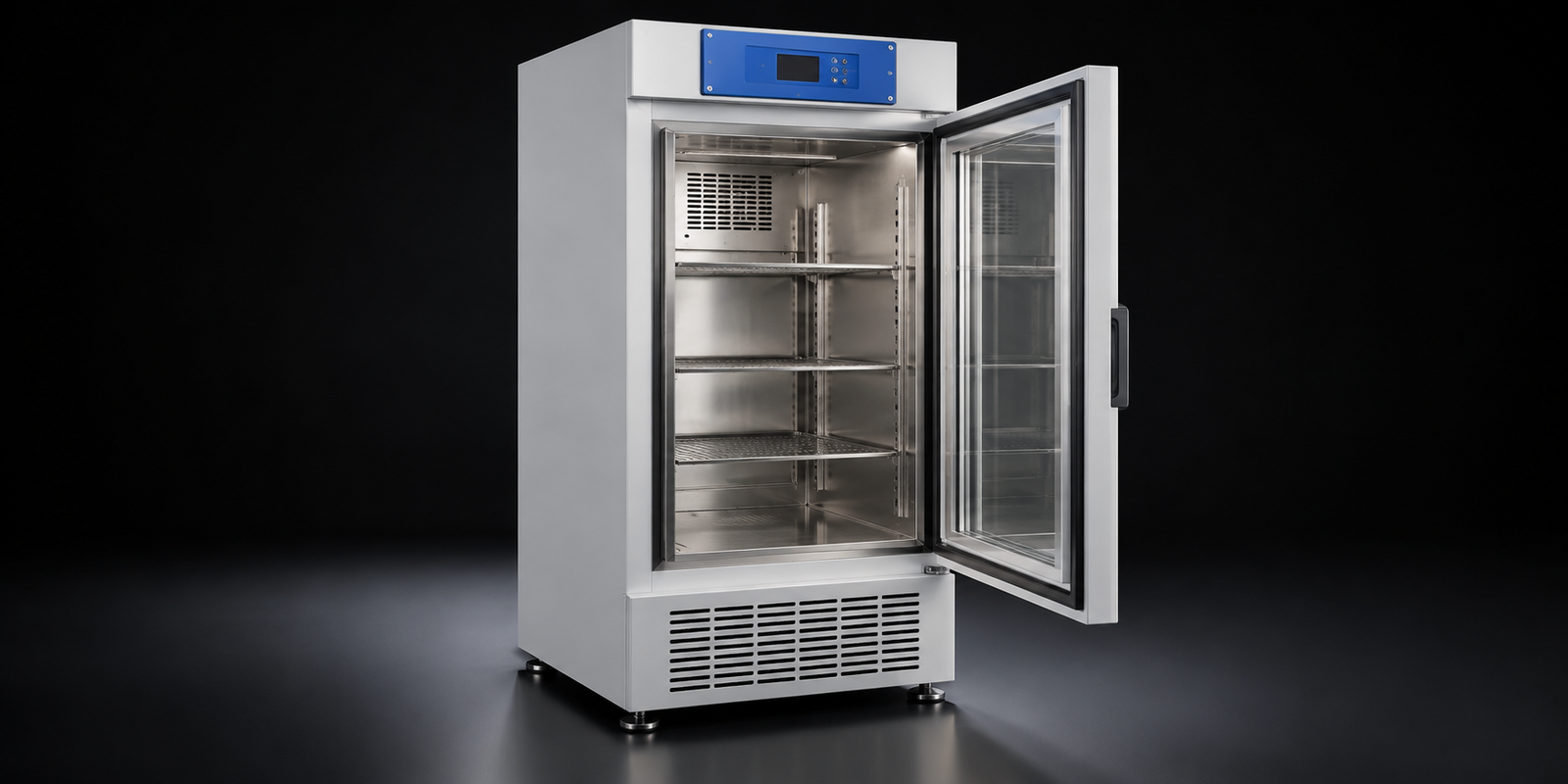
Quick answer: BOD incubator price in India ranges from about ₹65,000 for basic 100 to 120 litre units to over ₹2.5 lakh for branded 170 litre models with PID controllers, based on public procurement listings. The final cost depends on capacity, compressor, controller and build material. Bionics Consortium manufactures BOD incubators in-house, with 26 years of manufacturing experience.
If you run a water-testing lab, a microbiology unit or a pharma QC bench, the BOD incubator is an instrument you cannot work around. Ambient temperature in most Indian and Gulf labs sits well above 20°C for much of the year, so a plain heated incubator cannot hold the temperature that BOD work requires. You need active cooling and heating in one chamber, and that is a large part of the BOD incubator price.
Bionics Consortium is a laboratory equipment manufacturer, not a trading house, with 26 years of manufacturing experience behind its BOD incubator range.
A BOD incubator (also called a low-temperature or cooling incubator) is a double-walled, insulated chamber that can both cool and heat. That separates it from a standard bacteriological incubator, which only heats above ambient.
Its main job is incubating water and wastewater samples for the BOD test, which estimates how much dissolved oxygen aerobic microorganisms consume while breaking down organic matter. Labs also use it for seed germination, plant and insect studies, fermentation and low-temperature culture.
Two opposing systems work in balance:
In the standard 5-day BOD test (Standard Methods 5210 B), samples are sealed in BOD bottles and incubated at 20°C ±1°C in the dark. Darkness matters because light lets algae release oxygen and distort the reading. Dissolved oxygen is measured before and after, and the difference is reported as BOD in mg/L.
The table shows a typical configuration. Final values depend on the model and are confirmed on the datasheet issued with your quotation.
|
Parameter |
Typical specification |
|
Temperature range |
5°C to 60°C (at standard ambient) |
|
Accuracy / uniformity |
±0.5°C / ±1°C at set point |
|
Controller |
Microprocessor PID, digital display, optional timer |
|
Inner chamber |
Stainless steel SS 304 |
|
Outer body |
Powder-coated mild steel (SS 304 on request) |
|
Insulation and doors |
PUF, double-walled; outer door plus inner transparent door |
|
Cooling / heating |
Hermetically sealed compressor, CFC-free refrigerant / forced-air heater |
|
Capacity |
Roughly 100 to 400+ litres, benchtop and floor-standing |
|
Power supply |
230 V, 50 Hz single phase (other voltages on request) |
Reading other specifications: published ranges vary from 2°C–50°C to 10°C–60°C. Ask whether a figure applies at no load, at what ambient and at which set point; ±0.5°C at 37°C says little about performance at 20°C.
Public procurement listings show BOD incubator prices starting near ₹65,000 for basic 100 to 120 litre units and passing ₹2.5 lakh for branded 170 litre models with better controllers. The main cost drivers are:
The cheapest quote is rarely the cheapest to own, since a weak compressor or poor insulation shows up later as slow recovery and service calls. To compare BOD incubator price fairly, request a written quotation with specifications, warranty and delivery scope from Bionics Consortium.
|
Feature |
BOD / cooling incubator |
Bacteriological incubator |
CO₂ incubator |
|
Cooling |
Yes, compressor-based |
No |
Limited |
|
Typical range |
5°C to 60°C |
Ambient +5°C to about 60–70°C |
About 37°C with CO₂ control |
|
Best for |
BOD test, low-temperature culture |
Routine culture at 30–37°C |
Mammalian cell culture |
|
Holds 20°C in a hot room |
Yes |
No |
No |
A bacteriological incubator cannot run a 20°C BOD test, and a BOD incubator cannot supply CO₂. Browse our laboratory incubators to match the chamber to the method.
Pan-India. Most labs run on 230 V, 50 Hz single phase, but supply quality varies, so a stabiliser is sensible. Summer ambients in Delhi, Rajasthan and Gujarat push compressors hard.
Middle East. Ambients are high and supply differs by country: Saudi Arabia commonly uses 60 Hz, while Oman and the UAE use 50 Hz. Specify local supply at order stage and confirm conformity rules with your importer.
USA. Labs usually need 120 V, 60 Hz and follow their own validation requirements. Confirm electrical approval needs before purchase.
Send your capacity, set point range, supply voltage and delivery location for a written quotation and datasheet. Visit the contact or the BOD incubator for models.
It holds samples at a set temperature, usually 5°C to 60°C. Labs use it for BOD water testing, low-temperature culture and seed germination.
20°C ±1°C for five days, in the dark. Darkness stops algae from adding oxygen to the sample.
A normal incubator only heats. A BOD incubator also cools with a compressor, so it can hold 20°C even in a warm room.
It depends on capacity, compressor, controller and build material. Public listings run from about ?65,000 to over ?2.5 lakh. For an exact figure, request a written quote.
Count the BOD bottles you run per batch and leave space for airflow. If volume is growing, pick the next size up.
Yes, within its rated ambient temperature. Share your room temperature and lowest set point, and keep clearance around the condenser.
At least once a year, or more often under NABL or GMP. Keep daily temperature records in between.
Clean the condenser and filter, wipe the chamber, check door gaskets and verify temperature with a calibrated thermometer.
Yes. Voltage, frequency, plug type and shelves are set at build stage. Tell us the destination country with your enquiry.
You get clear specifications, customisation and one contact for service, with no reseller margin.

Connect with us for your business enquiries. Generally, we respond within a day.