Quick Answer
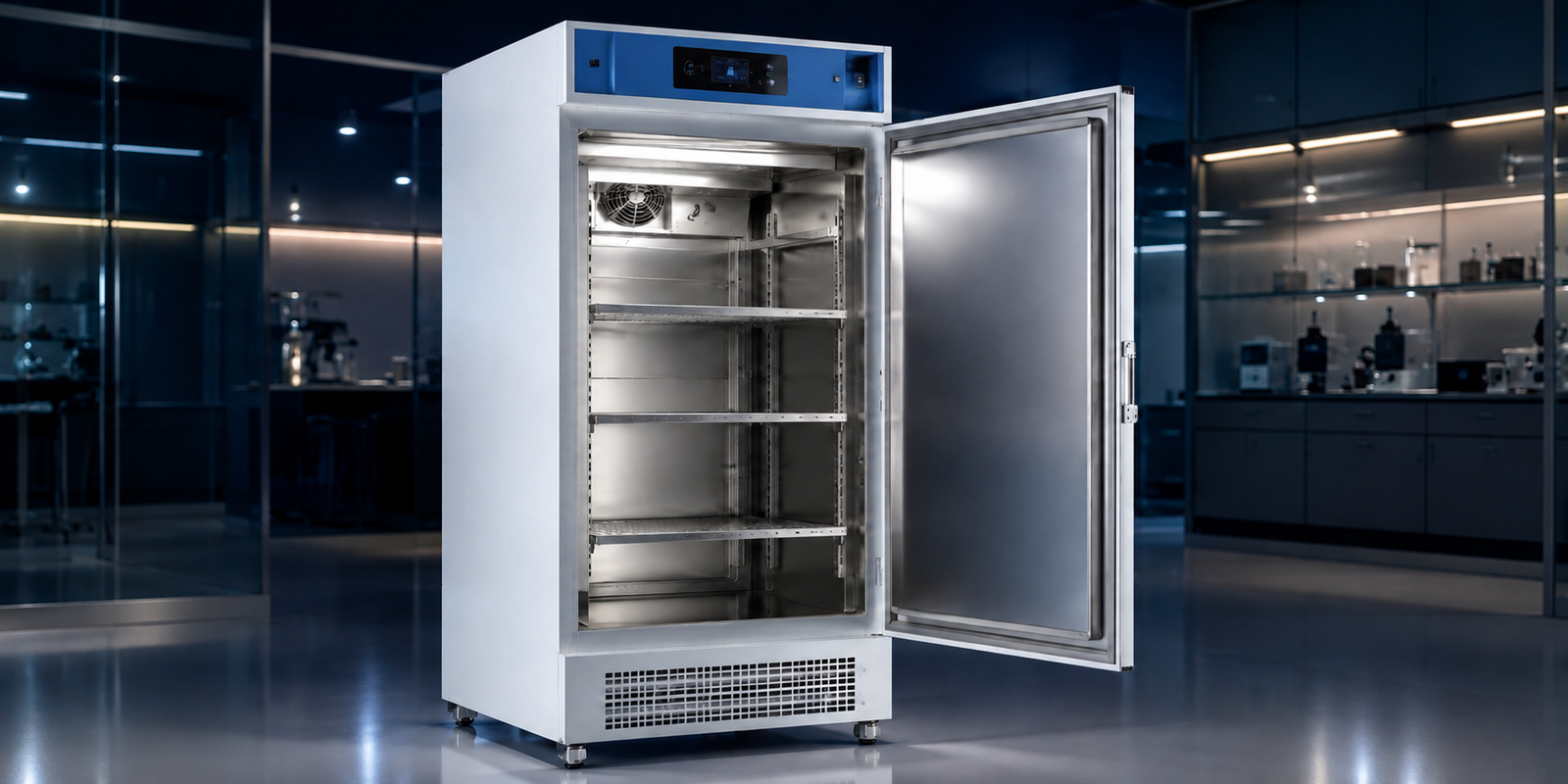
BOD incubator is short for Biochemical (or Biological) Oxygen Demand incubator. It's a refrigerated chamber that holds water and wastewater samples at a steady 20°C ± 1°C for the standard 5-day BOD test, which measures how much dissolved oxygen microorganisms use up while breaking down organic matter. The chamber runs on a vapour-compression refrigeration system paired with a PID controller, so it can both cool and heat the same space to hold that narrow temperature band. Bionicsro builds these units for environmental labs, pharma QC departments, and effluent treatment plants across India, the Middle East, Saudi Arabia, the US, and Oman.
BOD stands for Biochemical Oxygen Demand. A BOD incubator is the piece of equipment used to hold water, sewage, or effluent samples at a controlled low temperature for a set period — usually 3 or 5 days — so a lab can measure how much oxygen the microbes in that sample consume.
Here's the part that trips people up when they're comparing lab equipment: a hot air oven or a regular bacteriological incubator only heats above room temperature. A BOD incubator has to hold 20°C, which in most of India and the Gulf is actually below ambient room temperature for a good part of the year. That's why the standard BOD5 method under IS 3025 (Part 44) and APHA Standard Methods specifies 20°C in the first place — and it's why the refrigeration unit inside the incubator matters more than the heater when you're evaluating one. Buyers who skip this distinction sometimes end up with equipment that can't actually hold the required set point in summer.
Two systems run at the same time, working against each other:
That combination — cooling nonstop while heating in small increments — is how the chamber holds 20°C ± 1°C for the full 120-hour test, even if room temperature outside swings from 15°C in the morning to over 40°C by afternoon. A circulation fan keeps air moving so the top shelf and bottom shelf don't drift apart in temperature; most units stay within ±0.5°C shelf to shelf. Some models also log the temperature curve digitally through the whole incubation window, which labs going through NABL assessment tend to ask for now.
If you look at a labelled diagram of a typical unit, here's what you'll find:
This basic layout holds across most 250L to 1000L units, and scales up the same way in larger walk-in BOD rooms.
|
Parameter |
Typical Specification |
|
Chamber capacity |
100L, 150L, 250L, 500L, 1000L (custom sizes available) |
|
Temperature range |
0°C to 60°C (some models 5°C to 60°C) |
|
Standard test point |
20°C ± 1°C |
|
Temperature uniformity |
± 0.5°C to ± 1°C |
|
Control system |
Microprocessor-based PID controller |
|
Sensor |
RTD PT-100 |
|
Interior material |
SS304 stainless steel |
|
Exterior material |
Mild steel, powder-coated |
|
Insulation |
High-density PUF, 60–75mm |
|
Refrigeration |
Hermetically sealed, CFC-free compressor |
|
Door type |
Solid or double-walled glass |
|
Shelves |
Adjustable perforated SS (2–4 nos.) |
|
Illumination |
Interior LED |
|
Power supply |
220–240V, 50Hz single phase (export voltage on request) |
|
Alarm |
High/low temperature deviation alarm |
|
Data logging |
Optional, printer/USB output |
|
Application |
Set Temperature |
Typical Duration |
|
Standard BOD5 test (IS 3025/APHA) |
20°C ± 1°C |
5 days (120 hours) |
|
3-day BOD test (select industries) |
27°C ± 1°C |
3 days |
|
General microbial culture growth |
25°C ± 1°C |
24–72 hours |
|
Bacteriological/fungal incubation |
30–37°C |
24–48 hours |
|
Low-temperature stability studies |
5–10°C |
As per protocol |
Before you settle on a model, check which of these your lab will actually run. A chamber that only goes down to 10°C won't be much use if your protocol also calls for 5°C stability studies down the line.
India — ETP and STP compliance testing has to line up with CPCB and state Pollution Control Board formats, which point straight back to IS 3025 (Part 44). Worth checking that your unit's uniformity report actually cites this standard, not just a generic temperature spec.
Saudi Arabia — Imports usually need SASO conformity paperwork, so ask the manufacturer for their technical file upfront rather than after the order is placed; it saves time at customs. Summer ambient temperatures here regularly cross 45°C, which puts more load on the compressor and makes condenser airflow clearance a bigger deal than it would be in a cooler market.
UAE and the wider GCC — Government and semi-government lab procurement under ESMA rules often wants CE-marked equipment backed by a documented quality system. Get that paperwork ready at the RFQ stage instead of scrambling for it after confirmation.
Oman — Labs tied to the Environment Authority tend to follow APHA methods alongside IS references, so documentation that covers both standards is genuinely useful here, not just a box-ticking exercise.
United States — Labs working under EPA's 40 CFR Part 136 for BOD5 should ask whether NIST-traceable calibration certificates ship with the unit, rather than needing to request them separately after delivery.
Bionicsro has been building lab and scientific equipment for 26 years now, supplying BOD incubators, hot air ovens, autoclaves, and related equipment to testing labs, ETPs, pharma units, and research institutions across India and export markets including the Middle East, Saudi Arabia, the US, and Oman.
A few things worth knowing before you buy from us:
Whoever you buy from, ask for uniformity validation data, compressor brand and warranty terms, calibration traceability, and service coverage in your area. Those four things matter more to long-term BOD5 reliability than the chamber size printed on the brochure.
Get a BOD Incubator Quote From Bionicsro
Need a compact 100L unit for a single test line, or a 1000L chamber for a full ETP lab? Bionicsro's team can work out the right configuration for your test protocols and site conditions. Contact Bionicsro for a specification sheet, uniformity validation report, and export-ready quote — serving labs across India, the Middle East, Saudi Arabia, the US, and Oman.
Biochemical Oxygen Demand Incubator — sometimes written as Biological Oxygen Demand Incubator. It holds water and effluent samples at a controlled temperature for oxygen-demand testing.
20°C ± 1°C, per IS 3025 (Part 44) and APHA Standard Methods for the 5-day BOD test.
Because 20°C usually sits below room temperature, especially across India and the Gulf. The unit has to actively cool the chamber, not just add heat, to hold that set point.
Because 20°C usually sits below room temperature, especially across India and the Gulf. The unit has to actively cool the chamber, not just add heat, to hold that set point.
The standard BOD5 test runs exactly 5 days (120 hours) at 20°C ± 1°C. Some regional protocols use a shorter 3-day test at 27°C instead.
Most small labs doing routine water testing manage fine with 100L–250L. ETPs and bigger environmental labs with more samples usually go for 500L or 1000L.
Yes. Labs also use them for general microbial culture growth, stability studies, and other low-temperature incubation work, as long as the temperature range covers what's needed.
Yes. Labs also use them for general microbial culture growth, stability studies, and other low-temperature incubation work, as long as the temperature range covers what's needed.
Make sure the temperature range covers your required set points, ask for uniformity/mapping data, confirm compressor type and warranty, check calibration traceability, and look into after-sales service coverage in your area.


Connect with us for your business enquiries. Generally, we respond within a day.