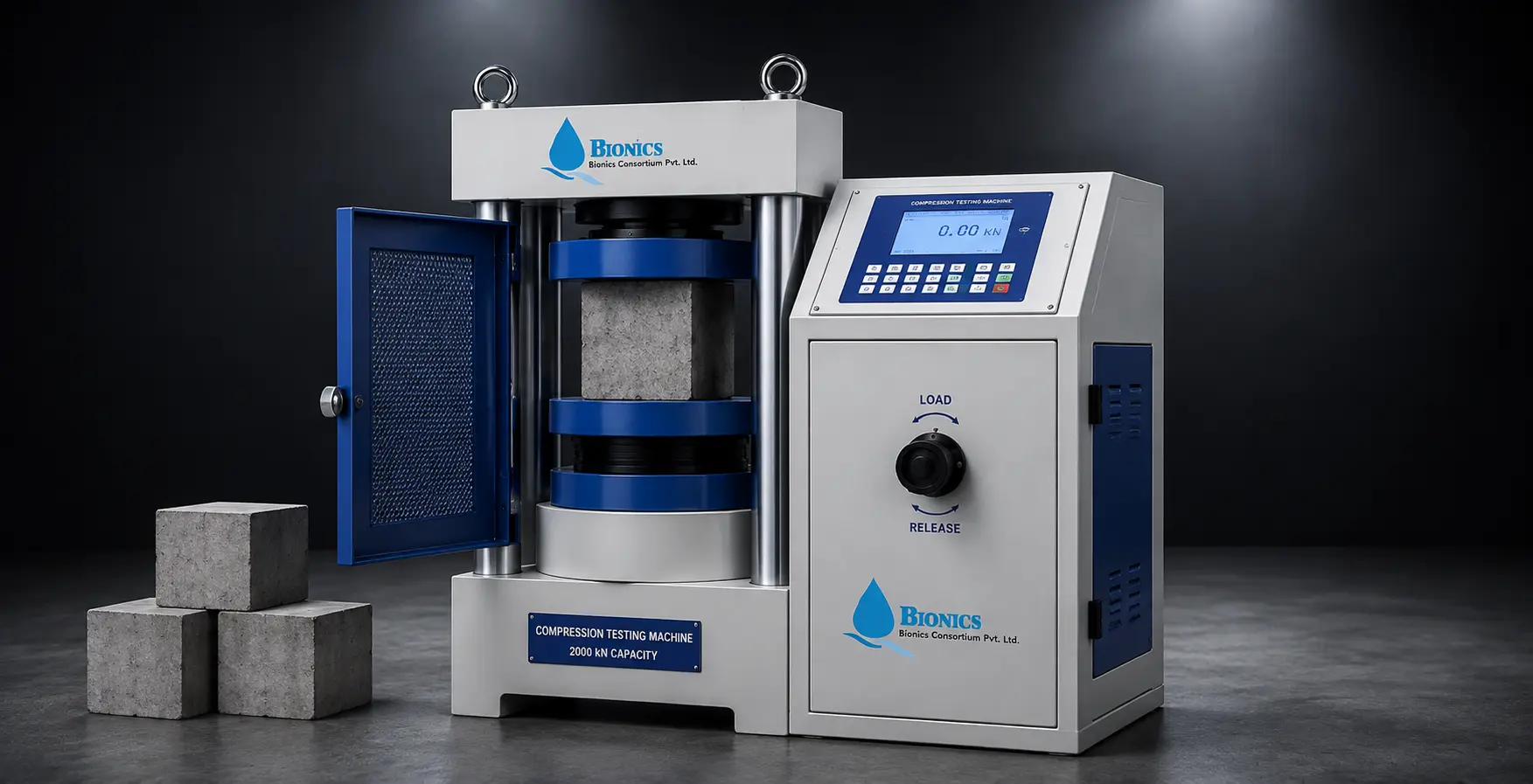
If you've spent any time on a construction site, you've probably seen a lab technician pull a heavy grey cube out of a curing tank, wipe it down, and load it into a machine that eventually crushes it with a loud crack. That's the concrete cube test — and honestly, despite being one of the most common tests in civil engineering, it's also one of the most misunderstood. Most people know it happens. Only a select few will be able to tell you how and why that is so and what these numbers represent after the cube breaks.
I've worked around construction quality control long enough to know that the gap isn't a lack of information — it's a lack of clear information. Most online resources either drown you in code clauses or oversimplify to the point of being useless. This article sits in the middle: practical, code-aware, and written for people who need to actually use this knowledge, not just skim it.
At Bionics RO, we help construction professionals and laboratories choose reliable concrete testing equipment for accurate quality control and compliance with industry standards.
A concrete cube test determines the compressive strength of hardened concrete — essentially, how much load a cube-shaped sample can bear before it fails. Concrete is cast into 150mm x 150mm x 150mm cube moulds on-site, cured for a fixed period (usually 7 and 28 days), and then crushed under controlled load using a cube testing machine.
Why cubes and not some other shape? Because cubes give consistent, repeatable results and are easier to cast and handle than cylinders, which is why Indian and several international standards rely heavily on the cube shape for routine site testing. The result of this cube test isn't just a number for a file — it's the primary evidence that the concrete poured into a beam, column, or slab will actually perform as designed. Skip it, or get it wrong, and you're gambling with structural safety.
It is here that a lot of people get confused. Fortunately the concrete cube test formula is simple enough once you know what each value represents.
Compressive Strength (N/mm²) = Maximum Load at Failure (N) / Area of Cross Section (mm2)
For a normal concrete cube of size 150 mm x 150 mm, the cross-sectional area will be:
150 × 150 = 22,500 mm²
For example if the cube is loaded with 450kN then it is equal to 450,000N (1kN = 1,000N ).
Compressive Strength = 450,000 / 22,500 = 20 N/mm2 (20 MPa)
This shows that the concrete has achieved the desired compressive strength for M20 grade concrete.
A Practical Example
Let’s take another example to understand the calculation better.
Assumed failure load of M25 concrete cube is 580 kN.
FAILURE LOAD: 580 kN = 580000 N
Cross Section Area: 22500 mm2
580,000 22,500 = 25.8 N/mm2 (MPa) Compressive Strength
The strength obtained is around 25.8 MPa, which shows the concrete has attained the required compressive strength for M25 grade concrete. This simple calculation enables engineers to verify that the concrete is meeting the required specification for design prior to approving construction.
Skipping or rushing any of these steps — especially curing duration or loading rate — throws off the result, sometimes badly enough to fail concrete that was actually fine, or worse, pass concrete that wasn't.
In India, this entire process is governed by the cube test IS code, primarily IS 516 (method of test for strength of concrete) alongside IS 456 (plain and reinforced concrete) for acceptance criteria. These codes specify everything from mould dimensions and curing conditions to the permissible loading rate, which is generally maintained around 140 kg/cm² per minute (roughly 0.6 N/mm² per second) to ensure uniform, comparable results across labs.
The code also lays out acceptance criteria — for instance, how individual cube results compare against the average, and what variation is acceptable before a batch is flagged for further investigation. Ignoring these details is one of the most common reasons site labs produce inconsistent, hard-to-defend results.
The cube testing machine you choose has a real impact on accuracy and workflow, not just convenience.
Bionics RO offers a range of manual, digital, and automatic concrete testing machines designed to deliver accurate and dependable compressive strength testing.
The right choice depends on testing volume, budget, and whether your lab needs NABL-level consistency or just routine site verification.
This is one of the problems of cube testing that very few people ever talk about; that of improperly cast or cured cubes giving wrong results. Common causes include improper compaction, curing at the wrong temperature, using an uncalibrated machine, or even testing cubes with honeycombing that went unnoticed. This "hidden" gap between what a certificate says and what the concrete actually is remains one of the biggest quality risks in construction, and it's why calibration records and proper procedure is just as important as the test.
|
Concrete Grade |
Expected 28-Day Strength (N/mm²) |
Typical Failure Load (kN, 150mm cube) |
|
M15 |
15 |
337.5 |
|
M20 |
20 |
450 |
|
M25 |
25 |
562.5 |
|
M30 |
30 |
675 |
|
M35 |
35 |
787.5 |
(Calculated using the cube test formula: Load = Strength × 22,500 mm²)
The cube test for concrete is considered one of the most accurate ways of testing the compressive strength and quality of concrete. With its execution as per the provisions of IS 516 and analysis as per IS 456, it enables engineers and contractors as well as quality control departments to ensure that the concrete has met the stipulated specifications.
Need help finding a dependable concrete cube tester or concrete testing machine? Discover the selection available from Bionics RO or Contact Us for advice on choosing the right concrete testing machine for your lab, construction site, or testing facility.
Most of the Indian laboratories use a 150 mm cube as a standard. A 100 mm cube is an acceptable alternative if you are using a finer aggregate mix.
Divide the failure load by the cube's cross-sectional area. On a 150 mm cube, that area works out to 22,500 mm².
The 7-day result is an early indication that the mix is strengthening at a normal rate. The 28-day result is what actually gets checked against the design strength requirement.
IS 516 covers how the test itself is carried out. IS 456 covers what strength result counts as acceptable.
One cube can give a skewed reading if it has a hidden defect. Three cubes, averaged, gives a number you can actually trust.
In practice, it's usually one of four things: compaction that wasn't done thoroughly, curing that was inconsistent, a mold that's cracked or out of shape, or a compression machine overdue for calibration.
Not necessarily. Site engineers typically follow up with core tests or other checks before making that call.
It does, and more than people expect. Concrete cured outside the recommended temperature range often falls short of its target strength.
Automatic compression machines are the better pick — they hold a steady loading rate, which manual operation struggles to match consistently.
No — cube tests happen under controlled lab conditions. Real structures are subject to site handling, placement quality, and curing conditions the lab test doesn't capture.


Connect with us for your business enquiries. Generally, we respond within a day.