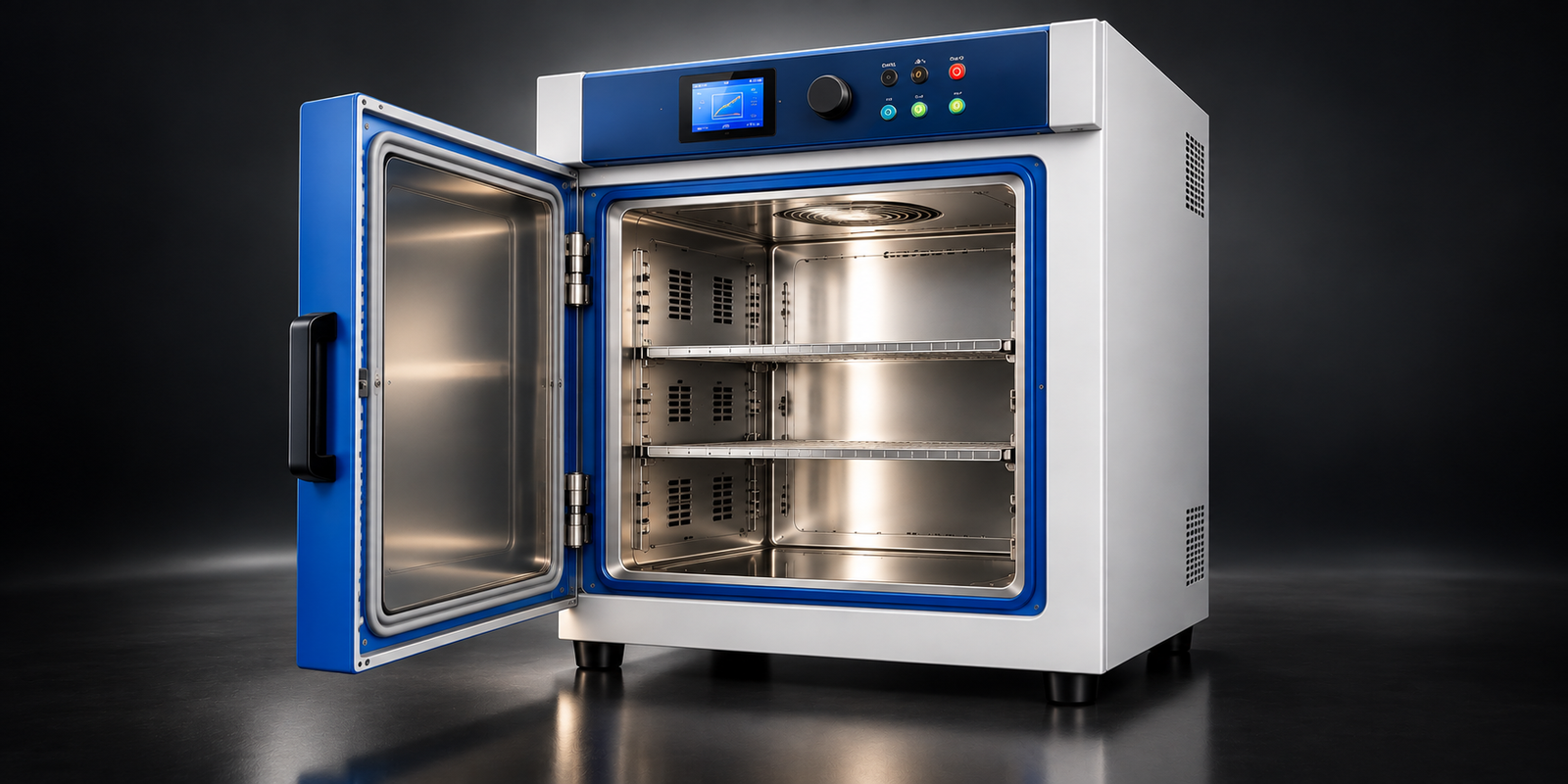
A lab oven is a temperature-controlled instrument used to dry, cure, sterilize, or heat-treat samples and glassware, generally from ambient +5°C up to 300°C depending on the model. Laboratory ovens split into three categories — gravity convection, forced-air convection, and vacuum ovens — each built for a different sample type and drying need. Bionics Consortium manufactures all three to ISO-certified quality standards, in sizes ranging from single-bench research units to industrial QC capacity.
Getting the oven type wrong shows up later — in uneven drying, inconsistent LOD results, or a batch that has to be re-run. The oven's uniformity and control precision determine whether the result holds up, whether you're conditioning powders, curing components, or running loss-on-drying analysis under a pharmacopeial method.
Bionics Consortium builds laboratory drying, vacuum, and microwave-assisted ovens for pharma QC labs, food-testing facilities, and industrial R&D — from a single bench in Mumbai to a multi-site QC network across the Middle East. This guide covers how each type works and how to pick the right configuration.
It's an insulated chamber with a heating element, temperature controller, and air circulation system (or a vacuum pump, in vacuum models) that holds a set temperature within a defined tolerance. What separates it from a domestic oven is uniformity across the chamber, repeatable set-point accuracy, and — on most current units — digital PID control rather than a basic thermostat.
"Lab oven" covers three distinct sub-types:
A lot of "lab oven price" searches conflate these three, which is a problem because their cost and performance profiles differ substantially — covered in the comparison table below.
Gravity convection heats air that rises, cools at the walls, and sinks — a slow natural loop that leaves shelf-to-shelf gradients of roughly 2–5°C since nothing forces the air to mix.
Forced-air convection adds a blower that actively circulates heated air, tightening uniformity to around ±1–2°C. Most labs specify this when shelf position shouldn't affect the result — sterility testing, curing, reproducible drying.
Vacuum ovens pair a heating chamber with a vacuum pump, dropping pressure so solvents and moisture evaporate well below their normal boiling point. That protects heat-sensitive compounds and limits oxidation, which is why formulation and battery-material work specify vacuum drying whenever atmospheric heat or ambient air would damage the sample.
Microwave lab ovens heat by exciting polar molecules — mainly water — inside the sample itself, rather than conducting heat in from the walls. That's faster for moisture determination, but it doesn't replace convection ovens where a long, gentle soak is what the method calls for.
All three rely on a digital controller reading a calibrated RTD or thermocouple, with over-temperature cutout standard on compliant units.
|
Parameter |
Gravity Convection |
Forced-Air Convection |
Vacuum Oven |
|
Temperature range |
Ambient +10°C to 250°C |
Ambient +10°C to 300°C |
Ambient +10°C to 200°C |
|
Uniformity |
±3–5°C |
±1–2°C |
±2–3°C |
|
Chamber capacity |
25L – 250L |
50L – 500L |
20L – 150L |
|
Control |
Digital PID |
Digital PID, programmable ramp/soak |
Digital PID, vacuum gauge interlock |
|
Air circulation |
Natural |
Motorized blower |
Static, vacuum-sealed |
|
Interior |
SS304 |
SS304/SS316 |
SS with vacuum-rated gasket |
|
Vacuum range |
N/A |
N/A |
1–5 mbar (pump-dependent) |
|
Safety |
Over-temp cutout, door interlock |
+ airflow sensor |
+ vacuum-release interlock, pressure relief |
|
Power |
220–240V, 50Hz, 1-phase |
220–240V or 415V, 1- or 3-phase |
220–240V, 50Hz, 1-phase |
|
Compliance |
Manufactured to ISO-certified quality standards |
Same |
Same |
A few questions decide which sub-type fits, ahead of comparing prices:
|
Criteria |
Standard Model |
Industrial Model |
|
Chamber size |
25L – 100L |
150L – 500L+ |
|
Uniformity |
±3–5°C |
±1–2°C |
|
Control |
Basic PID, on/off |
Programmable ramp/soak, data logging |
|
Interior |
SS304 |
SS316 |
|
Use case |
Single-bench R&D |
Multi-shift QC, batch production |
|
Power |
Single-phase |
Single- or three-phase |
|
Price |
Entry to mid-range |
Mid to premium |
|
Fits best |
Academic, small QC |
Pharma, industrial, high-throughput |
Pan-India pharma QC: LOD determination, glassware sterilization, and sample conditioning are routine, with forced-air convection the usual pick for shelf-to-shelf consistency.
Food and agricultural testing: Moisture content in grains, spices, and processed foods is checked with both convection and microwave ovens — microwave when turnaround matters more than soak time.
Middle East and Saudi Arabia: High ambient temperatures load extra work onto insulation and cooling cycles, so well-insulated forced-air units tend to hold up better. Export units should match the destination's voltage standard and ship with the paperwork customs will need.
USA: Vacuum ovens see steady demand in battery-material research, polymer science, and pharma formulation, where low-temperature, low-oxygen drying isn't optional.
Oman and the wider GCC: Confirm the electrical standard and local installation support before ordering, especially for industrial-capacity units.
Bionics Consortium builds its drying, vacuum, and microwave lab ovens to ISO-certified quality standards, with SS304/SS316 interiors and digital PID control throughout the range. As the manufacturer — not a reseller — Bionics Consortium can provide direct technical documentation, model-specific datasheets, and calibration support for buyers in regulated or QC-critical settings, which is harder to get from a trading intermediary.
Most ranking pages list temperature and capacity as bullet points with no real spec table, skip vacuum and microwave ovens despite ranking for those terms, and give no framework for choosing between the three types. FAQs, where they exist, answer "what is a lab oven" rather than what a buyer is actually stuck on, and geography — voltage, export paperwork — is rarely addressed. This guide fills those gaps directly.
Bionics Consortium manufactures laboratory drying, vacuum, and microwave ovens to ISO-certified quality standards, with direct manufacturer support for specification, documentation, and export configuration across Pan-India, the Middle East, Saudi Arabia, the USA, and Oman. Contact our team for a model-specific quote.
Typically ambient +10°C to 250–300°C, depending on the model — check the rated maximum before use.
Mainly by chamber capacity, control sophistication, interior material grade, and vacuum or microwave capability. Get a model-specific quote for accurate numbers.
Yes — dry-heat sterilization typically runs at 160–180°C for a defined hold time. Confirm your unit's rated maximum and uniformity support the protocol.
When the sample is heat-sensitive, oxidation-prone, or needs solvent removed at a lower temperature than atmospheric drying allows.
Most bench units run 220–240V/50Hz single-phase, matching standard Gulf infrastructure; larger units may need three-phase. Confirm against your facility spec first.
Base it on daily throughput. A 25–50L chamber covers most single-bench R&D; higher-volume QC departments usually need 100L or more.
Yes — as the manufacturer, we supply model-specific datasheets and calibration support for ISO-accredited or regulated settings. Contact the team for your model.

Connect with us for your business enquiries. Generally, we respond within a day.