Quick Answer
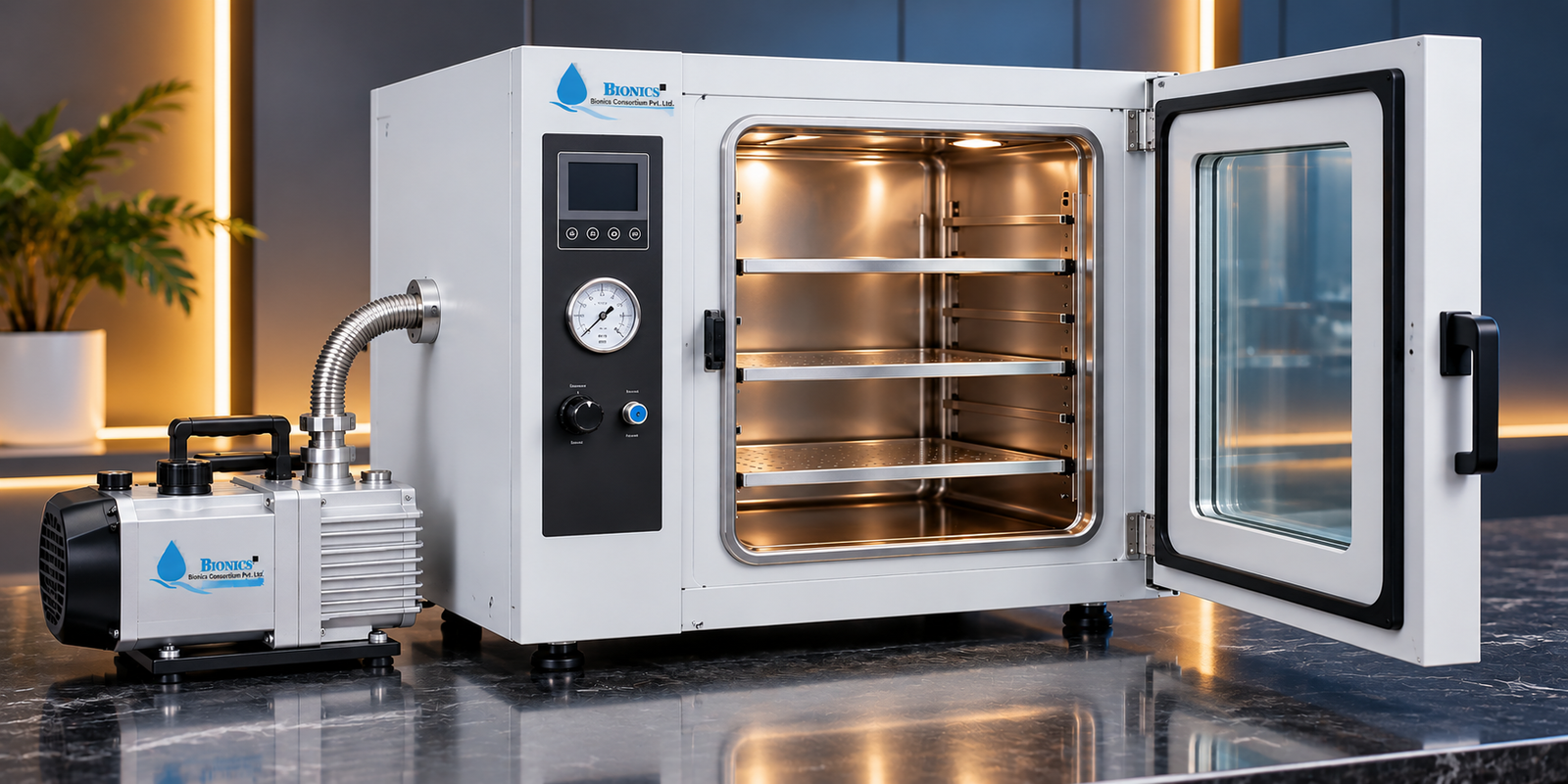
Put simply, a vacuum oven dries or cures materials by pulling air out of the chamber with a vacuum pump so drying can happen at a lower temperature than a regular hot air oven would need. Drop the pressure, and liquids inside a sample boil off at a lower temperature — that's the whole trick. It's why vacuum ovens end up handling the jobs a standard laboratory oven can't: heat-sensitive powders, solvent removal, moisture-touchy materials that would scorch or oxidize under normal atmospheric drying. Bionicsro has been building vacuum ovens, lab drying ovens, and laboratory ovens for 26 years, supplying labs and industry both across India and abroad.
Strip it down to basics: it's a sealed, heated chamber hooked up to a vacuum pump. The pump pulls air out, pressure inside drops below atmospheric, and that pressure drop lowers the boiling point of whatever liquid is in your sample. Moisture and solvents leave the sample at a lower temperature than they would in an ordinary laboratory oven or drying oven — that's the mechanism, not a marketing claim.
Where it gets specific: how much the boiling point drops depends on how deep a vacuum you pull (measured in mbar, or inches of mercury if you're working in older units) and which solvent or liquid you're dealing with. There's no single "vacuum drying temperature" that applies across the board. Process temperature gets set based on how heat-sensitive the sample is and what vacuum level your pump can actually reach — not from a chart that claims to work for everything.
Three things happen at once inside a vacuum oven:
Heating. Elements built into the shelves or chamber walls supply the heat. Shelf-mounted heating matters here specifically because there's barely any air left in the chamber to carry heat around by convection — so heat reaches the sample mostly by conduction through the shelf and by radiation, not by warm air circulating.
Vacuum draw-down. A pump connected to the chamber removes the air. Less air means less convective heat transfer, which is exactly why the heated-shelf design exists — it's compensating for the thing vacuum takes away.
Monitoring and control. A digital controller (sometimes microprocessor-driven with programmable ramp/soak steps) manages temperature, and a vacuum gauge tells you what pressure you've actually achieved — not just what the pump is rated for.
One side effect worth knowing: since there's so little oxygen left in the chamber once it's evacuated, a lot of oxidation-sensitive drying happens without needing a separate inert gas purge. That said, many units still come with a nitrogen or inert gas backfill port, for processes where you want that extra layer of control.
Worth flagging: a vacuum oven set up for moisture analysis and one set up for bulk drying aren't really doing the same job, even though they look similar. Moisture-analysis work usually needs tight, repeatable low-temperature control; bulk drying tends to prioritize chamber volume and shelf space instead. Pick based on what your process actually needs, not chamber size on a spec sheet.
|
Parameter |
Typical Range / Detail |
|
Temperature range |
Ambient +5°C to 200°C (varies by model — check the manufacturer's datasheet) |
|
Vacuum level |
Down to 1–5 mbar, depending on the pump fitted |
|
Chamber material |
Stainless steel, SS304 or SS316 interior options |
|
Outer body |
Powder-coated mild steel or stainless steel |
|
Shelves |
Heated aluminum or stainless steel, adjustable; 2–4 shelves depending on model |
|
Door |
Toughened glass viewing window, vacuum-rated gasket seal |
|
Control |
Digital PID or microprocessor controller with vacuum gauge |
|
Capacity |
20 L up to 250+ L, model-dependent |
|
Power supply |
Single-phase, 220–240V (confirm against your local voltage standard) |
|
Safety features |
Over-temperature cut-off, door interlock, vacuum-release valve |
Specs shift from model to model, so if you're comparing vacuum oven prices, get the actual datasheet for chamber volume, vacuum level, and temperature uniformity rather than going off a generic listing.
|
Application |
Typical Operating Temperature |
Notes |
|
Heat-sensitive powder drying |
40°C – 60°C |
Set by how much heat the sample can tolerate |
|
Solvent/residual moisture removal |
50°C – 80°C |
Depends on the solvent's boiling point under vacuum |
|
Resin/epoxy degassing |
60°C – 100°C |
Vacuum plus heat, for bubble removal |
|
Electronic component curing |
100°C – 150°C |
Follow the component manufacturer's own guidance |
|
General laboratory drying |
Ambient – 200°C |
Upper limit is set by the specific model, not a fixed rule |
Treat these as a starting point, not a rulebook. Actual temperature and vacuum settings should come from the material's own data sheet plus your oven's spec sheet, since drying behavior under vacuum is sample-specific — what works for one powder won't necessarily work for another.
There isn't one number here — price moves with a handful of variables:
Given how much configuration affects the final number, the more useful move is to request a quote against your actual chamber size, vacuum level, and temperature requirement rather than comparing list prices across brands.
Bionicsro has spent 26 years manufacturing laboratory and drying equipment, and that includes vacuum ovens, laboratory ovens, and lab drying ovens supplied to research institutions, pharmaceutical manufacturers, and industrial QC labs. Equipment goes out pan-India and to international markets — the United States (USA), United Kingdom (UK), United Arab Emirates (UAE), Saudi Arabia, South Africa, Canada, Australia, Singapore, Malaysia, Philippines, Indonesia, Kenya, Nigeria, Bangladesh, Nepal, Qatar, Oman, Kuwait, Bahrain, Vietnam, Thailand, Tanzania, Ghana, Sri Lanka, and New Zealand.
Need a vacuum oven, lab drying oven, or laboratory oven matched to your actual process? Bionicsro's technical team can walk you through chamber size, vacuum level, and configuration, and put together a spec sheet and quote. Reach out to Bionicsro to get started.
Mainly drying, degassing, and curing at temperatures lower than a standard oven would need, made possible by pulling the internal pressure down so liquids boil off sooner.
A hot air oven relies on convective heat at normal atmospheric pressure. A vacuum oven pairs heat with reduced pressure and depends mostly on conduction through heated shelves, since there's little air left to circulate.
Varies by model — many laboratory units run from near-ambient up to around 200°C, but check the manufacturer's spec sheet for the exact ceiling on the model you're looking at.
Yes. The pump is what evacuates the chamber, and whether it's oil-sealed or oil-free affects both the vacuum level you can hit and how much maintenance it needs.
Usually stainless steel — SS304 or SS316 — for corrosion resistance and easy cleaning, with the outer casing in powder-coated mild steel or stainless.
Yes, it's a common use, especially where a normal atmospheric oven would degrade or oxidize the sample before you got a reading.
Yes, it's a common use, especially where a normal atmospheric oven would degrade or oxidize the sample before you got a reading.
Chamber size, pump type, interior material, controller features, and whatever's bundled in (installation, calibration) — get a quote based on your actual requirement rather than comparing sticker prices.
Many models come with an optional nitrogen or inert gas backfill port, for when you want an oxygen-free atmosphere beyond what evacuation alone gives you.
Start from the process, not the catalog — chamber volume, target vacuum level, temperature range, and whether the interior material can handle your chemicals, in that order.

Connect with us for your business enquiries. Generally, we respond within a day.