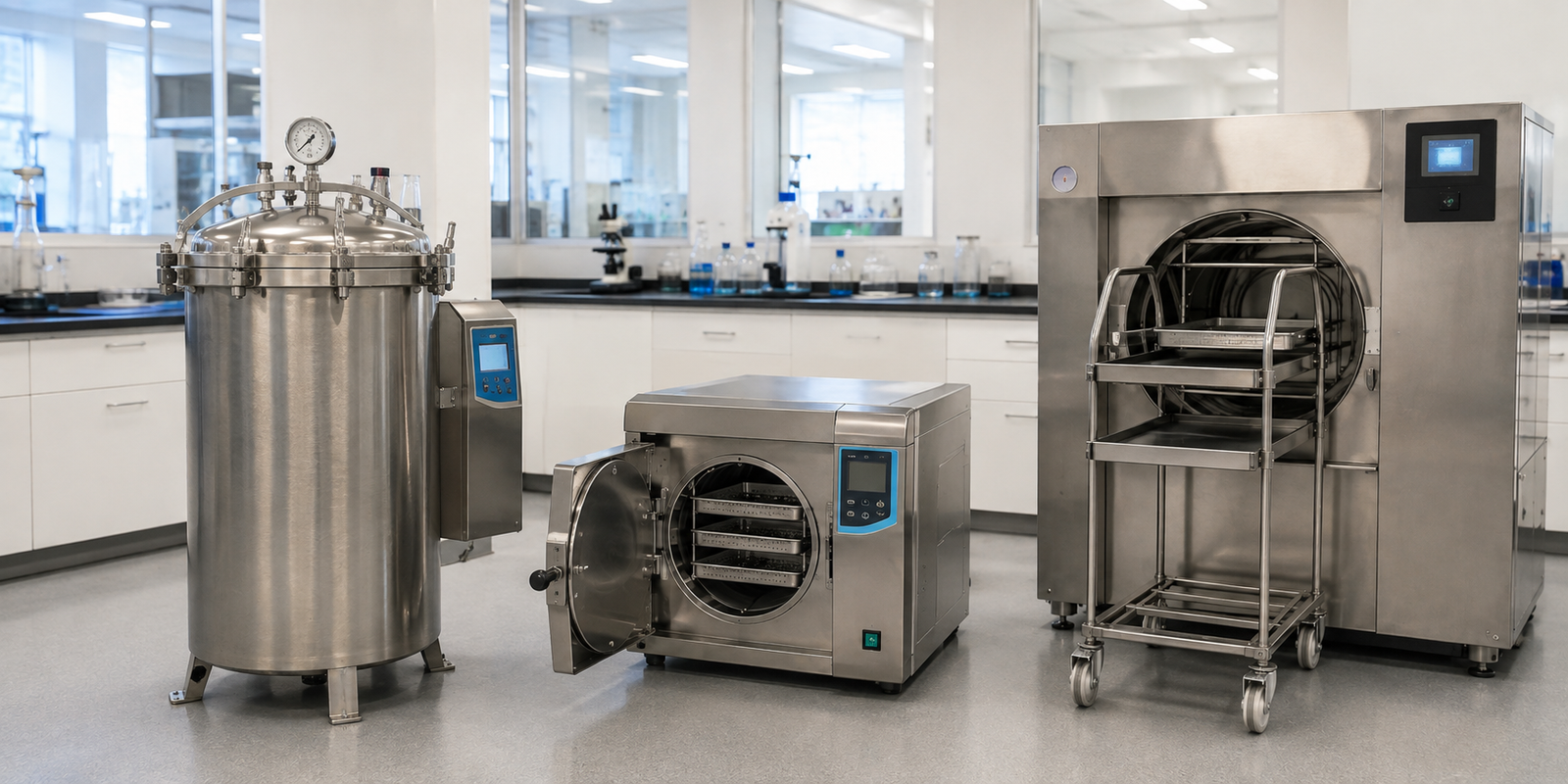
If you've ever stood in front of a supplier's catalogue trying to decide between a horizontal or vertical autoclave, or a Class B unit versus a standard gravity model, you've hit the real problem — most pages just list features without explaining why one type fits your lab. Here's how we explain it to walk-in customers at Bionicsro, in plain terms, with the physics behind it.
Autoclaves differ along two independent axes. Loading design (vertical or horizontal) is the physical build. Sterilization class (N, S, or B) is what load types the cycle is validated to sterilize under EN 13060. A vertical unit can be Class N, S, or B; so can a horizontal unit — check the two separately. A small clinic typically wants a Class B vertical tabletop unit (commonly 18–24 L) for wrapped and hollow instruments. A hospital CSSD or high-volume lab typically wants a horizontal unit with trolley loading, and separately needs to confirm Class B (or equivalent) validation for wrapped loads.
An autoclave is a pressure vessel that uses saturated steam to destroy microorganisms, spores included, on instruments, glassware, media, and waste. Water boils at 100°C at sea-level pressure, but trap that steam and raise pressure inside a sealed chamber, and the boiling point climbs well past 121°C. Held there for a validated duration, even heat-resistant spores can't survive.
Any autoclave diagram shows the same core parts: a chamber, a jacket or heating element, a pressure gauge, a safety valve, a locking door, and a drain/exhaust line. In gravity-displacement models, steam pushes air out through a lower vent. In pre-vacuum (Class B) units, a vacuum pump actively removes air before steam enters — critical for hollow or porous loads like wrapped surgical packs, where trapped air pockets would otherwise leave a "sterilized" instrument that isn't actually sterile.
Two reference cycles are commonly cited: ~121°C at ~15 psi gauge, and ~134°C at ~30 psi gauge. Treat these as indicative reference points, not a spec for any specific machine or load.
Gauge vs. absolute pressure. Gauges read pressure above atmospheric, not total chamber pressure. Atmospheric pressure at sea level is ~14.7 psi. Absolute pressure is gauge plus atmospheric, so ~15 psi gauge is roughly ~29.7 psi absolute (≈2 bar), and ~30 psi gauge is roughly ~44.7 psi absolute (≈3 bar).
Hold times aren't universal. The pressure-temperature relationship is fixed by physics, but the validated hold time depends on load type, packaging, chamber design, and the sterilizer's own validation data (per EN 13060 or ISO 17665). Liquids need slow exhaust; solids tolerate fast exhaust; wrapped or porous loads need the air-removal phase to complete first. Always run the cycle your unit's manufacturer has validated for your load.
Most guides muddle "horizontal," "vertical," and "Class B" as if they're on one menu. They're not — they answer two separate questions.
About the physical build and where the door is. A vertical autoclave loads from the top, has a smaller footprint, and suits clinics and small labs with tight space. A horizontal autoclave loads from the front like an oven, supports trolley-based bulk loading, and suits hospitals, CSSDs, and pharma units running continuous, high-volume sterilization. Horizontal units cost more upfront but process more per cycle, lowering cost-per-load over time. Either design can carry Class N, S, or B validation — check the two specs separately.
This comes from EN 13060, the standard for small steam sterilizers (compact, typically benchtop units) — it describes load type, not machine size. Larger pass-through or bulk sterilizers are generally validated against other standards (e.g. EN 285), so don't assume N/S/B labelling carries over to a large horizontal unit — ask which standard applies.
Skip the specs — what are you loading, and how much? Treat the litre figures below as typical ranges, not fixed brackets.
|
Your situation |
Typical daily load |
Loading design |
Validation class needed |
|
Dental clinic, small diagnostic lab |
Wrapped instruments, low-moderate volume |
Vertical tabletop |
Class B |
|
Tattoo studio, small vet clinic |
Wrapped instruments, low volume |
Vertical tabletop |
Class B |
|
Pathology/microbiology lab |
Glassware, media, tips; moderate volume |
Vertical |
Class N/S for solid items; Class B if wrapped items are included |
|
Hospital CSSD, pharma QC, research institute |
Continuous, high-volume, wrapped packs |
Horizontal, trolley loading |
Class B or equivalent large-sterilizer validation — confirm standard used |
Size by throughput, not just litres. Usable chamber volume is less than nominal capacity once trays and required pack spacing are accounted for — ask for a model's usable loading volume. To size correctly: estimate daily instrument/pack count, divide by how many fit per load, and multiply by validated cycle time to get total daily processing time. If that exceeds your working hours, you need a larger chamber or a second unit. Send us your daily counts and we'll size it against real model specs rather than upselling a bigger unit than you need.
Pricing depends far more on chamber material, control type, and validation documentation than on brand name. A basic vertical unit sits in a modest bracket; a Class B tabletop costs more due to its vacuum system; horizontal autoclaves scale up sharply with size and automation. Rather than quote a flat number that goes stale fast, we'd rather size a configuration to your actual load and give you an accurate quote.
|
Parameter |
Vertical |
Horizontal |
|
Loading style |
Top-loading |
Front-loading |
|
Typical capacity |
20–100 L |
50–1000+ L |
|
Best for |
Clinics, small labs |
Hospitals, pharma, CSSD |
|
Relative cost |
Lower |
Higher |
|
Parameter |
Class N |
Class S |
Class B |
|
Air removal |
None (gravity) |
Manufacturer-defined |
Fractionated pre-vacuum |
|
Validated for |
Solid, unwrapped only |
Per manufacturer's IFU |
Solid, hollow, porous, wrapped |
|
Dental/wrapped use |
Not suitable |
Only if the model's IFU validates it |
Suitable |
(Cost isn't listed under validation class — price is driven by build quality and documentation, not class label alone. Loading design and validation class are separate specs; check both.)
We manufacture our autoclave range with stainless steel chambers, PID-controlled temperature and pressure, and safety interlocks built for daily use — not just showroom conditions. Every unit ships with calibration documentation, and our technical team helps match chamber size and cycle type to your actual load.
Get in touch with Bionicsro today for a free consultation and a customized quote based on your load volume and space.
Usually an 18–24 litre Class B vertical tabletop unit, but the right size depends on daily instrument count and usable chamber volume, not litres alone.
Only advanced models with selectable exhaust rates and pre-vacuum capability — not every basic unit does both safely.
Routine indicator testing regularly (often weekly); full servicing and calibration typically annual or per usage intensity.
Sterilizer" is the broader term; an autoclave is a specific steam-pressure type, distinct from dry-heat or chemical sterilizers.
What the warranty covers (chamber, electronics, heating element), AMC pricing after it ends, and the supplier's local service reach.


Connect with us for your business enquiries. Generally, we respond within a day.