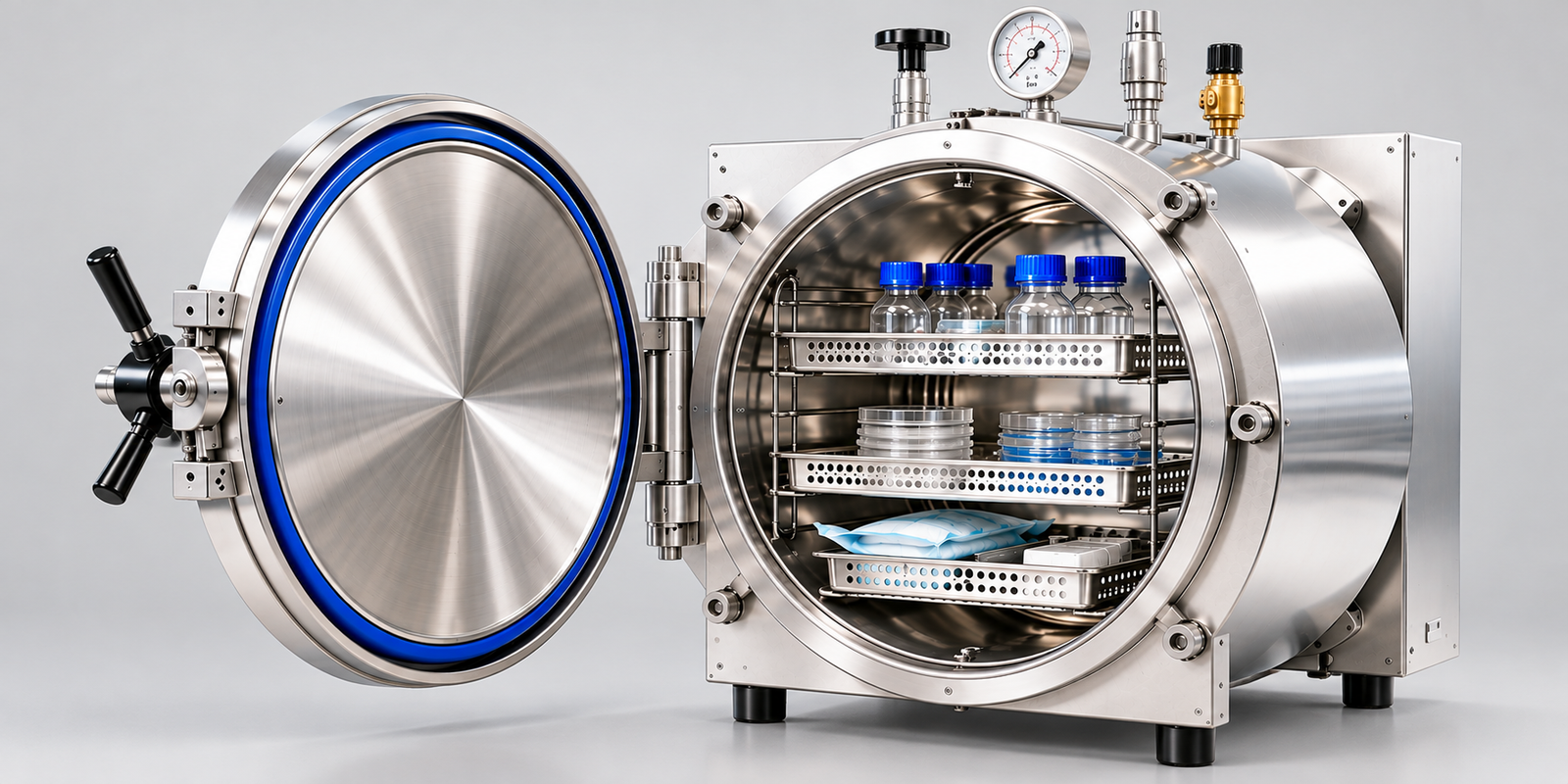
Quick answer: An autoclave is a sealed pressure vessel that sterilizes equipment, media and waste with saturated steam, typically at 121°C (about 15 psi) for 15 to 20 minutes or 134°C for shorter cycles. Choose by chamber capacity, loading style (vertical or horizontal), cycle type (gravity displacement or pre-vacuum) and chamber material. Bionics Consortium Pvt. Ltd., a Delhi-based autoclave manufacturer with 25+ years of experience, builds autoclave machines to order for laboratory and industrial use.
Walk through any microbiology lab, pharma QC unit, hospital CSSD or tissue culture facility and you will find an autoclave doing the work everything else depends on: sterilizing media, glassware, instruments and biohazard waste. Buying the wrong one shows up later as wet loads, failed biological indicators, or a chamber that corrodes within a few years.
Bionics Consortium Pvt. Ltd. designs and builds autoclave equipment as a manufacturer, not a trading house. This guide covers what an autoclave is, how it works, what to check in autoclave specifications and how to compare options, so you can send a purchase enquiry with the right numbers in it. You can see the full range at bionicsro.com.
An autoclave is a pressure chamber that kills bacteria, viruses, fungi and heat-resistant spores using pressurized saturated steam. Steam under pressure reaches temperatures above 100°C and transfers heat to the load far more efficiently than dry air, which is why an autoclave sterilizes in minutes where a dry-heat oven needs hours.
Two broad types dominate:
Cycle type matters as much as shape. Gravity displacement autoclaves let steam push air out of the chamber and suit media, liquids and simple glassware. Pre-vacuum (vacuum-assisted) autoclaves remove air first, so steam penetrates porous loads, wrapped instruments and hollow items more reliably.
Water in the chamber or a separate steam generator is heated by electric elements. As steam builds, it displaces air and pressure rises. Once the chamber reaches the set temperature, a sterilization hold timer starts. When the hold finishes, the autoclave exhausts steam, and some models add a drying phase.
A pressure gauge, temperature sensor and controller manage the cycle, while a safety valve protects against overpressure. A door interlock keeps the lid or door locked until pressure falls to a safe level, and a low-water cutoff protects the heating elements.
The most common sterilization failure is trapped air. Air pockets block steam contact, so loading pattern, air removal and container choice all affect the result as much as the temperature reading does.
The table shows typical ranges for the category. Confirm exact values for each Bionics Consortium model against its datasheet before ordering.
|
Parameter |
Typical range / option |
|
Sterilization temperature |
121°C standard; up to 134°C on selected models |
|
Working pressure |
Approx. 15 psi (121°C); higher for 134°C cycles |
|
Control |
Digital controller; programmable cycles on advanced models |
|
Cycle type |
Gravity displacement or pre-vacuum |
|
Chamber capacity |
Commonly 20 L to 1000 L |
|
Inner chamber |
Stainless steel (SS 304; SS 316 on request) |
|
Outer body |
Powder-coated mild steel or stainless steel |
|
Loading |
Vertical (top) or horizontal (front) |
|
Safety |
Safety valve, door interlock, low-water cutoff, over-temperature protection |
|
Power supply |
Configurable: 230 V 50 Hz (India), 240 V 50 Hz (Oman), 60 Hz variants for Saudi Arabia and the USA; three-phase on larger units |
Capacity. Size for your largest daily load and allow space for steam circulation. Packing the chamber tight is the most common cause of failed cycles.
Load type. Choose gravity displacement for media, liquids and glassware. Choose pre-vacuum for wrapped instruments, textiles, porous loads and hollow items.
Vertical or horizontal. Vertical suits limited bench or floor space and lighter workloads. Horizontal suits high volume and heavy trolleys.
Chamber material. SS 304 handles most laboratory sterilization. For frequent chemical cleaning or harsh conditions, ask about SS 316.
What not to sterilize. A standard autoclave is not meant for flammable solvents, corrosive chemicals or sealed airtight containers, and some plastics melt. Check material compatibility first.
Documentation. For pharma and regulated work, ask about calibration certificates, IQ/OQ support, material certificates and validation protocols.
Voltage and frequency. Match local supply at order stage. Retrofitting later is costly.
Price varies widely, so any single figure would mislead. The main drivers of autoclave price are chamber capacity, vertical vs horizontal design, cycle type (pre-vacuum costs more than gravity), chamber material, controller (basic vs programmable with data logging), steam generator requirements, and documentation or validation support. Freight and duties matter for export orders. For a firm quote, send Bionics Consortium your capacity, cycle type, power supply and destination country.
|
Criterion |
Vertical (gravity) |
Horizontal (gravity) |
Pre-vacuum (horizontal) |
|
Typical capacity |
Small to medium |
Medium to large |
Medium to large |
|
Best for |
Media, glassware, lab waste |
High-volume labs, bulk loads |
Wrapped instruments, porous loads |
|
Air removal |
Gravity |
Gravity |
Vacuum pump |
|
Drying |
Limited |
Optional |
Typically included |
|
Space needed |
Small footprint |
Larger footprint |
Larger footprint |
|
Relative cost |
Lowest |
Mid |
Highest |
Bionics Consortium Pvt. Ltd. is the manufacturer, so specification changes, spare parts and service are handled at source.
Send your capacity, cycle type, voltage and destination to Bionics Consortium for a specification sheet and price quotation. The team replies within 48 hours.
The standard is 121°C at about 15 psi for 15 to 20 minutes. Some cycles use 134°C for shorter holds. Exact times depend on load size, density and your SOP.
An autoclave uses pressurized steam and sterilizes in minutes. A hot air oven uses dry heat at higher temperatures for much longer, and suits glassware, powders and heat-stable items that steam could damage.
Vertical suits small to medium labs with limited space. Horizontal suits high-volume work and heavy loads.
Only if you sterilize wrapped instruments, textiles or hollow items where trapped air is a risk. Gravity displacement is enough for media, liquids and most glassware.
No. Avoid flammable solvents, corrosive chemicals, sealed airtight containers and plastics that cannot withstand 121°C.
No. Avoid flammable solvents, corrosive chemicals, sealed airtight containers and plastics that cannot withstand 121°C.
Use chemical indicators on every load and biological indicators (such as Geobacillus stearothermophilus spores) at regular intervals. Pre-vacuum units also need a Bowie-Dick test.
SS 304 handles most laboratory sterilization. SS 316 resists chlorides and harsh cleaning agents. Mild steel rusts easily and is unsuitable for chambers.
Typically once a year, or more often under pharma quality systems. Recalibrate after repairs, relocation or sensor replacement.
It depends on the destination: India typically 230 V/50 Hz, Oman 240 V/50 Hz, Saudi Arabia and the USA often 60 Hz. Larger units may need three-phase supply. State your site voltage, phase and frequency when ordering.
Drain and clean the chamber regularly, use distilled or softened water, inspect the door gasket, test the safety valve periodically and never override the door interlock.


Connect with us for your business enquiries. Generally, we respond within a day.