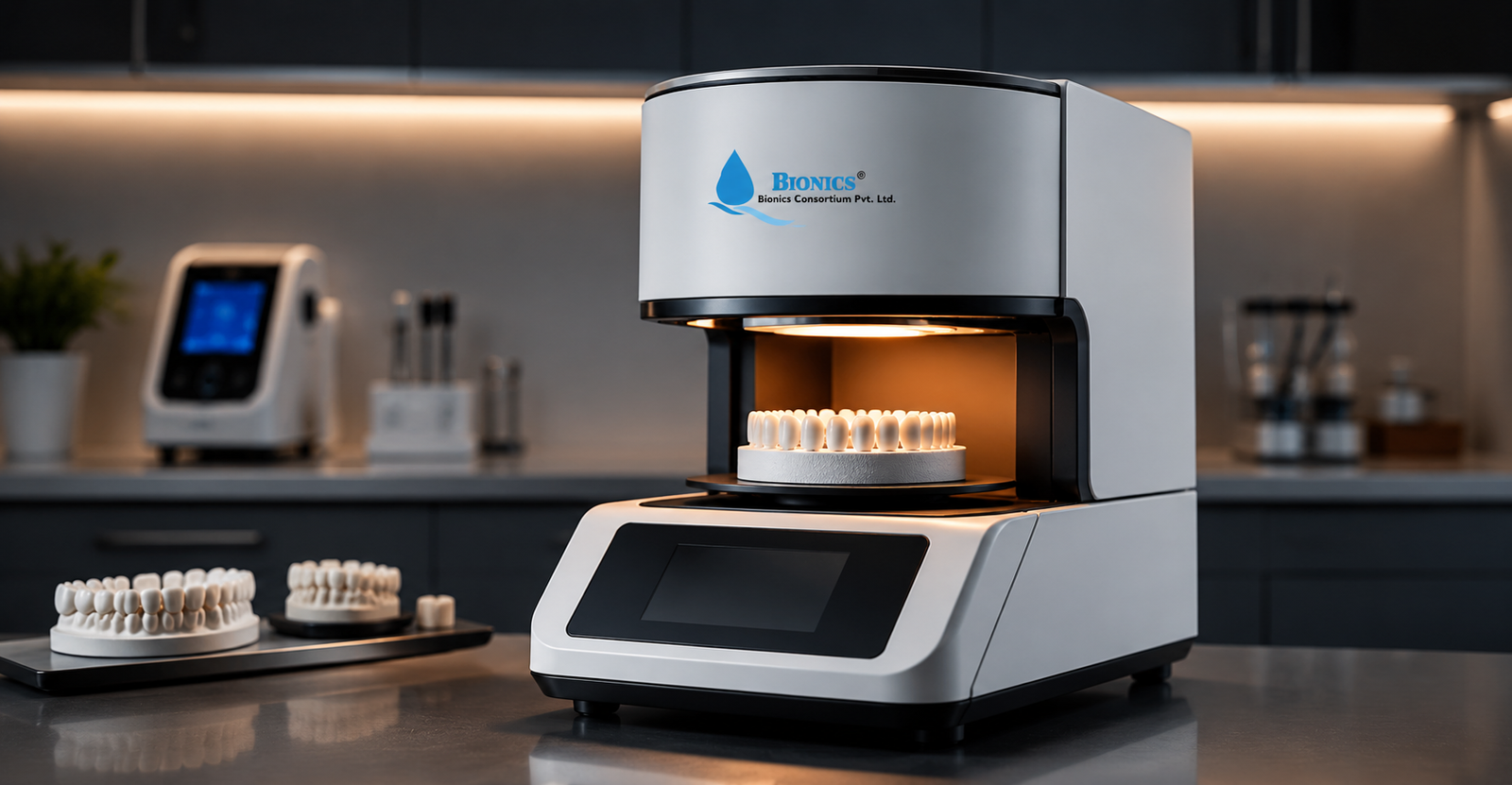
A crown can look flawless on the model and still fail the moment it's cemented in the mouth, all because the firing cycle ran a few degrees off target. That margin for error is exactly why dental furnaces get scrutinized so closely by lab owners before a purchase. Colleges use them to train students on correct firing sequences. Hospitals with in-house prosthodontic setups lean on them for same-day work. And across India's private labs, they're running daily for crowns, bridges, veneers, and zirconia frameworks. BionicsRO has spent years supplying this equipment to exactly this kind of buyer, technicians who care less about a flashy spec sheet and more about whether the furnace fires the same way on day 500 as it did on day one.
It's a heating unit purpose-built for firing, sintering, or glazing ceramic and zirconia restorations under tightly controlled conditions. A regular oven just gets hot; a dental furnace manages heating rate, vacuum, and cooling all at once, because ceramic particles only fuse properly inside a narrow temperature band. Miss that window and you're looking at a remake.
Labs typically use one to:
Not every lab needs the same setup, and buying more furnace than your case mix requires just wastes money.
Porcelain furnaces are built for layered ceramic on PFM restorations, where controlled vacuum firing keeps the porcelain from turning porous. Zirconia sintering furnaces run much hotter, often past 1500°C, since milled zirconia blocks need that heat to reach full strength and the right translucency. Press furnaces combine heat with mechanical pressure, forcing a softened ceramic ingot into a mold for pressable systems. Then there are combination units that handle both firing and pressing in one chamber, a sensible pick for mid-sized labs that don't have room, or budget, for two separate machines.
A restoration, say a milled zirconia crown or a metal coping ready for porcelain, goes into the firing chamber. The controller runs a pre-programmed cycle: temperature ramps up, holds at the target for a set time, then cools in a controlled way rather than just switching off. During porcelain firing, a vacuum pump pulls air out to cut down on bubbles in the ceramic. Sintering furnaces skip the vacuum step but run for several hours at sustained high heat to bring zirconia to full density. Throughout the cycle, sensors keep feeding temperature data back to the controller so the process stays on track even if room conditions shift a little.
|
Parameter |
Typical Range / Detail |
|
Temperature Range |
200°C – 1600°C, depending on furnace type |
|
Heating Technology |
Resistance or induction heating |
|
Heating Elements |
Kanthal or molybdenum disilicide (MoSi2) |
|
Chamber Material |
High-grade ceramic fiber insulation |
|
Controller Type |
Microprocessor-based digital controller |
|
Display |
LCD/LED touchscreen with programmable memory |
|
Power Supply |
220V single phase (lab models); 380V for larger units |
|
Power Consumption |
1.5 kW – 4 kW, depending on chamber size |
|
Heating Rate |
Up to 100°C per minute for porcelain furnaces |
|
Cooling System |
Natural or fan-assisted controlled cooling |
|
Capacity |
Single-unit trays up to multi-unit configurations |
|
Accuracy |
±1°C to ±3°C, depending on model |
|
Safety Features |
Overheat cutoff, door interlock, surge protection |
|
Compatibility |
PFM, zirconia, lithium disilicate, pressable ceramics |
|
Installation |
Bench-top, minimal electrical setup required |
|
Warranty |
Usually 1–3 years, depending on manufacturer |
Get a decent furnace and it shows up directly in your output quality:
Skip the temptation to chase the highest advertised temperature number. What matters more is whether the furnace matches your real case mix.
Daily
Weekly
Monthly
|
Problem |
Likely Cause |
What to Do |
|
Uneven firing results |
Worn heating element |
Replace the element and recalibrate |
|
Bubbling on the porcelain surface |
Weak vacuum seal |
Check gaskets and pump connections |
|
Heating cycle running slow |
Element wear or power fluctuation |
Check the power supply, service elements if needed |
|
Zirconia sintering coming out inconsistent |
Wrong program settings |
Cross-check the firing schedule against the material spec |
|
Controller or display acting up |
Software glitch or sensor fault |
Restart the controller, call technical support if it persists |
|
Feature |
Dental Furnace (General) |
Ceramic Furnace |
Sintering Furnace |
|
Primary Use |
Firing and glazing PFM/ceramic |
Porcelain layering and glazing |
Zirconia densification |
|
Max Temperature |
Up to 1200°C typically |
Around 1000°C–1200°C |
1500°C–1600°C |
|
Vacuum Requirement |
Usually yes |
Yes, for porosity control |
Not usually required |
|
Cycle Duration |
20–40 minutes |
20–40 minutes |
6–10 hours |
|
Common Setting |
General labs |
PFM-focused labs |
CAD/CAM zirconia centers |
BionicsRO supplies dental furnaces suited to the range of work Indian labs actually handle, from everyday PFM crowns to full-contour zirconia cases. Installation, calibration guidance, and technical support come with the equipment, so a lab isn't left figuring out a firing error on its own with a manual and a phone call. Spare parts have historically been a headache with imported machines in India; BionicsRO keeps components stocked and tries to keep support turnaround short rather than making labs wait weeks for a replacement part. Technicians get trained during installation, covering programming, upkeep, and safe daily operation, so the learning curve doesn't fall entirely on the lab afterward. Support and delivery reach beyond the metro dental hubs too, into smaller cities where finding someone to service this kind of equipment is usually harder.
If you're weighing a new furnace, replacing one that's on its last legs, or setting up a prosthetic department from scratch, it's worth talking through your case volume, material mix, and budget before settling on a model. That's the kind of conversation BionicsRO's team is set up to have, whether you need a quotation, help picking between models, or support once the furnace is already installed and running.
Porcelain furnaces generally run between 600°C and 1200°C, while zirconia sintering furnaces climb to 1500°C–1600°C depending on the material.
A standard porcelain cycle usually takes 20 to 40 minutes, counting ramp-up, hold, and cooling.
Not a standard porcelain furnace. Zirconia sintering needs a dedicated furnace capable of much higher sustained temperatures.
Monthly is a reasonable baseline for labs firing daily; high-volume labs may want to check more often.
Depends on the case mix. PFM-heavy labs need a strong porcelain furnace; CAD/CAM-focused labs need dedicated sintering capability.
Element condition, sensor calibration, chamber insulation, and vacuum seal integrity all play a part, and they degrade gradually, not all at once.
Most lab-scale units draw somewhere between 1.5 kW and 4 kW, depending on chamber size and heating type.
Regular cleaning, seal checks, periodic calibration, and keeping an eye on element wear. Nothing exotic, but it needs to be consistent.
With reasonable upkeep, 8 to 12 years before major components start needing replacement is a fair expectation.
Mainly the combination of equipment quality with practical support, installation help, calibration guidance, available spare parts, and service that actually reaches beyond the major metros.


Connect with us for your business enquiries. Generally, we respond within a day.