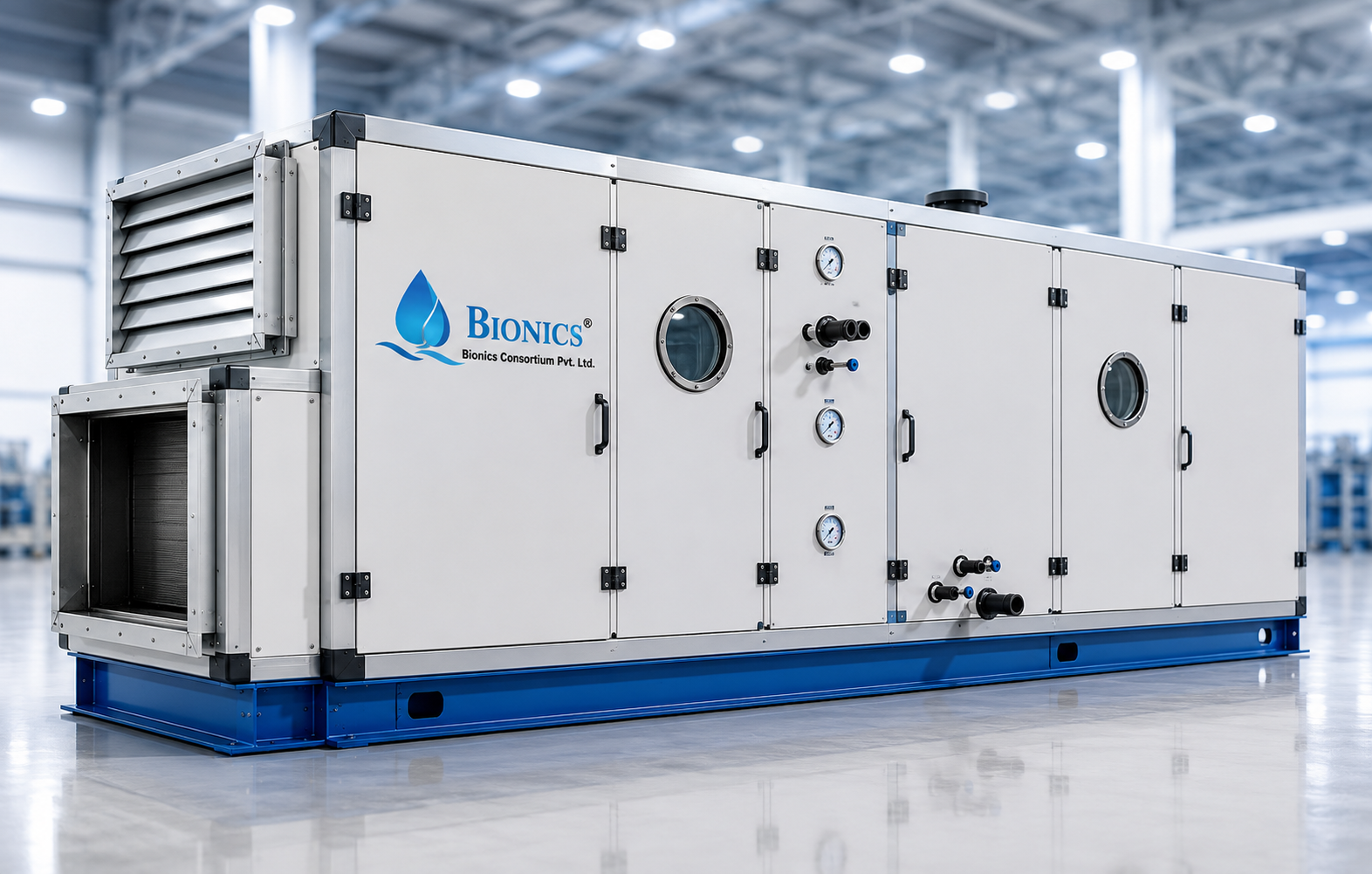
An Air Handling Unit (AHU) is considered to be one of the most important parts of HVAC systems. An AHU is used in industrial and commercial buildings, pharma, hospitals, clean rooms, and laboratories for processing and distributing filtered air.
With the increasing demands for good indoor air quality, energy-saving processes, and efficient environment control from industries in India, there is also a need for effective AHUs.
The knowledge of the working principle, types, components, cost, and installation process will help you make your decision when choosing an AHU for either an existing HVAC system or a new HVAC system.
In BionicsRO, we supply customized AHUs in India according to your needs.
Air Handling Unit (AHU) is an integral part of the HVAC system which performs filtration, heating, cooling, humidification, dehumidification, and distribution of air in buildings in order to keep the indoor air quality, temperature, and humidity.
The key function of an Air Handling Unit is to maintain comfort, hygiene, and control of indoor conditions.
Short Answer
In its functioning, an Air Handling Unit takes fresh or return air, filters it from contaminants, treats the air with heating/cooling coils, and distributes the treated air within the building.
The typical sequence of operation for an Air Handling Unit usually follows:
The AHU takes air from outside (fresh air) and returns air (air already circulated indoors) through air intake dampers.
It filters the air to eliminate dust, particles, pollution, bacteria, and any other contaminant from the air.
Conditioning can be through cooling/ heating coils depending on the requirements of the environment.
This is done via the use of a humidifier/dehumidifier depending on the intended usage of the air.
AHU diagram illustrates the route that the air flows in an Air Handling Unit together with all its main components. It gives people a clear understanding of how fresh air is filtered and distributed inside a structure.
Figure 1: AHU Schematic Diagram Illustrating Main Components and Air Flowing Route
There are several key parts to a typical AHU schematic diagram that include the following:
Comprehending the schematic diagram of AHUs can prove to be very useful.
Various buildings need various designs of AHU depending on airflow demand and environment.
This is a compact AHU where all components are enclosed together in a unit.
Constructed using several sections and modified depending on project needs.
This AHU is fitted on rooftops to conserve floor area of a building.
This unit supplies 100% fresh air to a building interior.
This AHU finds its application in the manufacturing industries such as biotechnology, electronic engineering, and health care industry.
This unit finds its application in food processing industries.
Understanding Air Handling Unit parts is essential for maintenance and efficient operation.
|
Component |
Function |
|
Air Filters |
Remove dust and airborne contaminants |
|
Supply Fan |
Distributes conditioned air |
|
Return Fan |
Returns air to the AHU |
|
Cooling Coil |
Reduces air temperature |
|
Heating Coil |
Increases air temperature |
|
Dampers |
Regulate airflow |
|
Humidifier |
Adds moisture to the air |
|
Dehumidifier |
Removes excess moisture |
|
Control Panel |
Monitors and controls operations |
|
Drain Pan |
Collects condensate water |
Each component plays a vital role in maintaining environmental control and HVAC efficiency.
Many buyers compare Air Handling Units with Fan Coil Units before selecting HVAC equipment.
|
Feature |
AHU |
FCU |
|
Airflow Capacity |
High |
Moderate |
|
Fresh Air Supply |
Yes |
Limited |
|
Coverage Area |
Large Buildings |
Individual Rooms |
|
Filtration Level |
Advanced |
Basic |
|
Application |
Industrial & Commercial |
Residential & Small Commercial |
|
Maintenance Requirement |
Moderate |
Low |
AHUs are ideal for centralized HVAC systems, while FCUs are more suitable for localized temperature control.
The AHU can be applied in a variety of different sectors.
Used to create controlled rooms during manufacture.
Used in the management of infections through the use of advanced filtration and ventilation techniques.
For provision of stable environmental conditions in laboratory work
Commercial Buildings
Industrial Manufacture
Manage ventilation and heat loads.
Correct installation ensures the efficient working of the unit for many years to come.
Professional installation will help save energy and reduce maintenance cost.
One of the most frequently searched questions is:
The cost of an AHU depends on multiple factors, including airflow capacity, filtration requirements, construction material, automation features, and application type.
|
AHU Type |
Approximate Price Range |
|
Small Commercial AHU |
₹50,000 – ₹2,00,000 |
|
Medium Capacity AHU |
₹2,00,000 – ₹8,00,000 |
|
Industrial AHU |
₹8,00,000 – ₹25,00,000+ |
|
Pharmaceutical Cleanroom AHU |
Custom Design & Quote |
Pricing will be more accurate when business firms seek assistance from a manufacturer who specializes in AHUs.
Choosing the right AHU has the potential to make HVAC systems more efficient and reduce energy costs.
Air Flow Rate
This depends on occupancy and size of the space to be serviced.
There is no universal application; different types require different standards.
An energy-efficient AHU will save more on operating costs.
There should be easy access to filters, coils, and fans for servicing.
Pharmaceutical and healthcare facilities need a specific AHU design.
Selecting the perfect HVAC service provider is a key element in ensuring proper and sustainable operation of the system.
BionicsRO offers bespoke designs of Air Handling Units in all types of industries like pharma, healthcare, commercial, etc. all over India.
✔ Customized AHU Design
✔ Experience in Pharma & Cleanrooms
✔ Energy-efficient HVAC
✔ Best Components
✔ Consulting Services
✔ Nationwide Supply and Installation
✔ Affordable Pricing
✔ Efficient After Sales Service
We have dedicated experts who work with the client to offer them an HVAC solution according to their needs.
BionicsRO makes and supplies tailor-made AHU systems to be used in:
✅ Pharma Plants
✅ Cleanroom Applications
✅ Hospitals / Healthcare Buildings
✅ Labs
✅ Commercial Structures
✅ Industrial Manufacturing Plants
Our HVAC engineers help select the right AHU based on certain criteria including air volume, filtration, room conditions, and regulation.
Schedule Your Free Consultation Today
If you need any kind of AHU, including a cleanroom AHU or a complete HVAC system, do not hesitate to contact us.
Get In Touch Today | Request Your Free Quote | Nationwide Delivery
An air handling unit (AHU) is an HVAC device that delivers treated air into the building, at the same time maintaining air quality, temperature, and humidity inside the building.
Its mechanism is such that it supplies filter treatment of air entering the building, controls temperature and humidity, and finally delivers treated air into the ducting system.
They include filters, fans, cooling coil, heating coil, dampers, humidifier, and controls.
An AHU caters to larger areas with air conditioning and supply of fresh air, whereas an FCU offers individual temperature regulation in specific areas.
Some examples of industries which employ AHUs are pharmaceutical industry, hospitals, labs, food industry, commercial buildings, and manufacturing industries.
The price depends on the capacity of AHUs, filtration needs, and other related features. Usually, industrial and cleanroom AHUs need quotes.
Cleanroom AHU with HEPA filtration and precise control of the environment is usually used in the pharmaceutical industry.


Connect with us for your business enquiries. Generally, we respond within a day.