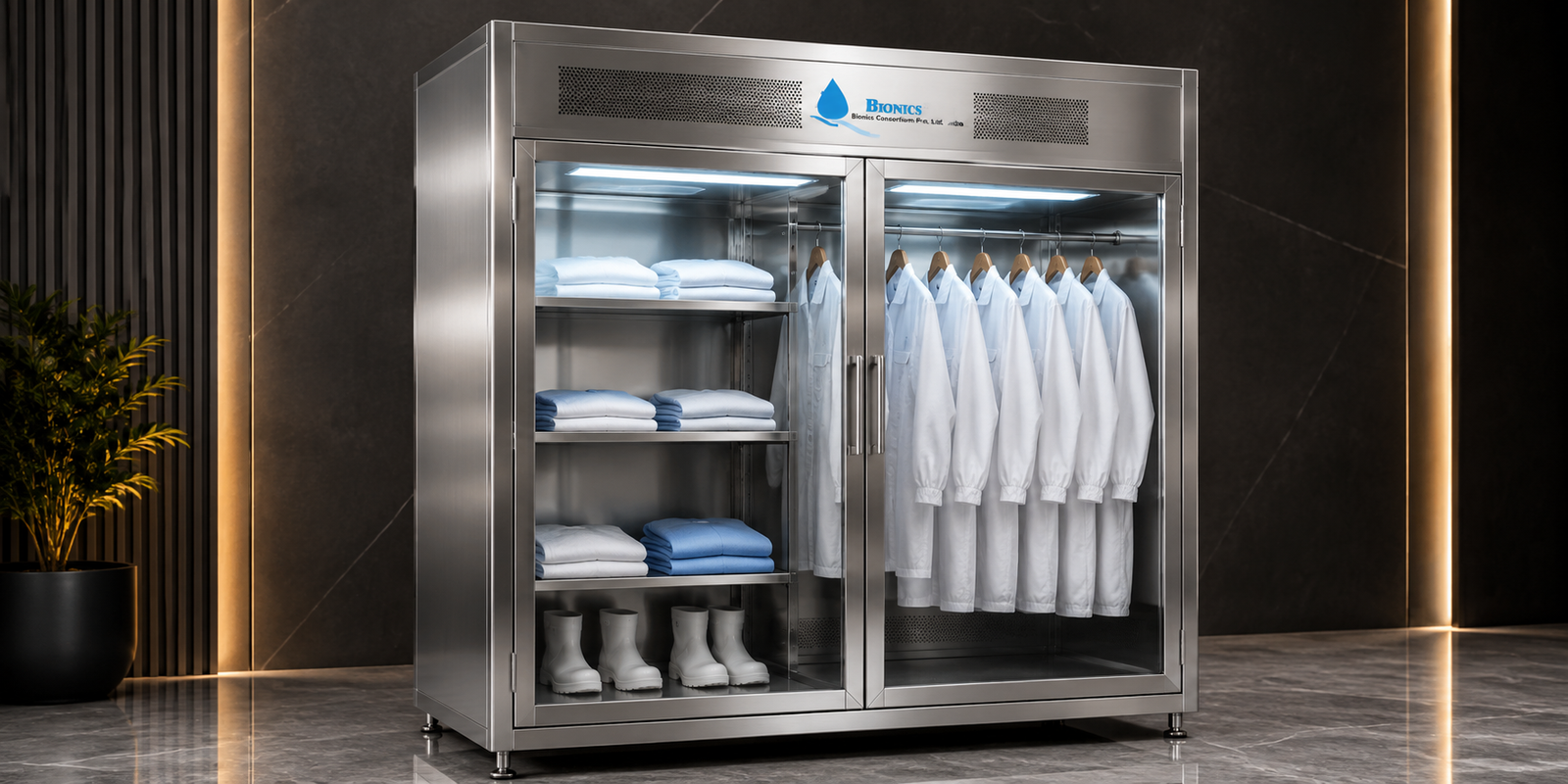
Walk into any gowning room — a pharma plant, a hospital sterile-processing unit, a biotech cleanroom — and you'll see the same thing: rows of coveralls, hoods, and masks hanging in wait for the next shift. What gets overlooked is the equipment holding those garments. Is it actively protecting them from contamination, or just sitting there, slowly working against the cleanliness the rest of the facility is built around?
A garment storage cabinet is a sealed, often HEPA-filtered enclosure used to store cleanroom apparel — coveralls, gowns, caps, masks, boots — so they stay free of airborne particles and microbial buildup between shifts. Static cabinets rely purely on a sealed enclosure; dynamic cabinets actively filter and circulate air through the chamber, which is why they're the default choice in ISO 5–7 cleanrooms and sterile pharma settings. When comparing options, filtration class, stainless steel grade, validated airflow, and compliance paperwork matter more than sticker price — gowning-room contamination is a recurring theme in audit findings, and the cabinet is often part of that conversation.
Strip away the marketing language and it's this: an enclosed, filtered (or sealed) storage unit built to hold cleanroom apparel — boots, gloves, caps, coveralls, masks — without letting them pick up airborne fibers, particulate, or microbial contamination while they wait to be worn again.
Buyers should know there are two distinct categories here, and mixing them up during procurement leads to expensive rework later.
Static garment storage cabinets depend on a sealed body and gasketed doors to keep ambient particulate out. There's no active filtration or circulation — the cabinet simply isolates what's inside. They cost less and work fine in lower-classification spaces, ISO 8 or general controlled areas, where garments aren't changed constantly.
Dynamic garment storage cabinet units take it further. Air is actively pulled through HEPA filters and kept moving inside the chamber, so garments get something close to continuous self-cleaning between wears. Pharmaceutical manufacturers, aseptic fill lines, and biotech operations tend to specify this category because it's actively reducing particle and microbial counts, not just keeping contaminants at bay.
If you're sourcing equipment for an ISO Class 5–7 cleanroom, an aseptic fill-finish suite, or a hospital CSSD, the garment cabinet is sitting at a control point that regulators actually care about. Personnel gowning shows up again and again in contamination investigations — a garment left exposed on an open rack, quietly absorbing ambient particulate, undoes the whole point of gowning procedures.
That's the value proposition of a cleanroom garment storage cabinet: HEPA filtration paired with low-turbulence, controlled airflow keeps stored apparel within acceptable particulate limits between shifts, which feeds directly into your environmental monitoring data and audit posture. For a garment storage cabinet for pharmaceutical industry use, this isn't optional extra credit — auditors reviewing gowning procedures will ask about it.
Push further into aseptic processing and you're likely looking at a sterile garment storage cabinet — tighter seal integrity, validated airflow patterns, sometimes UV-C or other decontamination cycles built in, all aimed at getting garments to a near-sterile presentation state before anyone puts them on.
Most procurement teams anchor on price and skip the specifications that determine whether the cabinet performs for the next five years. Here's what deserves real scrutiny.
Filtration class. Any HEPA filtered garment storage cabinet should list a specific filter efficiency — 99.97% at 0.3 microns is the common benchmark — plus how filters are accessed. Front-loading filters mean quick swaps; anything requiring full teardown means real maintenance downtime.
Construction material. A stainless steel garment storage cabinet, typically SS304 or SS316L, resists the corrosion that comes from repeated disinfectant wipe-downs and doesn't have painted seams where microbes can settle in. SS304 covers most pharma and biotech needs; SS316L comes into play when chemical resistance requirements are higher.
Airflow design. Vertical laminar, horizontal, or blower-recirculation — each behaves differently, and the air change rate tells you how fast garments actually get refreshed between storage cycles. Get this number from the supplier, don't assume it.
Doors and seals. Gasketed, self-closing doors with a viewing panel let a supervisor do a compliance check without opening the cabinet and disturbing the airflow inside.
Capacity planning. These range from single-user lockers to multi-bay units holding 10–20 garment sets. Size for overlapping shifts, not just headcount — buffer capacity gets missed more often than it should.
Compliance paperwork. IQ/OQ/DQ support, particle count validation reports, material certificates — for regulated buyers, these aren't optional add-ons, they're part of the purchase.
Noise and power draw. Dynamic units run blowers continuously. If the cabinet sits near sensitive lab space, specify acceptable decibel levels and power consumption up front.
|
Feature |
Static Garment Cabinet |
Dynamic Garment Storage Cabinet |
|
Airflow |
None — sealed enclosure only |
Continuous HEPA-filtered airflow |
|
Contamination Control |
Passive isolation |
Active particle reduction |
|
Suitable Cleanroom Class |
ISO 8 / general controlled areas |
ISO 5–7, aseptic/sterile zones |
|
Power Requirement |
None or minimal |
Required (blower/filtration unit) |
|
Maintenance |
Low |
Moderate — filter changes, blower checks |
|
Typical Buyer |
General manufacturing, hospitals |
Pharma, biotech, sterile fill-finish |
|
Relative Investment |
Lower upfront cost |
Higher, offset by reduced contamination risk |
|
Parameter |
Typical Specification |
|
Body Material |
SS304 / SS316L Stainless Steel |
|
Filtration |
HEPA, 99.97% @ 0.3 microns |
|
Door Type |
Gasketed, self-closing, with viewing window |
|
Airflow Type |
Vertical laminar / horizontal recirculating |
|
Capacity |
1 to 20 garment sets (customizable) |
|
Illumination |
LED, cleanroom-compatible |
|
Control Panel |
Digital, with differential pressure gauge |
|
Finish |
Matte/mirror, seamless welded joints |
|
Power Supply |
220V/50Hz (configurable per region) |
|
Compliance |
GMP, ISO 14644 alignment |
Garment storage cabinet price shifts quite a bit depending on material grade, filtration setup, capacity, and whether you're buying static or dynamic. If you're evaluating a garment storage cabinet in India, expect the quote to move with:
Don't stop at the headline number. Ask every garment storage cabinet manufacturer you're evaluating for a total-cost-of-ownership picture — filter replacement frequency, warranty length, and how fast their after-sales team actually responds tend to matter more over five years than what's on the first invoice.
When you're down to a shortlist of a garment storage cabinet manufacturer in India, go beyond the catalog. Are welds seamless and polished, or are there seams where particulate could collect? Is the filtration and airflow system engineered in-house, or bolted on from a third party? Can they show validation records and reference installations from facilities similar to yours?
At bionicsro, we build these cabinets around actual gowning-room workflows rather than retrofitting general storage furniture for cleanroom use. Every unit ships with seamless SS304/SS316L construction, validated HEPA airflow, and the documentation packages facilities need for GMP audits — support that continues well past the sale, through the equipment's full working life. Our team works directly with pharmaceutical, biotech, and hospital facility planners to size capacity, airflow, and controls around real shift patterns and cleanroom classifications instead of shipping a generic box and calling it done.
Contamination control in the gowning room starts with equipment built for that exact job — not general storage furniture pressed into service. If you're evaluating a garment storage cabinet for a pharmaceutical, biotech, or hospital facility, talk to the engineering team at bionicsro about a configuration matched to your cleanroom classification, shift pattern, and compliance requirements. Get in touch for a specification consultation and a quote built around how your facility actually grows up — not a generic catalog price.
The construction and, in dynamic models, the active HEPA filtration and airflow — features built specifically to stop particulate and microbial contamination from settling on cleanroom apparel, which a standard locker was never designed to handle.
It comes down to your cleanroom classification. ISO 5–7 sterile and aseptic areas generally call for HEPA-filtered dynamic cabinets; general controlled areas can often get by with a static enclosure.
There's no fixed calendar rule — it depends on usage and ambient particulate load. Most facilities check filter integrity every 6–12 months and replace based on differential pressure readings rather than a set schedule.
Not strictly, but stainless steel — SS304 or SS316L — holds up to repeated disinfectant cleaning without corroding, and there's no painted surface to chip and create a contamination site over time.
Yes. Most manufacturers, bionicsro included, will configure bay count and internal layout around your shift size and available gowning-room space.
Material certificates, HEPA filter test reports, airflow validation data, and IQ/OQ protocol support where your facility requires it.
Hospitals use them too — sterile-processing departments handling reusable surgical gowning increasingly rely on dynamic garment cabinets to keep apparel clean between procedures.
Filtration type (static vs. HEPA-dynamic) first, then body material grade, capacity, and any extras like UV sterilization or digital monitoring.
Often, yes — many facilities position garment cabinets right alongside pass-through boxes as part of the gowning room layout. Worth raising with your manufacturer during planning, not after installation.
Look for a track record in pharma or biotech installations, in-house fabrication and filtration engineering rather than outsourced components, and a willingness to hand over validation and compliance documentation — not just a glossy brochure.


Connect with us for your business enquiries. Generally, we respond within a day.