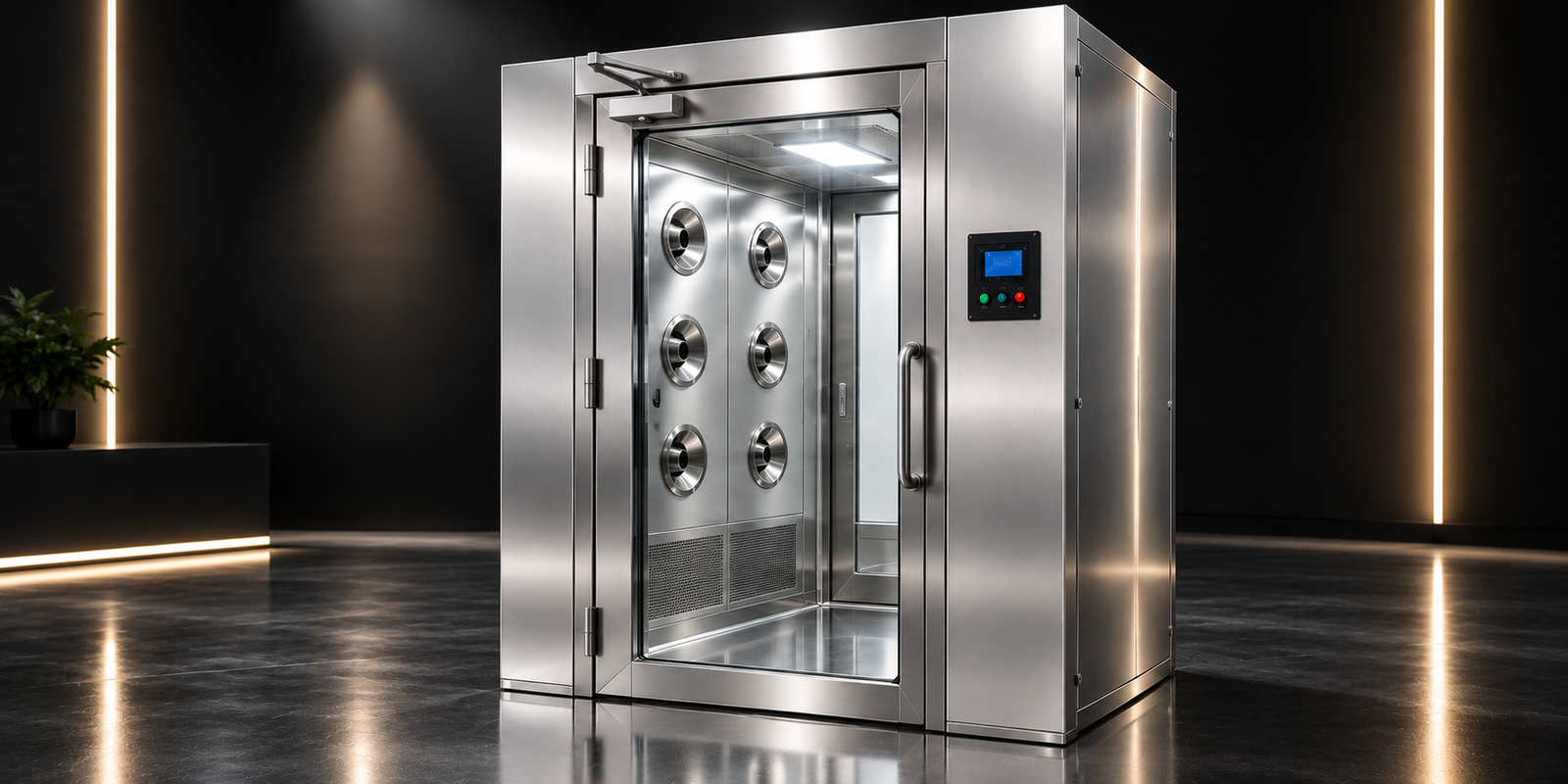
Quick Answer: Cleanroom equipment refers to engineered systems — laminar air flow units, biosafety cabinets, pass boxes, air showers, and HEPA filtration modules — that control airborne particles and pressure differentials to hold an ISO-classified environment. Bionics Consortium manufactures this equipment to ISO 9001:2015, CE, and GMP standards, with pricing driven by ISO class, airflow type, and cabinet material, and supplies pan-India as well as the Middle East, Saudi Arabia, the USA, and Oman.
Any facility running sterile manufacturing or particle-sensitive assembly eventually asks the same question: which cleanroom equipment meets the ISO class the process requires, and which supplier can back that with documentation rather than a marketing claim. This is written for that evaluation — a quality manager or procurement lead comparing a manufacturer against a trader before committing budget.
Bionics Consortium designs and manufactures cleanroom equipment as an original manufacturer, to ISO 9001:2015, CE (MDD 93/42/EEC), and GMP-certified quality systems, with the GMP certification's scope explicitly covering clean room equipment. Manufacturer versus trader status matters — it determines whether a buyer gets fabrication drawings, material traceability, and after-sales spares, or is routed through an intermediary with none of that.
Cleanroom equipment is engineered hardware used to establish and hold a controlled environment at a defined ISO 14644-1 classification (commonly ISO 5, 7, or 8). It differs from cleanroom consumables (garments, gloves) and cleanroom construction (wall panels, ceiling grids). Core equipment includes:
Cleanroom equipment combines filtration, directional airflow, and pressure control. Air is drawn through a pre-filter, then a HEPA (or ULPA, for sub-ISO-5 use) filter bank, entering the work zone as unidirectional (laminar) or turbulent airflow depending on class. Pressure cascades — positive in cleaner zones, negative in containment — stop unfiltered air migrating backward through doors or pass boxes. Air change rate, not filter grade alone, is typically what separates an ISO 7 room from an ISO 5 room.
|
Parameter |
Typical Range / Standard |
|
HEPA filter efficiency |
99.97% @ 0.3 micron (H13); ULPA 99.999% @ 0.12 micron (U15) available |
|
Airflow velocity (laminar zone) |
0.36–0.54 m/s (manufacturer-specified per application) |
|
ISO classification supported |
ISO 5 to ISO 8 (per ISO 14644-1) |
|
Cabinet construction |
SS304 / SS316 (contact surfaces), powder-coated MS (frame) |
|
Pass box type |
Static (no fan) or Dynamic (HEPA-filtered supply, pressure interlock) |
|
Interlocking |
Mechanical or electromagnetic, UV lamp optional |
|
Power supply |
220–240V 1-phase / 415V 3-phase, 50 Hz (voltage configurable for export) |
|
Noise level |
≤ 65 dB(A) at 1 metre (unit-dependent) |
|
Certification basis |
Manufactured under ISO 9001:2015 and GMP-certified processes; CE-marked where applicable |
|
Criteria |
Standard Model |
Industrial / GMP Model |
|
Typical ISO class |
ISO 7–8 |
ISO 5–7 |
|
Construction |
SS304 / MS powder-coated |
SS304/SS316, fully welded joints |
|
Airflow control |
Fixed-speed blower |
VFD-controlled, adjustable velocity |
|
Filter monitoring |
Manual DP gauge |
Digital DP gauge with alarm, BMS-ready |
|
Documentation |
Basic test certificate |
Full IQ/OQ, DOP report, traceability |
|
Typical use |
R&D/QC labs, light assembly |
Aseptic filling, sterile manufacturing |
|
Price positioning |
Lower capital cost |
Higher upfront cost, lower lifecycle risk |
Cleanroom equipment price in India varies by class, material, and automation level; request a line-item quote against a written specification, since two "ISO 7" quotes built to different air-change rates aren't comparable.
Cleanroom equipment serves pharmaceutical manufacturing, medical device assembly, electronics/semiconductor fabrication, hospital sterile supply, and research labs. Delivery details vary by region: Middle East/Saudi Arabia shipments run on 220V/50Hz with packaging suited to higher ambient transit temperatures and GCC conformity paperwork; USA-bound units are typically specified in imperial dimensions with 110–120V/60Hz options; Oman follows similar norms to Saudi Arabia; pan-India deployments use standard 230V/50Hz with GMP-annexed documentation for facility audits.
That certified quality system translates into buyer-facing evidence: production drawings on file, incoming-material checks logged, and in-process inspection records available for an audit — not a claim taken on faith. It's the difference a facility's quality team will look for when qualifying a new supplier.
Top-ranking cleanroom equipment pages tend to be catalog listings with one-line descriptions, no published spec ranges, no static-vs-dynamic pass box distinction, and thin buyer guidance. Trust signals, where present, are usually a bare "years in business" claim with no certificate number or scope attached. This page closes that gap with a defined specification table, an explicit comparison basis, and verifiable certification detail.
Contact Bionics Consortium for a written specification-based quotation, ISO/CE/GMP certificate copies, and validation documentation — whether you need a single laminar flow station or a full ISO 7 suite.
Typically ISO 5 (Grade A) within an ISO 7 or ISO 8 background, per GMP guidelines and the product's regulatory filing.
By ISO class, cabinet material, airflow control type, filter grade, and documentation level. A written spec is needed for an accurate quote.
Yes, from a manufacturer. Custom dimensions need revised airflow and filter-loading documentation, not just a resized enclosure.
A material test certificate, filter integrity (DOP/PAO) report, and airflow velocity report; regulated use also needs IQ/OQ protocols.
Usually yes. Sub-ISO-5 or containment-critical applications sometimes specify ULPA (99.999% @ 0.12 micron) instead.
Mainly plug type and ambient-rated components for transit — the region's standard electrical supply is close enough to Indian norms that voltage rarely needs reconfiguring.
At commissioning, then periodically per the facility's validation plan — commonly every six to twelve months, per applicable regulatory guidance.
Yes pan-India plus the Middle East, Saudi Arabia, the USA, and Oman, with voltage, documentation, and packaging adjusted per destination.


Connect with us for your business enquiries. Generally, we respond within a day.