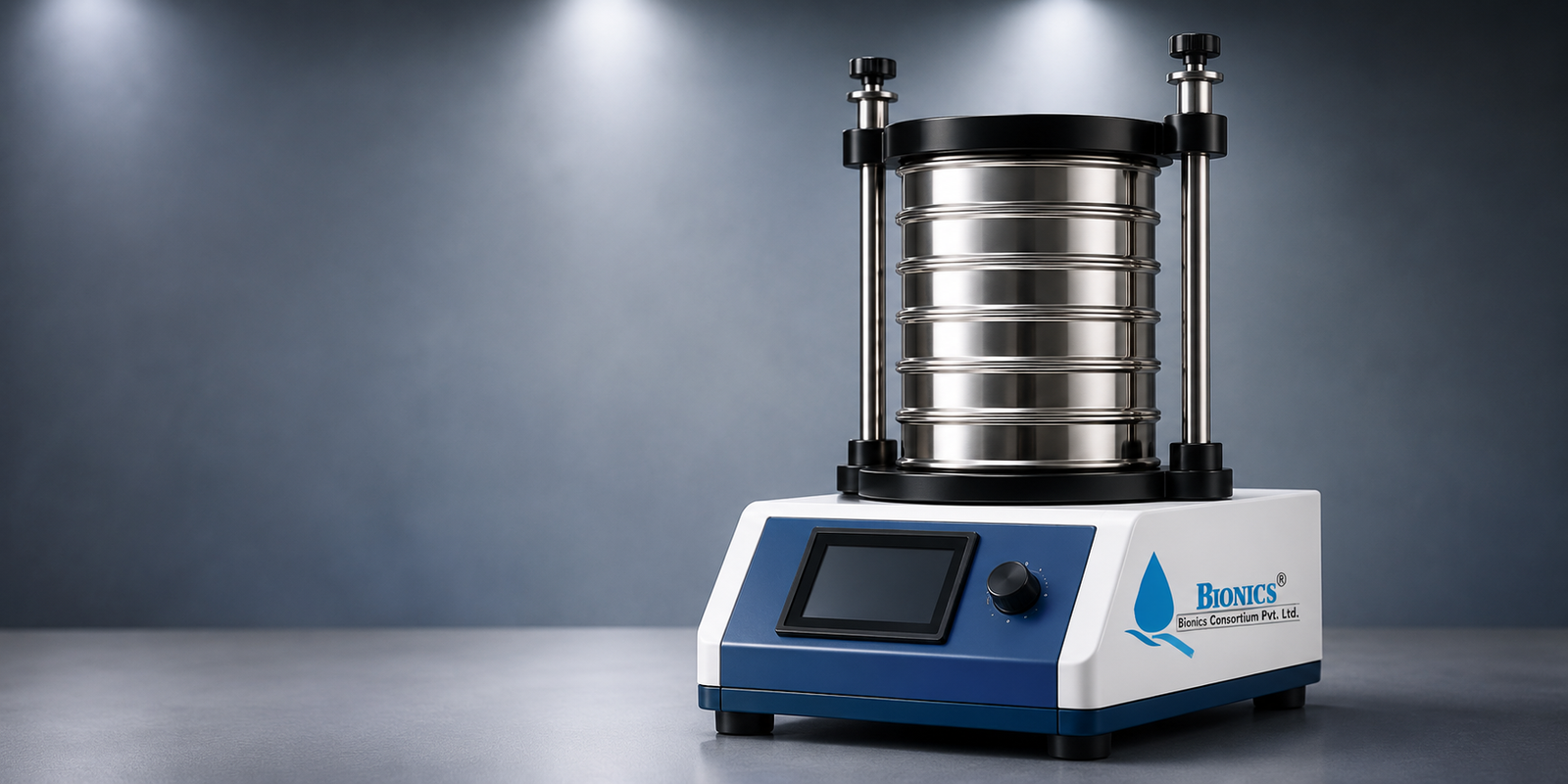
A client called us last year, frustrated because the same cement sample was giving her lab three different particle size readings depending on which technician ran the test. Same material, same sieves, same day even — just different shakers, different habits, different amounts of "banging the machine a bit harder because it felt slow." That's the problem an electromagnetic sieve shaker solves, and honestly, once you've watched it work side by side with an old mechanical unit, it's hard to go back.
I've spent the better part of a decade writing about and around lab testing equipment, and few instruments generate as many quiet "oh, that's so much better" reactions as this one. So let's get into what it actually is, how it works, where it earns its keep, and what to actually look at before you buy one — because the electromagnetic sieve shaker market has a lot of near-identical looking machines that perform very differently once you put a real sample through them.
An electromagnetic sieve shaker is a particle-size testing instrument. Instead of a motor spinning weights around to create shake, it uses an electromagnetic coil that pulses — tap, tap, tap — dozens or hundreds of times a second, sending a controlled vertical jolt through a stack of sieves. A slight rotational drift gets added on top of that tapping, so material doesn't just sit in one spot bouncing uselessly; it actually travels across the whole sieve surface.
No motor means no belts, no gearbox, nothing really to wear out mechanically. That single design choice is why these machines tend to run for years with barely any attention, while older shaker types eventually start rattling, squeaking, or drifting out of calibration.
People ask us for the electromagnetic sieve shaker principle constantly, usually right before they buy, sometimes right after (which, fair enough — better late than never). Here's the honest, non-textbook version of what happens inside the box:
The sample goes on top of a stack of sieves — coarsest mesh up top, finest near the bottom, collection pan waiting underneath to catch whatever makes it all the way through. Flip the machine on, and the coil starts generating a magnetic pulse strong enough to physically tap the whole stack. Depending on the model, you're looking at somewhere between roughly a thousand and several thousand of these taps per minute.
What makes it more than "just vibration," though, is the added rotational component. Vertical tapping alone tends to leave particles clumped wherever they happened to land first. Add a gentle rotation, and the material keeps redistributing itself, sweeping across fresh mesh openings instead of getting stuck retrying the same spot over and over. That's the real reason electromagnetic units separate fine powders so much better than older designs — it's not just stronger shaking, it's smarter shaking.
Amplitude and run time are both digitally controlled, which matters more than people expect. A pharmaceutical powder and a chunk of aggregate should absolutely not be run at the same settings, and a decent electromagnetic shaker lets you dial that in precisely instead of guessing.
We get asked "why not just use a mechanical shaker, it's cheaper" often enough that it deserves its own section rather than a buried bullet point.
Mechanical shakers use a motor and eccentric weights to force movement — reliable, sure, but noisy, and the motion tends to be rougher and less consistent test to test. Rotap-style machines add a rotating arm for combined vertical-and-horizontal motion, which works well for soil and sediment work but still carries that mechanical clatter. Gyratory shakers spin the whole stack in a circle, mimicking manual sieving, which is fine for rough, general-purpose work but not something you'd trust for tight specifications. Ultrasonic shakers sit at the opposite extreme — using sound waves instead of physical taps, brilliant for nano-scale or ultra-fine powders, but overkill and pricier than most labs actually need.
Electromagnetic sits in a genuinely useful middle ground: quiet enough for a shared lab, precise enough for pharma-grade work, and simple enough mechanically that maintenance calls become rare rather than routine.
The sieve shaker machine uses list is broader than most people assume walking in the door.
Pharma companies lean on it constantly, since drug powder particle size directly affects dosage consistency and dissolution rates — not a place to leave things to chance. Food processors run flour, spice blends, and sugar through similar testing to keep texture and quality uniform batch after batch. Cement and construction testing labs classify sand, aggregates, and fly ash against required standards before materials ever reach a job site. Mining operations use it to understand particle distribution in crushed ore. Chemical manufacturers separate raw powders before formulation, since inconsistent particle size can throw off reaction rates in ways that are expensive to trace back later. Even environmental labs use it, running soil and sediment samples for regulatory reporting. And plenty of university labs keep one around simply to teach the fundamentals of particle science hands-on.
If you've pulled up a sieve shaker machine diagram and felt a little lost, here's the plain-English version of what you're looking at. The base houses the electromagnetic drive — that's the engine room. Sitting on top of it is the digital control panel, where amplitude and timing get set. A clamping mechanism locks the sieve stack in place so nothing shifts mid-run. The stack itself is just your sieves, coarse to fine, with a collection pan at the very bottom catching the finest fraction. Rubber or anti-vibration feet underneath keep the whole thing from walking across the bench during a long cycle.
It's a genuinely simple machine once you've seen the diagram explained once — most of the apparent complexity is just unfamiliar labeling.
The electromagnetic sieve shaker price question doesn't have a single clean answer, because you're really paying for a combination of things: how many sieves the unit holds at once, whether it's built from stainless steel or a lighter mild steel body, how granular the digital controls actually are, whether it carries ISO or CE certification your industry requires, and — this one gets overlooked constantly — how good the manufacturer's after-sales support actually is once something needs a spare part two years down the line.
We've seen labs buy the bargain option, save a modest amount upfront, and then lose far more than that in failed audits and re-tested batches once the readings started drifting. It's rarely the sieve shaker itself that fails you — it's the corner-cutting behind it.
Any manufacturer worth buying from should hand you a proper electromagnetic sieve shaker PDF without you having to ask twice — full specs, dimensions, power draw, operating steps, the works. If a supplier is cagey about sending that over before you've paid, take it as a signal. At Bionicsro, we send this documentation upfront, precisely so nothing about the machine is a surprise after it's already sitting on your bench.
Skip the spec sheet for a second and start with your material. Fine powders behave nothing like coarse granular samples once vibration is involved, and wet sieving is its own separate conversation entirely. From there, be honest about your actual daily volume — a compact unit is plenty for occasional testing, but a lab running dozens of samples a day needs something built for that throughput, not squeezed into it.
Digital control depth matters more than most buyers realize going in. A machine with only two or three fixed settings will frustrate you within a month once you hit a sample that doesn't fit neatly into "coarse" or "fine." And don't skip the boring stuff — noise levels, bench footprint, and whether spare parts are actually stocked nearby all quietly determine whether you're happy with this purchase a year from now or already shopping for a replacement.
None of this requires much effort, but skipping it shows up in your data eventually. Stick to certified, properly calibrated sieves. Don't overload the stack trying to save a test cycle — it just muddies your results. Match your vibration settings to the actual material rather than reusing whatever was set last time. Clean the sieves properly after every run, since leftover residue from one sample will quietly contaminate the next. And get the machine recalibrated on a real schedule, not "whenever someone remembers."
If your particle size results have ever made you quietly second-guess a batch, that's not a technique problem — it's an equipment one. A properly built electromagnetic sieve shaker turns that uncertainty into a non-issue.
Bionicsro builds these machines for labs that can't afford inconsistent results — durable, precisely calibrated, and backed by documentation you'll actually receive when you ask for it. Reach out for a quote, request the full electromagnetic sieve shaker PDF, or ask for a live demo before you decide.
Talk to Bionicsro today — because your particle data deserves better than a guess.
Separating and grading particles by size through controlled electromagnetic vibration — most commonly for quality testing across pharma, food, cement, and mineral industries.
Separating and grading particles by size through controlled electromagnetic vibration — most commonly for quality testing across pharma, food, cement, and mineral industries.
No motor, no gearbox — just an electromagnetic drive, which means quieter operation, far less maintenance, and more consistent results run after run.
Sieve capacity, build material, how detailed the digital controls are, certification requirements, and the manufacturer's after-sales support.
Yes — a proper supplier, Bionicsro included, will send full specifications and operating documentation before you ever commit to buying.
Pharmaceuticals, food processing, construction and cement, mining, chemicals, environmental testing, and academic research labs, among others.
Most standard models handle somewhere between 6 and 13 sieves plus a collection pan, depending on capacity.
Very well — the gentler, controlled vibration is actually one of its biggest advantages over older mechanical designs for fine materials.
Every few months is typical, though your internal quality system may dictate a tighter schedule.
We're obviously biased, but Bionicsro builds these with real documentation and support behind them — worth a look either way.

Connect with us for your business enquiries. Generally, we respond within a day.