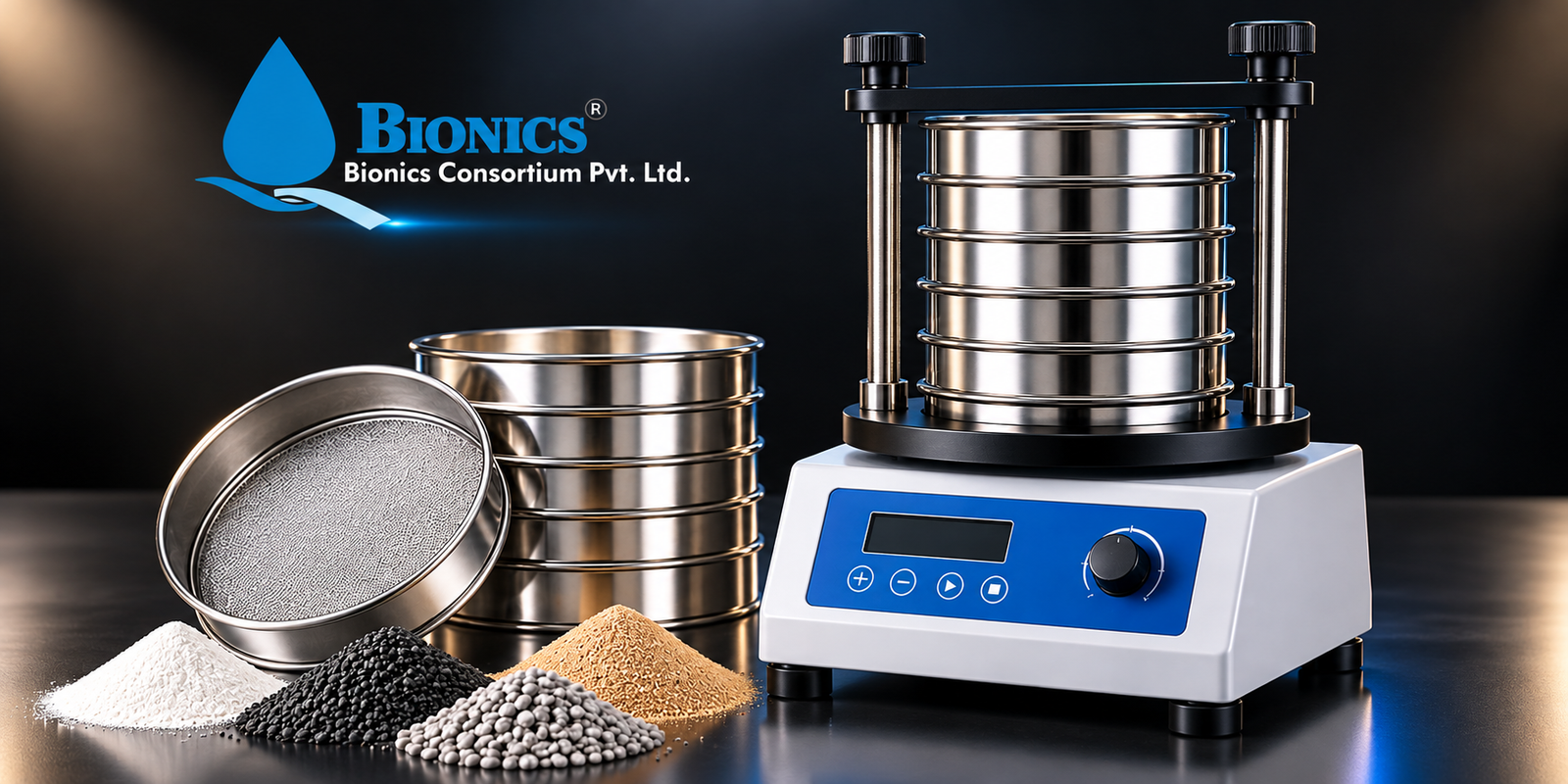
A sieve shaker mechanically agitates a stack of test sieves — coarsest mesh on top, finest on bottom — so a sample separates by particle size in minutes instead of hours of manual shaking. Mechanical (RO-Tap style) shakers combine circular motion with vertical tapping; electromagnetic shakers use a 3D throw-and-drop motion. Both run a sieve analysis test to standards like ASTM E11, ISO 3310-1, or IS 460.
Particle size distribution affects how concrete cures, how a tablet dissolves, and how consistent a production batch is. A sieve shaker gives labs a repeatable way to measure it. Bionics Consortium manufactures sieve shakers for civil, geotechnical, pharmaceutical, food, mining, and cement labs. This guide covers how the equipment works, what to check on a spec sheet, and how to choose between a mechanical sieve shaker machine and an electromagnetic sieve shaker.
A sieve shaker holds a stack of test sieves — mesh frames of progressively smaller opening sizes — and agitates the stack so a sample separates into size fractions. The operator weighs the sample, loads it onto the top (coarsest) sieve, runs the machine for a fixed time, then weighs the material retained on each sieve to build a particle size distribution curve. This procedure — a sieve test or sieve analysis test — remains widely used for being inexpensive, repeatable, and traceable to mesh standards.
A sieve shaker machine diagram shows four parts: a drive unit, a clamping mechanism, a base plate, and a timer/control panel for duration, amplitude, and tap frequency.
The sieve shaker principle depends on drive type:
The physics is the same across all three: repeated motion between particle and mesh gives near-size particles a chance to pass through, while oversize particles are retained. Sieving time, amplitude, and sample loading most affect accuracy — overloading blinds the mesh and understates fines, which is why standards cap sample mass per sieve area.
|
Parameter |
Specification |
|
Sieve diameter |
8″ / 200mm |
|
Sieve capacity |
Up to 6 full-height sieves or 13 half-height sieves |
|
Particle size range |
4″ down to US #635 mesh (20 µm) |
|
Motion |
Horizontal circular + vertical tap |
|
Oscillations per minute |
278 ± 10 |
|
Taps per minute |
150 ± 10 |
|
Timer |
99-minute digital timer, accurate to ±0.1 sec |
|
Power supply |
115V or 230V, 50/60 Hz |
|
Motor |
187W (1/4 hp), totally enclosed |
|
Dimensions |
28″ x 21″ x 25″ (71 x 54 x 64 cm) |
|
Weight |
180 lbs (82 kg) |
|
Sieving mode |
Dry sieving (mechanical/tap design) |
|
Standards compliance |
ASTM E11, ISO 3310-1, IS 460 |
|
Criteria |
Standard Model |
Industrial Model |
|
Sieve capacity |
Up to 8 sieves (200 mm) |
Up to 13 sieves or 300 mm |
|
Drive type |
Mechanical/basic electromagnetic |
Heavy-duty electromagnetic or gyratory |
|
Timer |
Analog/basic digital |
Digital, programmable, auto shut-off |
|
Construction |
Mild steel, powder-coated |
Stainless steel or reinforced housing |
|
Wet sieving |
Optional accessory |
Built-in spray and drainage |
|
Best for |
Small/academic, occasional use |
Production QC, high-throughput labs |
|
Price positioning |
Lower upfront |
Higher upfront, lower cost-per-test |
Construction/geotechnical (Pan-India, Middle East, Saudi Arabia, Oman): Sieve analysis of soil, sand, and aggregate is routine for concrete mix design and road-base approval, typically to IS 460 or ISO 3310-1. Gulf units should specify corrosion-resistant coatings, since humidity and salt air accelerate wear. Pharmaceutical/food: Powder sizing favors electromagnetic shakers; stainless steel supports GMP-aligned cleaning.
Mining/minerals: Large sizes and high loads will require gyratory or heavy-duty mechanical crushers.
Cement/building materials: High output rate requires digital timers and continuous-duty motors.
USA/export market: The two items which are often overlooked in the export order are ASTM E11 and 110-120V/60Hz.
Bionics Consortium designs and manufactures sieve shaker systems for laboratory and industrial particle-size analysis — as the manufacturer, not a reseller, model selection, specification changes, and technical documentation are handled directly, without routing through an intermediary.
Sieve shakers are built for use with test sieves conforming to ASTM E11, ISO 3310-1, and IS 460, and specification sheets, certification details, QC documentation, and warranty terms are available on request, matched to the model and order.
Bionics Consortium serves labs across India, the Middle East, Saudi Arabia, Oman, and the USA, with voltage and configuration set according to destination and application before dispatch.
Most pages ranking for "sieve shaker" are thin product listings or spec-sheet PDFs written for existing owners, not buyers comparing options — few combine an accurate working-principle explanation with a real spec table, comparison table, and geography-specific buying guidance.
Bionics Consortium manufactures sieve shakers configured for your region's voltage standard and test protocol. Contact our team for a spec sheet, pricing, or a demonstration.
Most protocols specify a fixed time (commonly 10–15 minutes) run to a constant end point, where added time produces no further measurable change in retained mass.
Yes, with a water-spray attachment and drain-compatible base — confirm this is included, as not all standard models have it by default.
The sieve with diameter of 200 mm (8″) fits for all the benches, whereas the sieve of 300 mm (12″) fits larger quantities.
ASTM E11 is used in the US, ISO 3310-1 is used in the Middle East and Asia, IS 460
Yes — the Middle East, Saudi Arabia, and Oman need 220–240V/50Hz; North America needs 110–120V/60Hz.
Most machines take 6–13 sieves depending on height and capacity; exceeding rated capacity affects consistency.
Overloading, inconsistent sieving time, worn mesh, and mixed certification batches. Standardizing loading mass and run time fixes most issues.
Neither is universally better — gyratory suits larger batches; RO-Tap-style is the reference method in many construction protocols.
Yes — export and compliance documentation are prepared as standard for shipments to Pan-India, the Middle East, Saudi Arabia, the USA, and Oman.


Connect with us for your business enquiries. Generally, we respond within a day.