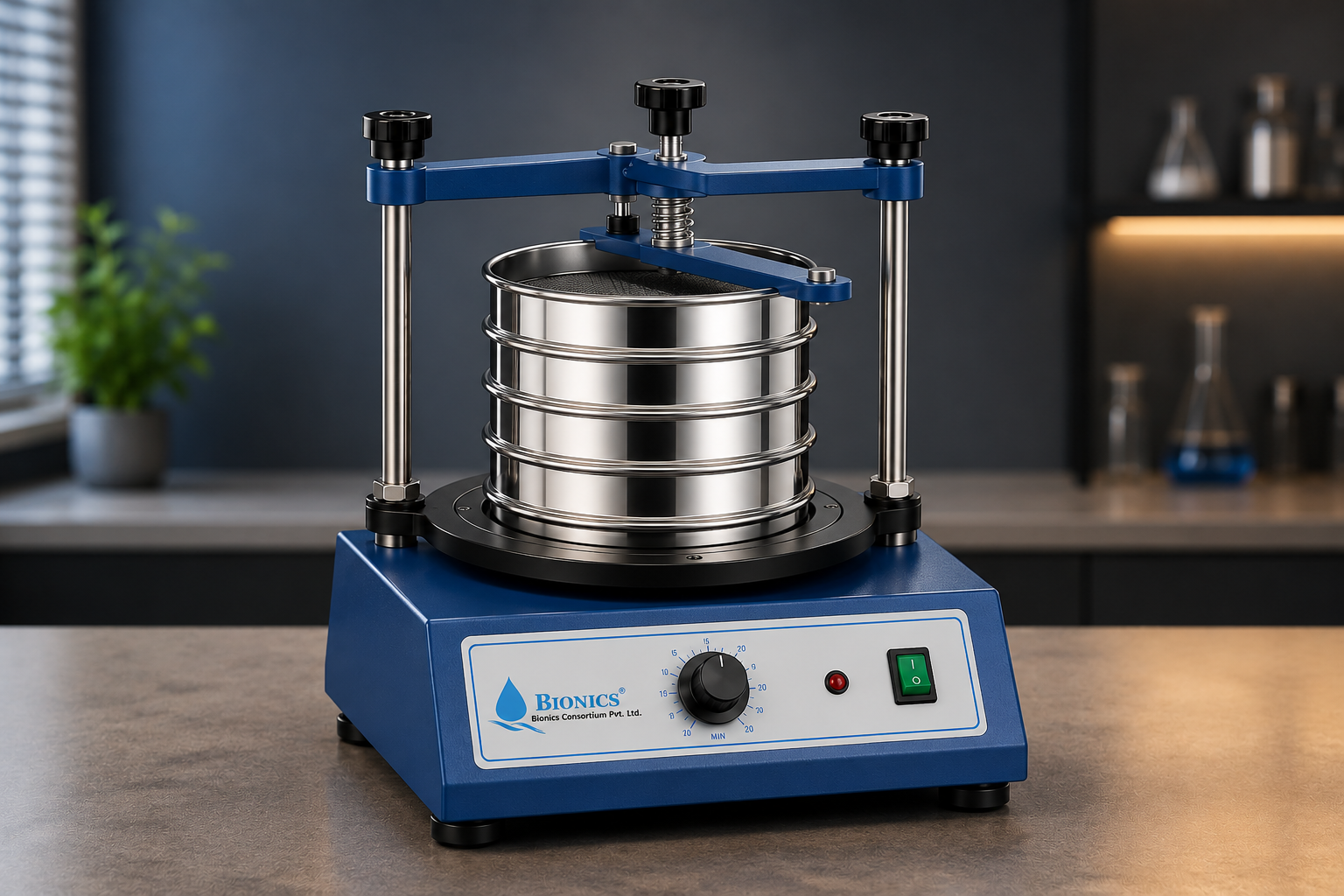
Walk into almost any serious materials testing lab — cement, pharma, foundry, food, doesn't matter — and you'll find some version of the same machine sitting near the QC bench. It's usually got a slightly boxy frame, a stack of sieves clamped on top, and this distinctive rhythmic thumping sound while it runs. That's the RO Tap Sieve Shaker, and honestly, it's been around long enough that most techs just call it "the RO-Tap" without thinking twice about what the name even means.
At Bionicro, we get asked about this machine constantly — how it works, which model to buy, why it costs what it costs, what parts wear out first. So instead of another generic spec sheet, here's a straightforward rundown from people who actually deal with this equipment day to day.
Strip away the branding and it's a particle separation device. You load a stack of test sieves — coarsest mesh on top, finest at the bottom — with your sample, clamp it down, and let the machine do what manual sieving used to take forever to do by hand.
Here's the part that makes it different from a basic shaker: it doesn't just vibrate. It does two things at once — a circular (rotary) motion that spreads your sample evenly across the sieve, and a tapping motion where an arm strikes the top of the stack at regular intervals. That combination is where the name comes from: RO for rotary, TAP for tapping. Simple enough once you know it.
Because a sieve that only vibrates tends to let particles clump or sit in one spot on the mesh. Add the tap, and particles get knocked loose, reoriented, and given another chance to pass through — which is basically what a person would do if they were shaking a sieve by hand for twenty minutes straight. Except the machine doesn't get tired or inconsistent halfway through.
If you've never operated one, the process goes something like this:
That's it. No babysitting required once it's set up correctly, which is a big part of why this machine became the default in so many labs.
If you've spent any time reading equipment specs, you've probably run into references to the RO Tap testing sieve shaker model B. It shows up constantly in technical documentation and lab procurement lists, mostly because of its motor reliability and consistent tapping rate — the kind of thing that matters a lot when you're running the same test hundreds of times a year and need results that don't drift.
We build our own sieve shaker line around those same fundamentals, but we've updated the practical bits — digital timers instead of mechanical dials, quieter motor housings (your neighbors in the lab will thank you), and frames that hold up better in humid Indian conditions where corrosion is a real problem for older mild-steel builds.
You don't need to be a technician to keep one of these running well, but it helps to know what's actually inside it. Here's a quick breakdown of the main RO-Tap sieve shaker parts:
|
Part |
What It Does |
|
Base Plate |
Where the sieve stack sits and rotates |
|
Tapping Arm |
Delivers the vertical strike to the top sieve |
|
Motor & Drive Assembly |
Runs both the rotary and tapping motion together |
|
Clamping Nut |
Holds the sieve stack firmly during the cycle |
|
Timer Control |
Sets how long each cycle runs |
|
Spring/Counterbalance |
Keeps the motion smooth and absorbs shock |
|
Rubber Feet |
Cuts down on vibration noise and keeps the unit steady |
If your results start drifting for no obvious reason, check the tapping arm first — it's the part that wears fastest and the one most people forget about until it's already causing problems.
Every RO-Tap shaker ships with a RO-Tap sieve shaker manual, and yes, people skip reading it more often than they should. It covers sieve assembly order, recommended sample weights, cycle timing by testing standard, and lubrication schedules for the motor. Half the "inconsistent results" complaints we hear trace back to someone winging it instead of following the manual's sample weight recommendations. We provide full documentation with every unit we ship, plus phone support if you've lost yours or inherited a machine without one.
The other question we get asked constantly: what's a fair RO Tap sieve shaker price? There's no single number, because it depends on a handful of things:
Our honest advice? Don't just chase the cheapest quote. A shaker that's ₹5,000 cheaper but falls apart in eighteen months, or one where you can't get spare parts locally, ends up costing more. Bionicro prices its units fairly and backs them with real service across India, so you're not stuck if something needs fixing two years down the line.
We're not the only manufacturer making sieve shakers, but we've built a reputation with labs, colleges, and industrial QC teams for machines that hold up under daily use and don't leave you stranded when a part wears out. Every unit gets checked before it leaves our facility, and our team sticks around for installation, calibration, and whatever spare parts you need later.
Need a sieve shaker that won't let you down mid-audit?
Get in touch with Bionicsro for a quote, a live demo, or just a straight answer about which model fits your lab.
Looking for a reliable RO-Tap Sieve Shaker, genuine spare parts, or expert setup support? Talk to Bionicsro — built for labs that can't afford inconsistent results.
It separates particles by size using a stack of sieves and utilizes a rotary and tapping action for efficient, reproducible separations.
Regular shakers just vibrate or shake side to side . RO-Tap shakers add a tapping motion to the rotary movement and this separates particles better .
Depending on the material, you're usually looking at ASTM C136, ASTM D452, ASTM E11, or equivalent ISO methods.
Most commonly 8-inch and 12-inch diameter sieves, though some models also take half-height sieves for bigger stacks.
Usually somewhere between 5 and 15 minutes, depending on your material and which standard you're following.
It has a reliable motor and consistent tapping rate, and is often seen in many lab
Check the tapping arm, clamping nut, and rubber feet every few months. Replace as soon as you notice wear affecting the motion.
Yes, each unit comes with a complete operating manual for setup, calibration and maintenance.
Sieve capacity, timer type, frame material, and the level of after-sales support all factor in — compare total value, not just the sticker price.
Yes and it is recommended to do so periodically to keep results accurate. We offer calibration support on all units we supply.


Connect with us for your business enquiries. Generally, we respond within a day.