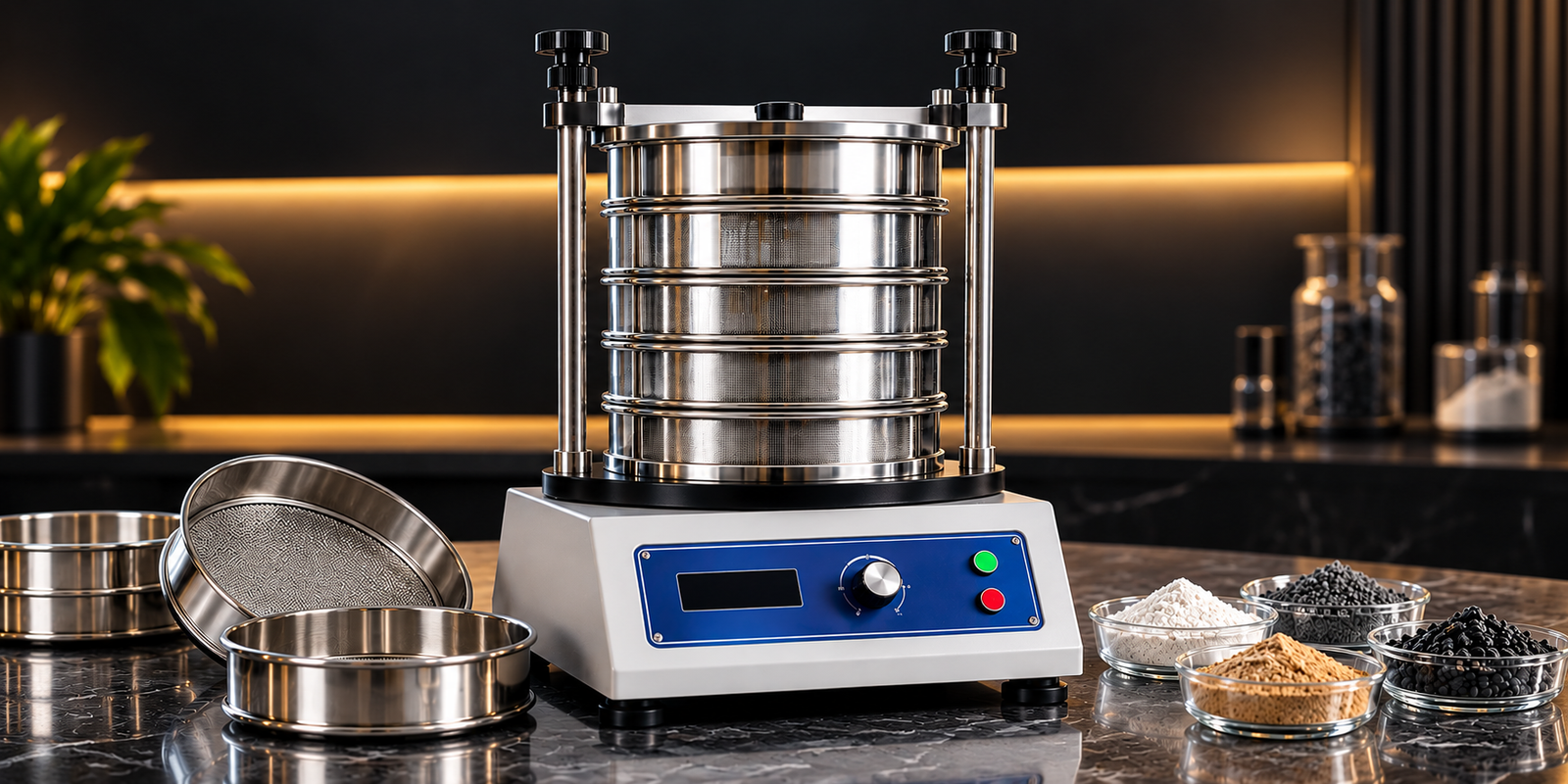
Quick Answer
A Sieve Shaker manufacturer is an analytical device that shakes a series of test sieves to separate a sample according to particle size and generate consistent PSD data. For the past 26 years, Bionics Consortium has been manufacturing sieve shakers for laboratories engaged in pharmaceutical testing, food analysis, cement screening, mining operations, chemical analysis, and soil analysis. This buying guide explains how shaker models work, features and spec details, factors affecting cost, and typical inquiries made by buyers.
Before mechanical shakers, someone stood at a bench and shook a stack of sieves by hand—and no two people shook a stack the same way, so the same sample could produce different readings depending on who ran the test. A sieve shaker removes that variable by applying one fixed, programmed motion—tapping, rotating, or both—for the same duration every time.
That consistency matters: particle size governs how fast a tablet dissolves, how smoothly a powder feeds through a hopper, and whether a soil sample passes a construction spec. Frameworks like USP, ASTM E11, and ISO 3310 only work as comparison points if the sieving step itself is controlled.
A rotap-style mechanical shaker layers a rotary sweep with a vertical tap, roughly reproducing hand-shaking with machine-level repeatability. It's the default in most pharma and construction-testing labs, handling fine powder and coarser granular material equally well.
An electromagnetic vibratory shaker relies on a magnetic drive instead of moving parts, running quieter and suiting fine-powder work.
A wet sieving unit adds a spray-bar attachment so a sample can be sieved in water—the go-to for materials that clump or build static charge when dry-sieved.
Heavy-duty and industry-specific shakers, built for soil, aggregate, or cement labs, take larger sieve diameters (200–450 mm) and heavier sample loads than a standard benchtop unit.
The stack arrangement starts from the coarse sieve at the top and the fine sieve at the bottom, with the catch pan below. The sample is placed on top sieve, the stack is clamped, and the shaking machine is subjected to the defined movements for a certain period of time depending on the sample and the standard used. Particles will sieve downwards until they get stuck on a mesh they cannot sieve through.
Amplitude and run time matter most for repeatability. The digital timer and amplitude controls lock in the same settings every run, instead of leaving it to wherever an analog dial happened to sit.
|
Parameter |
Typical Range |
Notes |
|
Sieve diameter compatibility |
100 mm, 200 mm, 300 mm, 450 mm |
Must match sieves already owned |
|
Sieves per stack |
6–13, model dependent |
The taller stack supports finer multi-fraction breakdowns. |
|
Motion type |
Rotap, pure vibratory, or orbital |
Pick per sample—powder vs. granular. |
|
Amplitude control |
Manual dial or digital, 0–3 mm |
Digital gives more consistent repeats |
|
Timer |
Digital, 1–99 minutes |
Duration follows the applicable standard. |
|
Motor type |
Induction or electromagnetic vibratory drive |
Tied to shaker's motion type |
|
Wet sieving attachment |
Optional spray-bar kit |
Needed only for wet-sieving |
|
Power supply |
220V/50Hz, 110V/60Hz for export |
Check destination voltage first. |
|
Build material |
Powder-coated mild steel or stainless steel |
Stainless is preferred for pharma/food. |
|
Reference standards |
ASTM E11, ISO 3310-1, IS 460 |
Calibration should tie to the standard you report against. |
Quotes shift with motion type, build material (stainless costs more than powder-coated steel), sieve diameter range, and whether controls are digital or manual. Compare whether sieves, pans, and clamps are included or billed separately—that's usually where similar-looking quotes diverge.
Buyers searching "Sieve Shaker manufacturer in India" or trying to "buy sieve shaker" direct from a manufacturer generally get better access to calibration paperwork, spares, and support than going through a trading middleman. Bionics Consortium sells across India and ships to the United States (USA), United Kingdom (UK), United Arab Emirates (UAE), Saudi Arabia, South Africa, Canada, Australia, Singapore, Malaysia, the Philippines, Indonesia, Kenya, Nigeria, Bangladesh, Nepal, Qatar, Oman, Kuwait, Bahrain, Vietnam, Thailand, Tanzania, Ghana, Sri Lanka, and New Zealand.
Price alone doesn't tell you much. A manufacturer that also makes test sieves, ovens, and other lab gear tends to support your whole testing setup, not one isolated machine. Ask any supplier for a calibration certificate, a written warranty, and quality-system paperwork—that's what separates a purchase you forget about from equipment that stays serviceable long-term.
A sieve shaker isn't the only route to particle size data. A laser particle size analyzer covers a broader range with finer resolution and handles very fine powders well but costs considerably more and needs a trained operator. Air jet sieving replaces mechanical motion with a rotating jet of air, better suited to fine or clump-prone powders, though it usually processes one sieve at a time rather than a full stack. For everyday QC—pharmaceutical granules, cement, soil, general powders—a mechanical or vibratory sieve shaker stays the practical default: simpler to run, cheaper to maintain, and comparable against decades of existing test history.
Looking for a sieve shaker manufacturer that stays involved after the sale? Bionics Consortium builds sieve shakers for labs across India and ships to more than 20 countries worldwide. Pricing depends on sieve diameter, motion type, and accessories—send your testing standard and sample type through the enquiry form, and expect a configuration-matched quote back within one business day.
It shakes a sample through mesh sieves from coarse to fine, so particles sort by size.
Usually 5 to 15 minutes, per the test standard the lab follows.
Not without a spray-bar attachment—a dry unit isn't built for liquid.
100 mm, 200 mm, 300 mm, and 450 mm; the clamp has to match your sieves.
Motion mechanism, build material, sieve sizes handled, and whether digital controls/accessories are included.
Pharmaceutical labs, food processors, cement and construction testing, mining, chemical manufacturers, and soil/geotechnical testing.
Yes—without traceable calibration on the shaker and sieves, results aren't defensible under most quality systems.
Varies by manufacturer—get it in writing, including what's covered and for how long.
Indian-made" usually means quicker delivery and easier spares/support without giving up international compliance—weigh that against import cost.


Connect with us for your business enquiries. Generally, we respond within a day.