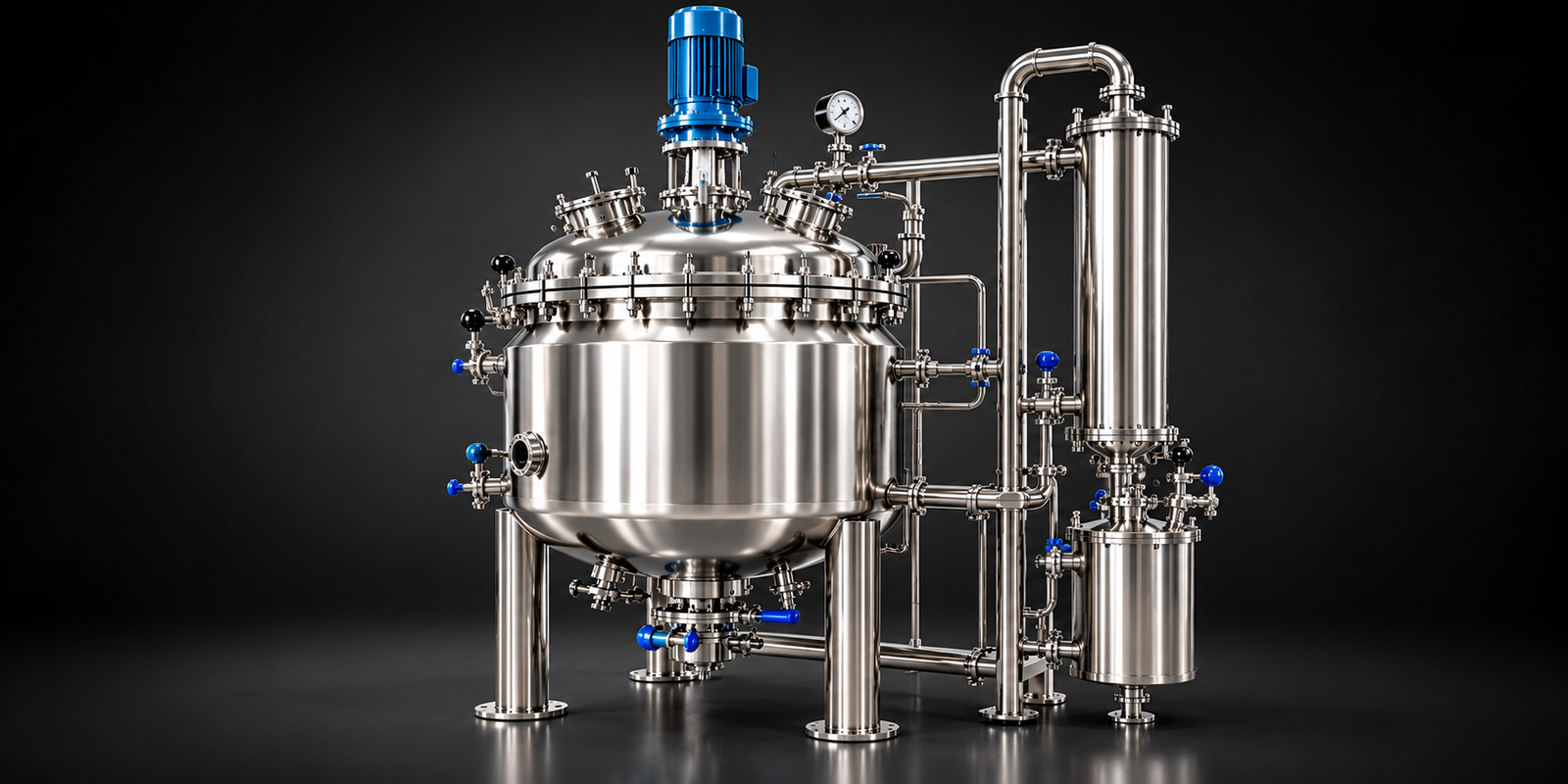
Quick answer: Filtration drying equipment is a closed, single-vessel system that separates solids from a slurry, washes the cake and dries it under vacuum or heat without transferring the product. It suits laboratory, kilo-lab and pilot work in pharma, fine chemicals and food. Bionics Consortium manufactures lab-scale units in SS 316L, backed by 26 years of manufacturing experience.
Anyone who has filtered a slurry on a Buchner funnel, scraped the cake into a tray and slid it into an oven knows where losses happen. Product sticks to the paper, solvent vapour escapes, and moisture varies from tray to tray. Filtration drying equipment removes those hand-offs. The slurry goes in, dry solid comes out, and the vessel stays closed.
Bionics Consortium designs and builds this equipment in-house, with 26 years of manufacturing experience in laboratory equipment. We sell as the manufacturer, not a trader. This guide covers how the machine works, which specifications matter, and how to choose one.
Often called a filter dryer or agitated Nutsche filter dryer, it combines filtration, cake washing and drying in one jacketed vessel. A porous filter plate sits at the base. An agitator moves through the cake to smooth it and turn it during drying, while a heating jacket supplies the energy to evaporate residual solvent.
It replaces a separate filter, tray dryer and the manual transfer between them. That matters most for products that are toxic, hygroscopic, oxygen-sensitive or wet with flammable solvents.
Most batch problems trace back to cake depth, which controls filtration time, and jacket temperature, which must stay below the product's degradation point.
These are standard ranges for our laboratory and kilo-lab units. Final dimensions, plate area and media are fixed against your batch and solvent system.
|
Parameter |
Standard range |
|
Working volume |
1 L to 50 L (larger on request) |
|
Contact-part material |
SS 316L; SS 304 for non-corrosive duty |
|
Internal finish |
Mirror polish, Ra 0.8 µm or better |
|
Filter media |
Multi-layer SS mesh or sintered plate, 5 to 100 µm |
|
Design pressure |
Full vacuum to 3 bar(g) |
|
Jacket heating |
Hot water or thermic fluid, ambient to 150 °C |
|
Agitator |
5 to 60 rpm via VFD, lift and lower mechanism |
|
Agitator drive |
0.37 kW to 2.2 kW |
|
Shaft seal |
Mechanical seal, gas-purged option |
|
Instrumentation |
PT100 probe, vacuum/pressure transmitter, sight glass |
|
Electrical supply |
415 V, 3-phase, 50 Hz (India); 380 V to 480 V, 50/60 Hz export |
|
Documentation |
Drawings, material test certificates, operating manual |
Batch size. Work backwards from wet cake volume, not slurry volume. The same 20 L slurry at 40% solids needs more filter area than at 10%.
Solvent compatibility. Chlorinated solvents and strong acids attack lower stainless grades. Specify SS 316L and share your full solvent list.
Particle size. Fine particles blind coarse media, while very fine mesh slows throughput. A trial filtration on a sample is worth the time.
Heat sensitivity. Vacuum lowers solvent boiling points, protecting delicate products. Confirm the jacket and pump can reach your target dryness within the product's stability limit.
Containment and cleaning. Potent compounds need closed discharge. Multi-product labs should check for flush-ground welds and a strippable seal area.
No single price exists. Cost moves with vessel volume, material grade, media, jacket design, drive power, instrumentation and documentation scope. Send your batch size, solvents and target dryness, and we return a priced configuration.
|
Criteria |
Funnel + tray oven |
Standard lab filter dryer |
Pilot/industrial filter dryer |
|
Typical batch |
Few litres |
1 L to 50 L |
50 L and above |
|
Product transfer |
Manual, open |
None, closed |
None, closed |
|
Operator solvent exposure |
High |
Low |
Low |
|
Drying uniformity |
Variable |
Good, agitated bed |
Good, agitated bed |
|
Automation |
None |
VFD and probes |
PLC-based recipes |
|
Best fit |
Teaching, one-off work |
R&D, kilo-lab |
Scale-up, small production |
|
Relative investment |
Lowest |
Moderate |
Highest |
Pharma and API development. Contained filtration, washing and drying of intermediates. Indian buyers typically work to cGMP expectations under the revised Schedule M. In the USA, the equipment sits within the FDA's current good manufacturing practice regulations, so documentation and surface finish must support the audit trail.
Fine chemicals. Pigments, catalysts and specialty salts needing a precise residual-solvent level, common across Gujarat and Maharashtra.
Food and nutraceuticals. Plant extracts and protein isolates dried gently at low temperature.
Middle East. Gulf summers affect condenser and chiller sizing, so we recommend extra cooling capacity. Saudi Arabia uses 60 Hz supply and Oman 50 Hz, and we configure drives accordingly.
USA. Buyers usually request 460 V to 480 V, 60 Hz, 3-phase equipment with full material traceability.
If your process only needs post-filtration drying, see our vacuum ovens, or our laboratory incubators for temperature-controlled work.
Ranking pages for this keyword usually offer a short description, a feature list and a contact button. Most lack a real specification table, an explanation of the wash and dry stages, sizing guidance, regional electrical and compliance notes, and a buyer FAQ. This guide covers each of those.
Evaluating filtration drying equipment for a lab, kilo-lab or pilot setup? Tell us your batch volume, solvents and destination. Contact our engineering team through the Bionics Consortium contact form and ask for the certification list and documentation pack with your quote.
It filters a slurry, washes the cake and dries it in one closed vessel. Labs use it to isolate intermediates, APIs, pigments and food ingredients without opening the batch, protecting both product and operator.
A funnel and oven need manual transfer, expose operators to vapour and dry unevenly. A filter dryer stays enclosed, agitates the cake and gives repeatable results across batches.
Choose by wet cake volume, not slurry volume. Most research labs suit 1 L to 20 L units. Size for roughly 60 to 70 percent fill, leaving headroom for the agitator.
SS 316L suits most pharma and chemical work because it resists chlorides and mild acids better than SS 304. Use SS 304 only for non-corrosive duty, and share your solvent list first.
Jacket circulation runs from ambient to 150 °C using hot water or thermic fluid. Combined with vacuum, heat-sensitive products dry at far lower temperatures than atmospheric drying needs.
Yes. We configure voltage, frequency and packing for the destination. Middle East and USA buyers commonly ask for 60 Hz drives, export crating and full material documentation.
Each unit ships with drawings, material test certificates and an operating manual. Instrument calibration records and validation support documents are available on request.
Vacuum suits free-draining solids. Pressure helps with fine, compressible cakes and volatile solvents. Our vessels handle both, so you can use whichever your product needs.
Routine care covers inspecting the shaft seal, checking media for blinding and calibrating probes. Polished vessels clean quickly between batches. Seal replacement follows your duty cycle.
Share batch size, solvent list, target dryness and destination country through our contact page. We reply with a configured specification and a priced quotation.

Connect with us for your business enquiries. Generally, we respond within a day.