Spend enough time on a chemical plant floor, a mineral processing site, or a wastewater treatment facility, and you'll notice the same machine everywhere — a slow-turning drum, running nonstop, quietly pulling liquid away from solids without anyone touching it. That's a rotary filter. It doesn't get much attention, but ask anyone who's had to manage a batch filtration line and they'll tell you exactly why this equipment earned its reputation. At Bionicsro, we've spent years building and troubleshooting these systems, so this isn't textbook theory — it's what we've actually learned from the field.
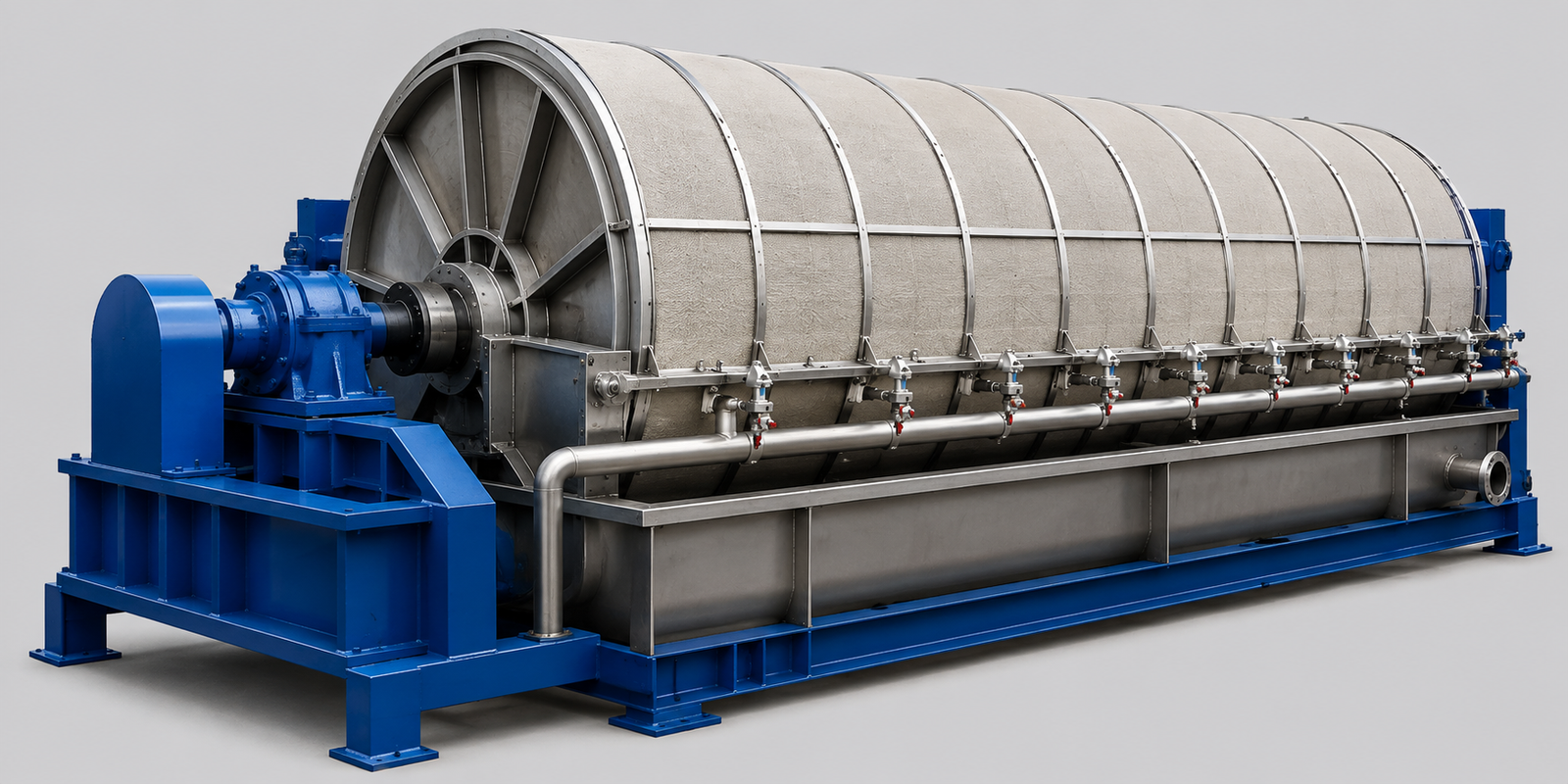
Strip away the jargon and a rotary filter is simply a rotating drum wrapped in a filter cloth that separates solids from liquid slurry — continuously, not in fits and starts. The drum dips into a slurry tank as it turns, and while one section is submerged, another is already discharging dried cake. No stopping to clean, reload, or reset. That's the whole appeal. Plants running batch filters know the drill: load, wait, unload, repeat. A rotary filter skips all of that.
People often assume the rotary filter working principle is complicated. It isn't, once you break it into stages:
That's it. Six steps, running in a loop, forever — which is exactly what makes a continuous rotary filter so different from anything that needs a "start" and "stop" button.
We get this question a lot: "Isn't a rotary filter just.a rotary filter?" Not quite. A few variants exist, and picking the wrong one for your slurry can cost you efficiency down the line:
Each type of rotary drum filter is built for a specific job — there's no universal "best" option, only the right fit for your slurry and output goals.
|
Parameter |
Typical Range |
|
Drum Diameter |
0.5m – 4.5m |
|
Drum Length |
0.5m – 6m |
|
Filtration Area |
1m² – 80m² |
|
Drum Speed |
0.1 – 3 RPM |
|
Vacuum Pressure |
300–500 mmHg |
|
Cake Thickness |
3mm – 40mm |
|
Construction Material |
SS304 / SS316 / MS with rubber lining |
|
Common Applications |
Chemical, Mining, Food, Pharma, Wastewater |
|
Feature |
Rotary Vacuum Filter |
Plate & Frame Filter |
Centrifuge |
|
Operation Mode |
Continuous |
Batch |
Semi-continuous |
|
Labor Requirement |
Low |
High |
Moderate |
|
Output Consistency |
High |
Moderate |
High |
|
Maintenance Frequency |
Moderate |
Frequent |
High |
|
Energy Consumption |
Moderate |
Low |
High |
|
Best Suited For |
Large-volume continuous processing |
Small batch, high-purity filtration |
High-speed separation |
Looking at this side by side, it's clear why a rotary drum vacuum filter wins out for anyone running large, continuous volumes. It's not the cheapest option on day one, but it usually wins on total cost once you factor in labor and downtime.
The first time you look at a rotary drum filter diagram, it can seem like a maze of pipes and zones. Once you know what you're looking at, though, it's straightforward: a slurry feed tank, the rotating drum itself, internal vacuum piping split into pickup/wash/dry/discharge zones, a scraper blade, and a filtrate collection line. Operators who can actually read this diagram catch problems — uneven cake, weak vacuum — long before they turn into a maintenance headache.
Honestly, this is the question we field the most. There's no flat number we can throw out, because rotary filter price depends on a handful of moving parts:
Smaller units won't break the bank. Larger, automated systems cost more upfront but tend to pay themselves back fast through lower labor bills and steadier output.
Mining operations lean on it for dewatering mineral concentrate. Food processors use it to clarify sugar syrups. Wastewater plants run it around the clock for sludge dewatering. And pharmaceutical manufacturers rely on precision-built rotary drum filter systems for API filtration, where even small inconsistencies aren't an option.
We're not interested in selling a generic drum. Every Bionicsro rotary filter gets built around the slurry it'll actually handle, the throughput a plant actually needs, and a budget that makes sense. That comes from years of hands-on work — not guesswork, not templates.
Want a rotary filter that's actually engineered for your process instead of a generic catalog spec? Talk to Bionicsro — let's figure out what fits.
Continuous separation of solids from liquids across industrial processes.
A vacuum removes liquids through the rotating cylinder filter cloth, leaving the solids as cake.
It operates continuously whereas the other stops after each cycle, is unloaded and reloaded.
The industries include mining, chemical manufacturing, foods and beverages, pharmaceuticals, and wastewater treatment plants.
They depend on the drum size, construction materials, degree of automation, and additional specifications of your choice.
Look at the vacuum chambers, location of the feed tank, filter cloth, and discharge.
SS304, SS316, or mild steel with liner based on the slurry.
10 -15 years with good maintenance.
Yes — with the right material choice and drum coating.
Yes, every unit is tailored to the process it's going into.

Connect with us for your business enquiries. Generally, we respond within a day.