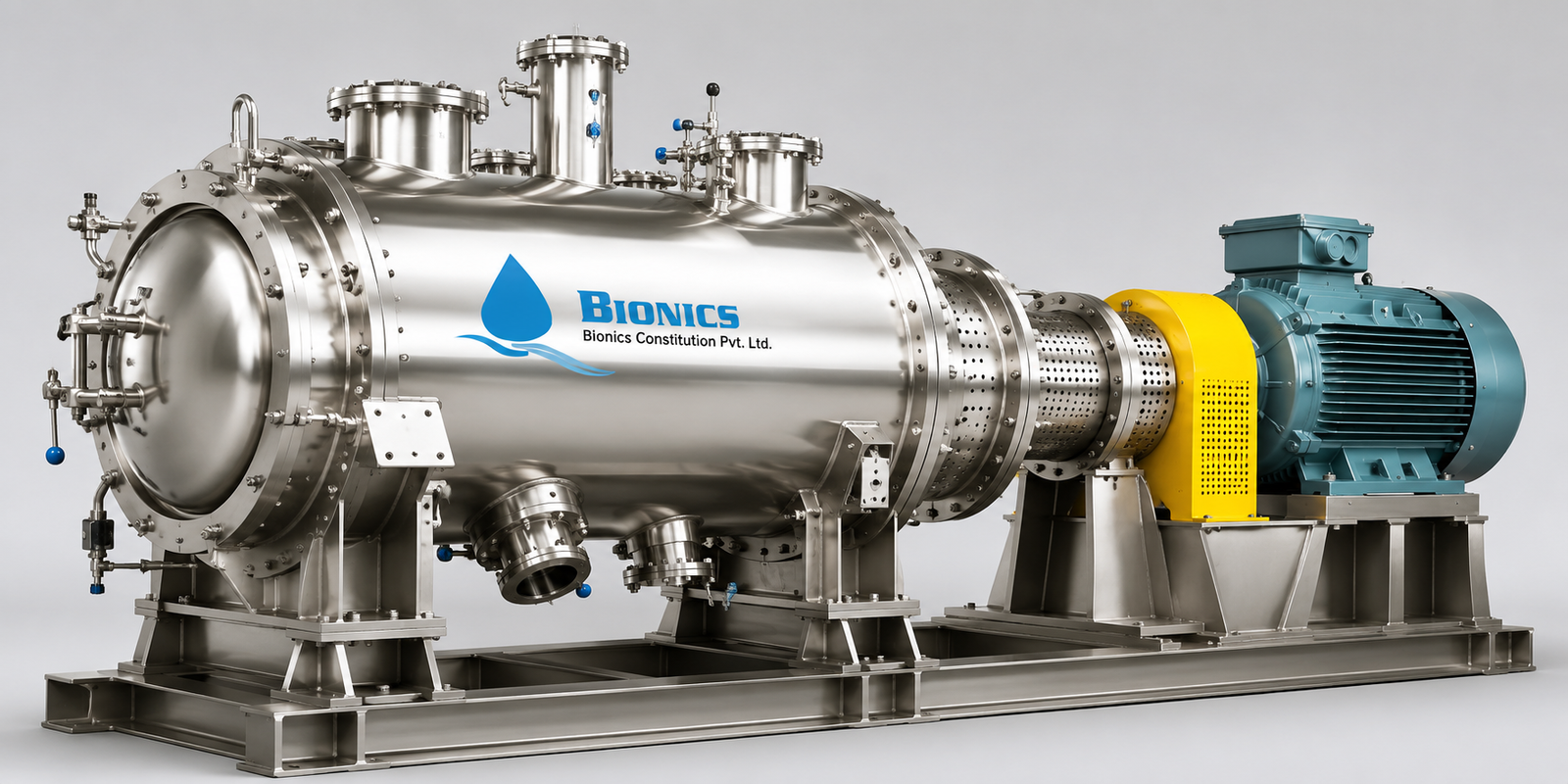
A rotary vacuum paddle dryer has become one of the most efficient solutions in the industries where the product quality depends on low-temperature, moisture-free drying. Whether you are processing pharmaceuticals, chemicals, food ingredients, pigments, or specialty materials, this equipment provides gentle drying with protection of heat sensitive products.
At BionicsRO we understand that choosing the right vacuum dryer has a direct impact on production efficiency, product quality and operating costs. With experience in industrial drying applications throughout India, we have witnessed manufacturers face the challenges of inconsistent moisture, overheating, and product degradation caused by conventional drying systems.
This comprehensive guide covers all you need to know about Rotary Vacuum Paddle Dryer including Working, Features, Applications, Benefits, Selection and Maintenance.
The rotary vacuum paddle dryer is a complex industrial drying machine which is designed for drying powders, granules, crystals, slurries and filter cakes under vacuum conditions.
Traditional dryers operate at atmospheric pressure, but vacuum drying reduces the boiling point of water and solvent. This allows drying of materials at much lower temperatures preserving their physical and chemical properties.
The paddle mechanism rotates, continuously agitating the material, to achieve the following:
Many industries require accurate moisture control and this technology is widely used in such industries.
It is a simple but very effective working process.
Wet material is charged into the vacuum drying chamber.
The vacuum pump draws air out of the chamber , reducing the pressure inside .
The chamber is jacketed to circulate steam, hot water or thermal oil.
Specially designed paddles slowly turn to constantly blend the material, giving uniform heat to each particle.
Because it is a vacuum, the water will evaporate at much lower temperatures.
The evaporated moisture is led through a condenser and safely collected.
When the moisture content required is reached the dried material is discharged Why a rotary vacuum paddle dryer? There are a few operational advantages of this equipment over conventional drying systems.
Keeps color, texture, aroma, potency, and chemical composition.
A vacuum will reduce your drying time significantly.
Efficient heat transfer means less energy consumption.
Prevents contamination and loss of solvent.
Hot spots are eliminated with continuous paddle mixing.
Recovers costly solvents.
SS304/SS316 Stainless Steel Construction
Heavy-duty rotator paddle assembly
PLC or HMI Automation
Operating temperature low
Easy to clean
Condenser and receiver units.
Rotary Vacuum Paddle Dryer Application
Herbal extracts.
Bulk drugs
Chemical Industry
Specialty chemicals
Catalysts
Food and Beverage
Extracts of fruit
Seasonings
protein shakes
Fertilisers
Insecticides.
Activated charcoal
|
Parameter |
Typical Range |
|
Capacity |
5 L to 5000 L |
|
Vacuum Level |
Up to 700 mm Hg |
|
Heating Medium |
Steam / Hot Water / Thermal Oil |
|
Construction |
SS304 / SS316 |
|
Control System |
PLC / Digital Controller |
|
Working Temperature |
Ambient to 150°C (customizable) |
|
Drying Method |
Vacuum with Paddle Agitation |
|
Feature |
Rotary Vacuum Paddle Dryer |
Tray Dryer |
|
Drying Temperature |
Low |
High |
|
Product Quality |
Excellent |
Moderate |
|
Drying Speed |
Faster |
Slower |
|
Vacuum Operation |
Yes |
No |
|
Energy Consumption |
Lower |
Higher |
|
Mixing |
Continuous |
Manual |
|
Automation |
High |
Limited |
Consider before you buy:
Proper maintenance will extend the life of equipment.
We at BionicsRO produce industrial vacuum drying systems built for reliability and durability. We manufacture equipment to meet the stringent requirements of pharmaceutical, chemical, food, biotechnology & research industries all across India.
Installation & Supply All Over India
Our engineering team works with the customer to recommend the most appropriate drying solution based on product properties, production capacity, and process requirements. This application-based approach aims to improve the drying efficiency and at the same time reduce the operating costs.
Abstract:
For industries that require drying at low temperatures, without contamination and efficiently, the best solution is the rotary vacuum paddle dryer. It uses vacuum technology and continuous paddle agitation, all important for maintaining product quality, improving process efficiency, and reducing operating costs.
BionicsRO is one of the leading rotary vacuum paddle dryer manufacturers in India. We have high-end drying systems, engineering support and national support.
Reach out to BionicsRO today! Bionics
Seeking a dependable rotary vacuum paddle dryer for your pharmaceutical, chemical,
food, or industrial application?
Need expert guidance , tailor made solutions , affordable price & installation support all across India ? BionicsR0: Get a quote now and let our specialists help you choose the right vacuum drying equipment for your business. Get in touch.
It is used for drying powders, granules, filter cakes, slurries, and heat-sensitive materials under vacuum conditions.
Vacuum drying lowers the boiling point of water so that the water can be dried at lower temperatures without damage to the quality of the product.
Pharmaceutical, chemical, food, cosmetic, biotechnology, agrochemical, and mineral processing.
Yes. Condenser & receiver system – for efficient recovery of valuable solvents.
Powders, crystals, APIs, herbal extracts, pigments, chemicals, food products and filter cakes
Normal capacity ranges from 5 to 5,000 liters or more depending on production needs.
Yes, it is. It is particularly suitable for products that require low temperature and soft drying.
SS304 is used in many industrial settings. Pharmaceutical and corrosive materials shall be of SS316.
They transfer heat well, and they shorten drying times, which can also mean less total energy used than many conventional drying techniques.
BionicsRO provides vacuum drying solutions, quality manufacturing, pan-India support, technical expertise, and reliable after-sales service to a wide range of industries.

Connect with us for your business enquiries. Generally, we respond within a day.