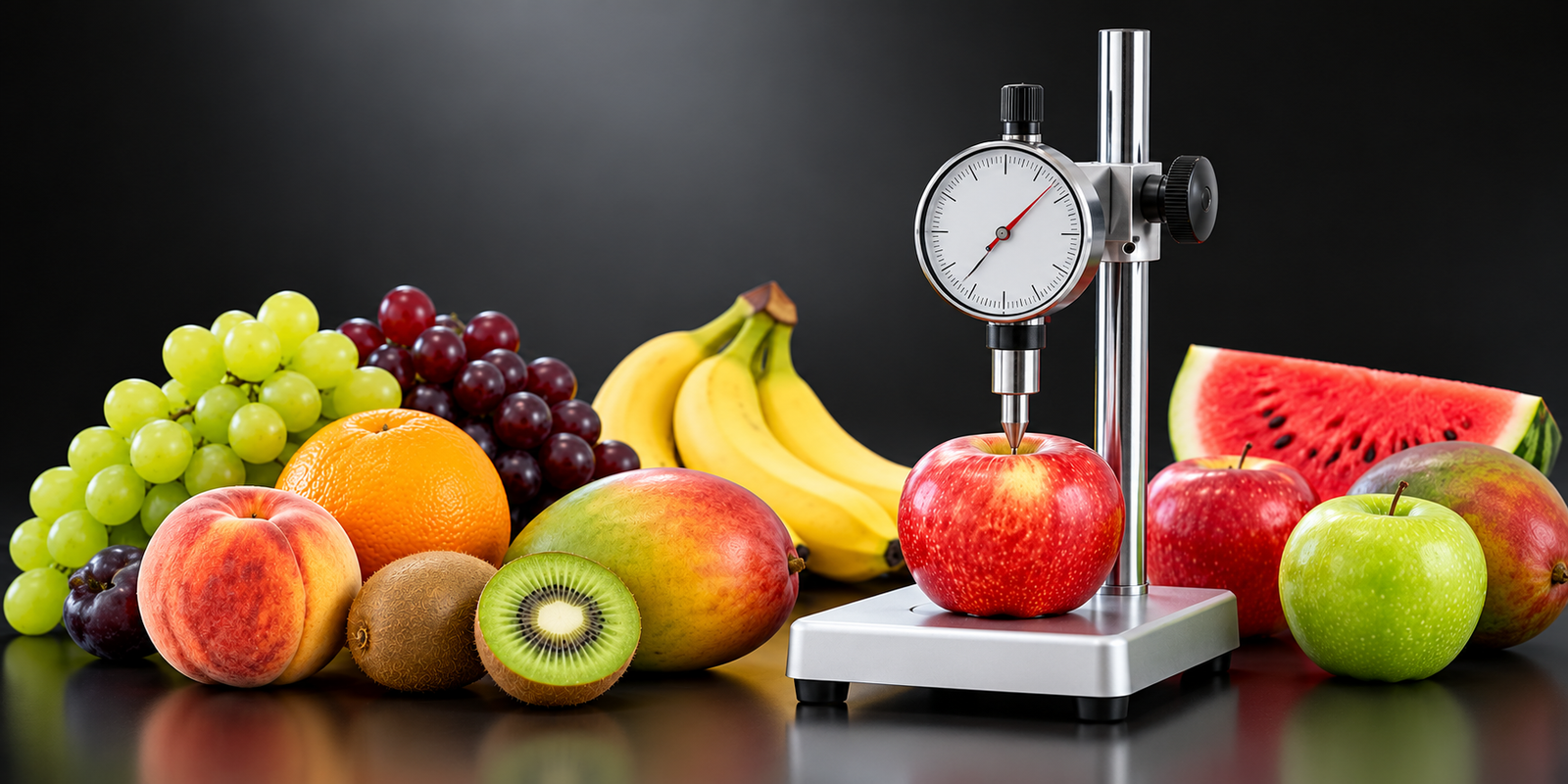
Quick answer: A fruit penetrometer is a handheld or stand-mounted firmness tester that presses a fixed-diameter plunger into a fruit to a set depth and records the force needed. Packhouses, growers and laboratories use it to judge ripeness, harvest timing and shelf life. Bionics Consortium manufactures fruit penetrometer machines in analog and digital formats.
Firmness is the quickest objective signal of when a fruit should be picked, stored or shipped. Colour misleads, and thumb pressure varies from one person to the next. A fruit penetrometer replaces opinion with a number you can log and compare across lots.
Bionics Consortium has 26 years of manufacturing experience in laboratory and testing equipment, and we build the fruit penetrometer in-house rather than relabelling imports. This guide covers how the instrument works, what to check on a specification sheet, how models differ, and what buyers in India and export markets should ask before placing an order.
A fruit penetrometer, also sold as a fruit hardness tester or fruit pressure tester, measures the resistance of fruit flesh to a probe. The reading is reported as force (kgf, lbf or newtons) or as pressure (kg/cm²).
The method traces back to the Magness-Taylor test, which remains the reference for apples, pears and many stone fruits. A plunger of fixed diameter enters the flesh to a marked depth, and the peak force is the firmness value. Higher readings mean firmer fruit.
The operator removes a thin disc of skin at the test point, because skin adds its own resistance and distorts the flesh reading. The plunger is then pushed straight in at a steady speed until the depth mark reaches the surface.
Inside the body, a calibrated spring converts the applied force into pointer travel on an analog dial. Digital units replace the spring and dial with a load cell and a display, and many hold the peak value until reset.
Three variables decide whether a reading can be trusted:
The table below shows the standard configuration of our fruit penetrometer machine. Ranges and tip sizes can be adjusted for a specific crop, so confirm them against the datasheet for your order.
|
Parameter |
Standard specification |
|
Measuring principle |
Spring-loaded plunger (analog) or load cell (digital) |
|
Range with 8 mm tip |
0.5 to 24 kg/cm² |
|
Range with 11 mm tip |
0.5 to 12 kg/cm² |
|
Resolution |
0.1 kg/cm² |
|
Plunger tips |
Stainless steel, 8 mm and 11 mm interchangeable |
|
Penetration depth |
10 mm, marked on the plunger |
|
Units |
kg/cm², lbf, N (digital models) |
|
Body material |
Aluminium alloy with stainless steel contact parts |
|
Digital model power |
Battery operated |
|
Suitable fruit |
Apple, pear, grape, peach, plum, kiwi, mango, banana, watermelon |
|
Calibration |
Provided with the instrument; recalibration on request |
Most listings for this instrument publish a price and little else. Before you buy a fruit penetrometer, work through these points:
Fruit penetrometer price depends on the sensing method, the number of tips, the finish and the order quantity. In the Indian market, basic analog units are listed at the low end, digital versions cost several times more, and imported models quoted in dollars sit in between before freight and duty.
We quote against your configuration instead of a fixed catalogue figure, so you pay for the range, tips and accessories you actually need. For bulk orders from distributors and institutions, volume pricing is available.
|
Criteria |
Analog pointer model |
Digital handheld model |
Digital model with test stand |
|
Reading method |
Dial pointer |
LCD display |
LCD display |
|
Power |
None |
Battery |
Battery |
|
Peak hold |
Pointer drag mark |
Yes |
Yes |
|
Operator influence |
High |
Moderate |
Low |
|
Best for |
Orchard spot checks |
Packhouse grading |
Laboratory and research |
|
Data logging |
Manual notes |
Manual or exportable |
Manual or exportable |
|
Relative cost |
Lowest |
Mid |
Highest |
Availability of each variant depends on the current production run, so confirm with our team when you send an enquiry.
Orchards and growers. Harvest windows for apples, pears, grapes and stone fruit are often set by firmness thresholds. Growers in Himachal Pradesh, Kashmir and Maharashtra's grape belt use the reading to schedule picking crews.
Packhouses and cold chain operators. Firmness sorting decides which lots go to long-haul export and which move to nearby markets. Our humidity chambers are commonly used alongside the penetrometer in storage and shelf-life trials.
Universities and horticulture research. Postharvest programmes track firmness loss over days in storage. Our leaf area meter supports the plant-side measurements in the same studies, and the UC Davis Postharvest Technology Center is a widely used reference for maturity indices and handling practice.
Export markets. Buyers in Saudi Arabia, the UAE and Oman receive large volumes of imported fruit under hot, dry transit conditions, so arrival firmness matters at the receiving dock. In the USA, packers and importers usually report firmness in lbf, which is why a unit with switchable units saves a conversion step. For shipments, share your destination so we can prepare the commercial invoice and packing documents correctly. Penetrometers generally fall under customs heading 9024, but your broker should confirm the code for your country.
Pages that rank for this instrument today are mostly directory and marketplace listings. They tend to share the same gaps: no explanation of the Magness-Taylor method, no link between tip diameter and range, no guidance on technique, no comparison across analog and digital formats, and no FAQ. Many also leave out calibration and documentation. This page covers those points so a buyer can specify the instrument correctly, not just compare prices.
Send us your crop type, expected firmness range, preferred format and delivery country, and our team will recommend a configuration and a quotation. Datasheets and documentation are available before you commit.
Contact Bionics Consortium for a quote
It measures the force needed to push a fixed-size plunger into fruit flesh to a set depth. The reading, in kg/cm², kgf or lbf, indicates firmness and ripeness.
Yes, when it is calibrated and used with a steady press, the same tip and a consistent test spot. A test stand improves repeatability further.
Use about 11 mm for apples and pears, and about 8 mm for smaller or softer fruit. Keep one tip size throughout a trial.
Yes. Remove a thin disc of skin at the test point, because skin adds resistance and inflates the reading.
Choose analog for low cost and field use. Choose digital for peak hold, unit switching and recorded values, especially in labs and export grading.
Yes, within its range. Swap the tip to suit the fruit. Very soft fruit, such as ripe berries, may need a different instrument.
Calibrate before each season and after any drop. Heavy users, such as packhouses, often check monthly against a reference weight.
Yes. We pack for air and sea freight and supply the invoice and packing list. Share your destination and incoterm to confirm lead time.
Standard configurations dispatch faster than custom ranges or tips. We confirm lead time, payment and delivery terms in the quotation.
Yes. Share your crop, range and tip sizes, and we will advise a configuration. Custom scales and extra tips are available for larger orders.
Connect with us for your business enquiries. Generally, we respond within a day.