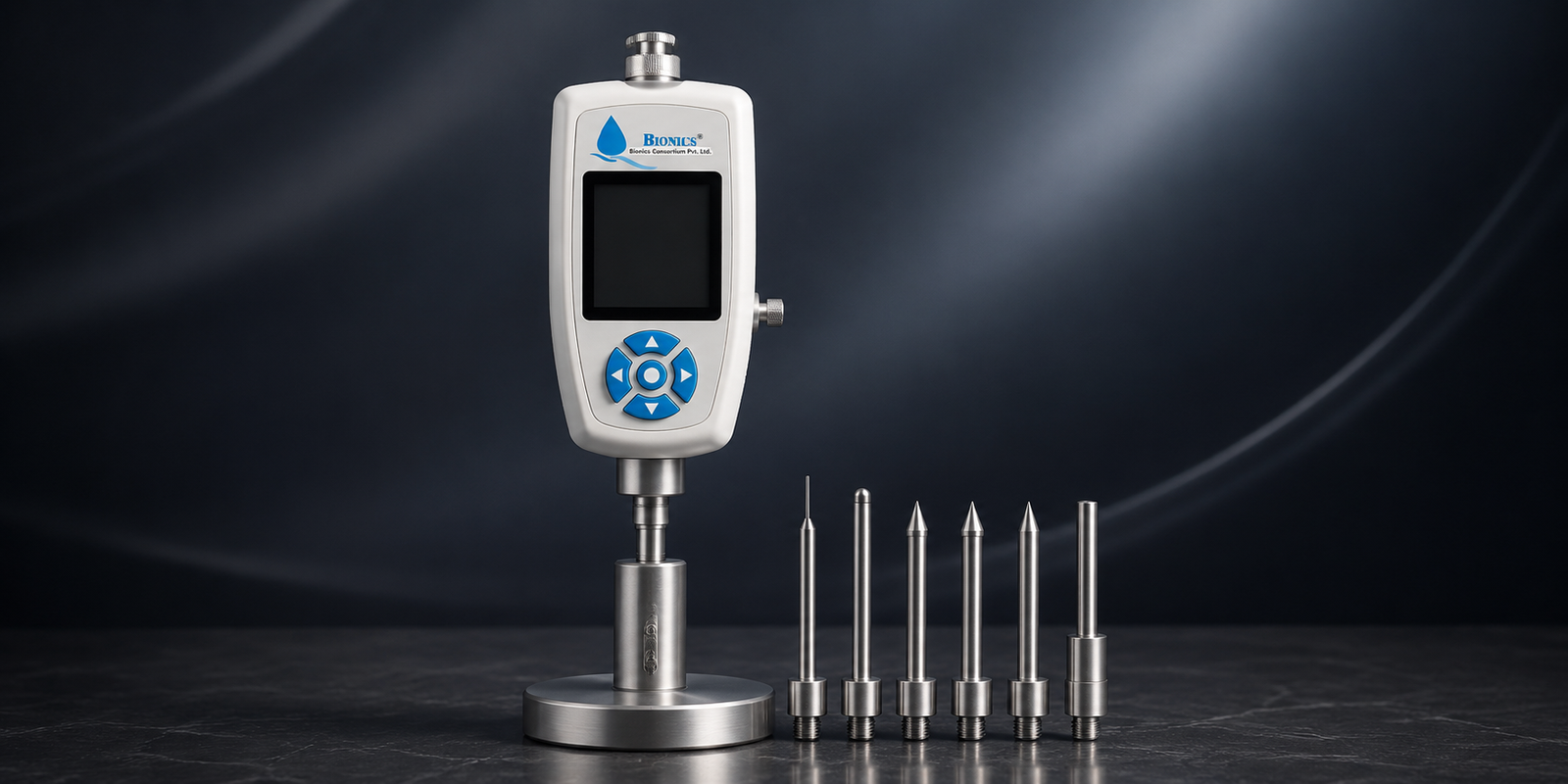
A Fruit Penetrometer measures how firm a fruit is by recording the force needed to push a probe into its flesh. Growers use that number to decide when to pick. Packhouses use it to sort ripeness stages before a truck leaves. Food testing labs use it because "the fruit feels about right" isn't something you can put in a quality report. Bionicsro works with buyers across all three groups, and most arrive with the same question: which instrument fits what I'm testing, and what it should cost.
Quick Answer: A Fruit Penetrometer measures fruit firmness by pressing a probe into the flesh and recording resistance at peak penetration, usually in kilograms-force. Manual models use a dial gauge; digital models show the reading on screen and often store it. Price in India depends on instrument type, probe configuration, accuracy, and calibration support — get a quotation from Bionicsro once you know your requirements.
At its core, a Fruit Penetrometer is a force-measuring instrument. A probe goes into the fruit at a set depth, and whatever resistance builds up along the way becomes your firmness reading.
Firmness tracks what's happening inside the fruit as it ripens: cell walls loosen, moisture shifts, and the tissue gets easier to push through. A high reading usually points to firmer fruit that will hold up during transport; a lower one suggests it's closer to the point where it needs to move. Probe choice matters more than first-time buyers expect — a probe sized for an apple is the wrong tool for a mango, since the flesh densities aren't comparable, and using the wrong probe just gives you a number that doesn't mean anything.
The applications spread across the whole post-harvest chain, not just one department.
How deep the probe goes, its diameter, and the rate of force applied all depend on the fruit, the probe fitted, and whether you're running a manual or digital unit.
Specifications aren't standardized across brands, so it's worth checking this list before ordering rather than assuming any two units are interchangeable.
|
Specification |
What the Buyer Should Check |
|
Instrument type |
Manual or digital |
|
Measurement parameter |
Fruit firmness / penetration force |
|
Measurement range |
Suited to the fruit and application |
|
Probe |
Suitable type and size |
|
Accuracy |
Manufacturer's stated accuracy |
|
Resolution |
Smallest readable measurement |
|
Display |
Digital or analog |
|
Calibration |
Requirements and procedure |
|
Construction |
Material and durability |
|
Accessories |
Included and optional items |
|
Support |
Technical and after-sales support |
This table is a checklist for evaluating any instrument — it isn't a confirmed spec sheet for a Bionicsro model. Ask for the datasheet on the exact unit you're considering.
Manual units run on a dial gauge, and you read the peak force by eye as the probe goes in. No batteries, no screen — a reasonable pick for occasional or field-based checks where you're not testing dozens of samples a day.
Digital units put the reading on a screen and often hold or store the peak value. That matters more than it sounds — reading a fast-moving dial accurately takes practice, and digital removes the guesswork. It's part of why digital fruit penetrometer price sits higher than manual: you're paying for the sensor and display, sometimes data logging too.
Which one's right depends on your volume and documentation needs. A field team doing occasional spot checks probably doesn't need digital. A lab running consistent batches with traceability requirements usually ends up there anyway.
There isn't a single Fruit Penetrometer price in India — it moves with the spec. Manual versus digital is the biggest swing factor, but measurement range, probe configuration, build quality, calibration support, accessories, and warranty terms all play in too.
The cheapest quote isn't automatically the best deal. Skip calibration documentation or service support and you can end up paying more later in downtime or bad readings than you saved upfront. Nail down your testing requirements first — fruit types, volume, accuracy needs — then request a current quotation from Bionicsro against that spec.
There's no single "best fruit penetrometer" — there's the one that fits what you're actually testing. Before deciding, work through: which fruits you're testing, what measurement range you need, which probe suits that flesh type, whether manual or digital fits your volume, how important repeatability is, what calibration support is available, how durable the build needs to be, what accessories are included, and what service and spares backup the supplier offers.
Growers use it to time harvest correctly. Packhouses and exporters use it to sort and certify fruit before dispatch — especially for export markets that specify firmness limits contractually. Before production, the processors check the raw material against firmness limits. Agricultural laboratories, food testing labs, universities, and quality-control teams rely on it for consistent, comparable data.
What buyers usually want from a supplier isn't complicated: someone who can explain the difference between models, help match an instrument to their fruit and testing volume, and back the purchase with a real quotation and after-sales support. Bionicsro can walk you through the relevant Fruit Penetrometer options and answer specification questions directly.
✓ Define the testing application ✓ Identify fruit types ✓ Confirm measurement range ✓ Confirm probe requirements ✓ Compare manual and digital options ✓ Check accuracy and repeatability ✓ Ask about calibration ✓ Review warranty ✓ Confirm service support ✓ Check accessories/spares ✓ Request current quotation ✓ Confirm suitability before purchase
Ready to take the next step?
Know about Fruit Penetrometer price in India. Its technical specification. Contact Bionicsro.
A measuring device that assesses the firmness of fruits by measuring the required force for insertion of a probe up to a certain depth within the fruit.
Fruit maturity determination, ripeness determination, quality testing, storage conditions, fruit grading, research and processing control, same measurement but different decisions.
A probe is inserted into the prepared fruit flesh up to a certain depth at a controlled speed and firmness readings are determined from the recorded resistance during peak penetration.
Manual uses a dial gauge read by eye; digital shows the reading on a screen and can store it. Digital suits higher testing volumes better.
It depends on manual versus digital design, measurement range, probe configuration, and accessories. Contact Bionicsro with your requirements for a current quotation.
Instrument model, precision, probes arrangement, calibration facility, warranty period, and quality of services from the vendor. Low cost without any calibration and after-sales support is not always the most favorable option.
Not automatically — it depends on testing volume and documentation needs. Digital cuts reading error; manual still works fine for occasional testing.
Identify your fruit types and measurement range needed, and then match probe type, manual or digital operation, and accuracy to that.
Growers, packhouses, exporters, food processors, agricultural and food testing laboratories, universities, and quality-control teams, each applying it differently.
Manufacturers you can trust for lab/testing equipment such as Bionicsro. Contact them to know about the available models and its price.


Connect with us for your business enquiries. Generally, we respond within a day.