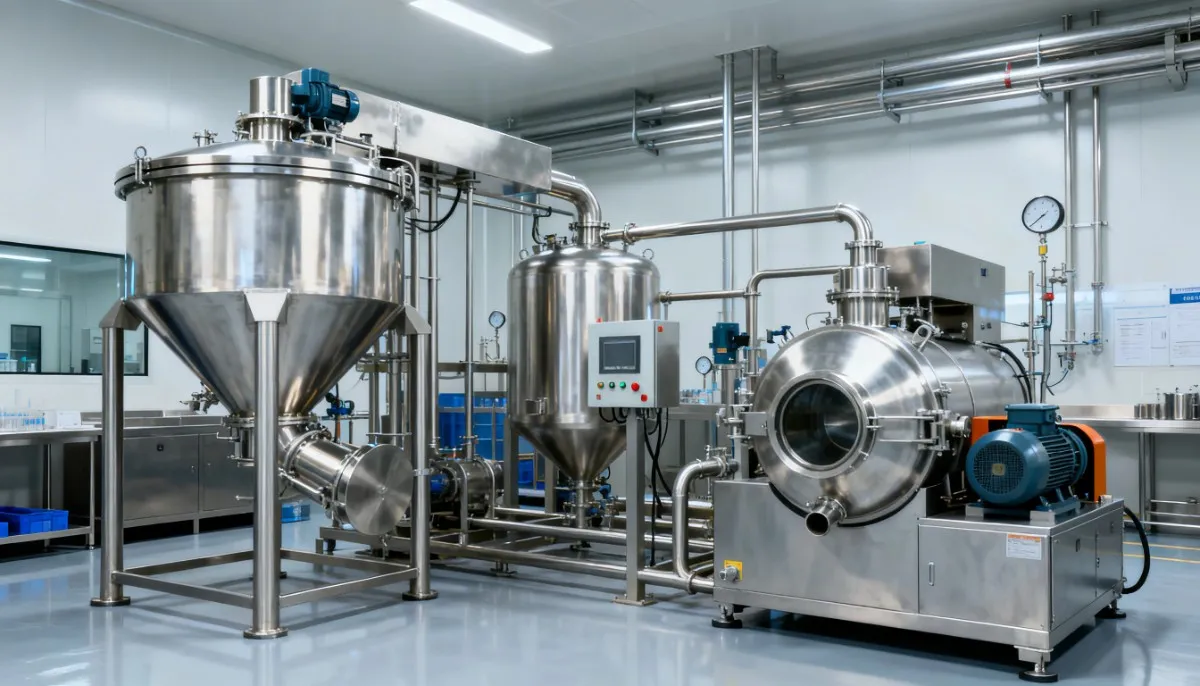
Some industries require purity, efficiency and consistency more than others do. Filtration and drying equipment are extremely important investments in such industries. Pharmaceuticals, chemicals and food processing units are some of the areas. The following blog will enable you to make informed procurement choices with confidence.
Filtration and drying equipment are important parts of most industries that include pharmaceuticals, chemicals, food processing, textiles and water treatment. The systems assist in segregating solids and liquids and dry material to enhance quality, stability and utilisation.
Choose reliable and trustworthy Filtration and Drying Equipment Suppliers in India who know everything about equipment like working structure, maintenance etc.
Fun Fact: “Vacuum Power: Vacuum drying allows materials to dry at much lower temperatures, which is critical for heat-sensitive materials in pharmaceutical production.”
Here are some of the ways to source high-performance filtration and drying equipment:
You should have audited your material properties before viewing a filtration and drying equipment list. The "one-size-fits-all" approach does not exist in industrial processing. You must consider:
The optimal equipment is that which fits into your workflow. The main types that you will encounter are as follows:
Agitated Nutsche Filter Dryers (ANFDs)
Considered standard in high-purity applications, Agitated Nutsche Filter Dryer enable filtration, washing, and drying in one closed vessel. This reduces exposure of operators and eliminates batch contamination. They are necessary in case your process is based on high-value cakes that need extensive washing.
Filter Presses
Filter presses are still the workhorse of the business in high-volume wastewater treatment or mining applications, where the main objective is maximum liquid recovery and maximum cake dryness at a reduced capital cost. They are mechanically straightforward and consume much floor space.
Rotary Vacuum Drum Filters (RVDFs)
Rotary vacuum drum filters are preferred in continuous processing of slurries with high solids concentrations. RVDFs maintain a steady output and are ideal in starch, mineral, and pulp processing, where interruptions that operate in batches would impede performance.
The choice of partner is important, just like the choice of the machine. In vetting filtration and drying equipment manufacturers, consider more than the cost: -
Filtration and drying equipment suppliers in India have turned into a routine activity of European and American companies seeking a compromise between quality engineering and affordability.
The Indian ecosystem has grown to create advanced pressure vessel fabrication and automated control systems engineers, and Indian suppliers represent a worthy alternative to tailor-crafted solutions.
‘Bionics Consortium is a company that deals with the provision of high-quality environmental test chambers and laboratory equipment.' As a company that highly values innovation and accuracy, Bionics develops and produces sophisticated testing systems serving numerous industries, including pharmaceuticals, electronics, automobiles, and research laboratories. We have been providing this service to industries for more than 25+ years with ISO certification. The company has a diverse product line that includes salt spray chambers, environmental chambers, laboratory chambers, humidity chambers, and laboratory indicators, among other related products. All the products are designed to provide accurate, reliable, and consistent performance to ensure that clients obtain optimal testing performance. The customer-oriented strategy and emphasis on quality have made Bionics remain a reliable partner to the companies that want reliable and efficient laboratory solutions.’
The following table talks about the technical specification of filtration and drying equipment.
| Parameter | Filtration Equipment Specification | Drying Equipment Specification |
|---|---|---|
| Working Principle | Separation using porous media or centrifugal force | Heat transfer and evaporation for moisture removal |
| Equipment Type | Pressure filter, vacuum filter, membrane filter, centrifuge | Tray dryer, rotary dryer, spray dryer, fluidized bed dryer |
| Construction Material | Stainless steel, mild steel, polypropylene, rubber lined | Stainless steel, alloy steel, insulated chambers |
| Surface Finish | Smooth, corrosion-resistant, polished interior | Mirror finish or matte finish with thermal insulation |
| Filtration or Drying Media | Filter cloth, cartridge, membrane, sand bed | Hot air, vacuum, steam, infrared radiation |
| Operating Mode | Batch or continuous | Batch or continuous |
| Temperature Condition | Ambient to moderately elevated temperature | Low to highly elevated temperature |
| Pressure Condition | Atmospheric pressure, vacuum, or pressurized system | Atmospheric or vacuum conditions |
| Flow Handling Capacity | Suitable for low to high flow rate liquids | Suitable for small to bulk solid or liquid drying |
| Particle Handling | Fine to coarse particle separation | Uniform drying of powders, granules, and pastes |
| Moisture Handling | Removes suspended solids from liquids | Reduces moisture content to desired dryness |
| Energy Source | Electric motor, pneumatic system | Electric heaters, steam, thermal oil |
| Automation Level | Manual, semi-automatic, fully automatic | Semi-automatic to fully automatic |
| Control System | PLC based or manual control panel | PLC based system with temperature and airflow control |
| Safety Features | Pressure relief valves, leak-proof design | Overheat protection, airflow monitoring, safety interlocks |
| Cleaning System | Manual cleaning or clean-in-place system | Easy cleaning design with removable trays or chambers |
| Installation Type | Skid-mounted or floor-mounted | Floor-mounted with insulated structure |
| Maintenance Requirement | Low to moderate maintenance | Moderate maintenance |
| Output Form | Clarified liquid and separated solid residue | Dry powder, flakes, granules |
| Noise Level | Low to moderate | Moderate |
| Environmental Impact | Minimal waste generation with proper disposal | Controlled emissions with exhaust or filtration system |
| Application Industries | Water treatment, pharmaceutical, chemical, food processing | Pharmaceutical, chemical, food, agriculture, minerals |
The choice of the equipment is based on your process requirements and industry requirements.
Filtration Options:
Drying Options:
Did you know? “Modern mining operations use filter presses the size of a building. Some have over 200 filter plates and can handle hundreds of tonnes of slurry per day – dewatering minerals like iron ore, copper, and lithium before transport or smelting.”
It is possible to save time, money, and effort by avoiding typical errors.
An effective procurement strategy will reduce risk and will lead to successful implementation.
Here is another blog you might be interested in.
Seed Germinator Buying Guide: What to Look for Before You Buy
Here are some of the applications of filtration equipment:
Here are some of the applications of drying equipment:
The following are advantages of filtration equipment:
Eliminates undesired particles, contaminants and impurities, leading to a purer and better output.
Accelerates separation processes and provides a smooth flow of production systems.
Used in a wide variety of industries, including pharmaceuticals, food processing, chemicals and water treatment.
Minimizes the risks of microbial or particulate contamination, especially in industries that are sensitive.
Assists in waste minimization and reprocessing expense through enhancing the first-pass yield.
Numerous systems have replaceable filters and cleaners with easy mechanisms.
Adaptable to both large- and small-scale industrial applications.
Helps to reduce waste and facilitate recycling of liquids in numerous processes.
The following are advantages of drying equipment:
Lessens moisture level, inhibits microbial growth and spoilage of products.
Guarantees uniformity of physical and chemical characteristics of materials.
Transforms wet materials into dry and easy handling materials such as powders or granules.
Increases the rate of drying, shortening of time spent in production.
The new systems can be used efficiently with regards to the consumption of heat.
Even removal of moisture is guaranteed on all materials due to advanced technologies.
Applicable to drying liquids, slurries, powders and solids.
Dry materials are less heavy and easy to move as opposed to wet products.
The following table talks about the filtration and drying equipment.
| Category | Parameter | Filtration Equipment | Drying Equipment | Procurement Insight |
|---|---|---|---|---|
| Equipment Selection | Suitable Type | Pressure, vacuum, membrane, centrifugal | Tray, spray, rotary, fluid bed, vacuum | Choose based on material and process |
| Application Area | Industry Use | Pharma, water treatment, chemical, food | Pharma, food, agriculture, chemical | Match equipment with industry requirement |
| Performance | Efficiency Level | High separation efficiency | Uniform and fast drying | Higher efficiency improves output quality |
| Cost Factor | Initial Investment | Moderate | Moderate to high | Balance cost with long-term benefits |
| Cost Factor | Operating Cost | Low to moderate | Moderate | Energy-efficient models reduce expenses |
| Maintenance | Service Requirement | Filter replacement, cleaning | Heater, airflow system maintenance | Regular maintenance ensures longevity |
| Lifecycle | Equipment Lifespan | Long with proper care | Long with proper maintenance | Consider total lifecycle cost |
| Energy Efficiency | Power Consumption | Low to moderate | Moderate to high | Check for energy-saving features |
| Automation | Control System | Manual to PLC-based | Semi to fully automatic | Automation improves precision |
| Supplier Evaluation | Vendor Capability | Custom design, support services | Installation, training, spare parts | Choose experienced and reliable suppliers |
| Compliance | Industry Standards | Hygiene and filtration standards | Safety and thermal standards | Ensure regulatory compliance |
| Safety | Risk Factors | Pressure, leakage | High temperature, overheating | Check built-in safety features |
| Safety | Safety Measures | Pressure valves, sealed systems | Sensors, auto shutdown systems | Essential for safe operations |
| Scalability | Expansion Capability | Easily scalable systems | Upgradeable drying capacity | Plan for future growth |
| Material Handling | Input Type | Liquids, slurries | Wet solids, liquids | Match with process material |
| Output Quality | Final Product | Clear liquid, separated solids | Dry powder, granules | Impacts product usability |
| Decision Making | Selection Criteria | Based on filtration accuracy | Based on drying uniformity | Compare multiple options before finalizing |
Here are some of the reasons:
Purchasing of filtration and drying equipment is not just a mere purchasing move. It involves a thorough knowledge of process requirements, technical requirements, and supplier competencies. With the concentration on quality, efficiency and long-term value, businesses can guarantee seamless operations, better quality of products, and long-term growth. For that, Bionics Consortium is the best platform.
If you are thinking of investing in filtration and drying equipment, then Bionics Consortium is the right choice. The brand also deals in cleanroom equipment, laboratory ovens, glove boxes, leaf area meters, and much more. For further information,
ANFDs have better containment and are capable of doing several processes in a single unit (filtering, washing, and drying) whereas Centrifuges are mainly used to separate and typically a separate dryer is needed.
Although RVDFs are very good with continuous high-volume work, they are more difficult to seal with high-potency API (Active Pharmaceutical Ingredient) work than a closed-system ANFD.
There is typically a high cost-effectiveness of Filter Presses when the objective of the process is to recover as much liquid as possible, and the solids to be recovered are of low value.
Here are some of the ways:
Centrifuges have extremely high rotational speeds, and therefore bearings and vibration sensors should be checked after every quarter to avoid disastrous outcomes.
Bionics Consortium provides the best quality filtration and drying equipment in India.

Connect with us for your business enquiries. Generally, we respond within a day.