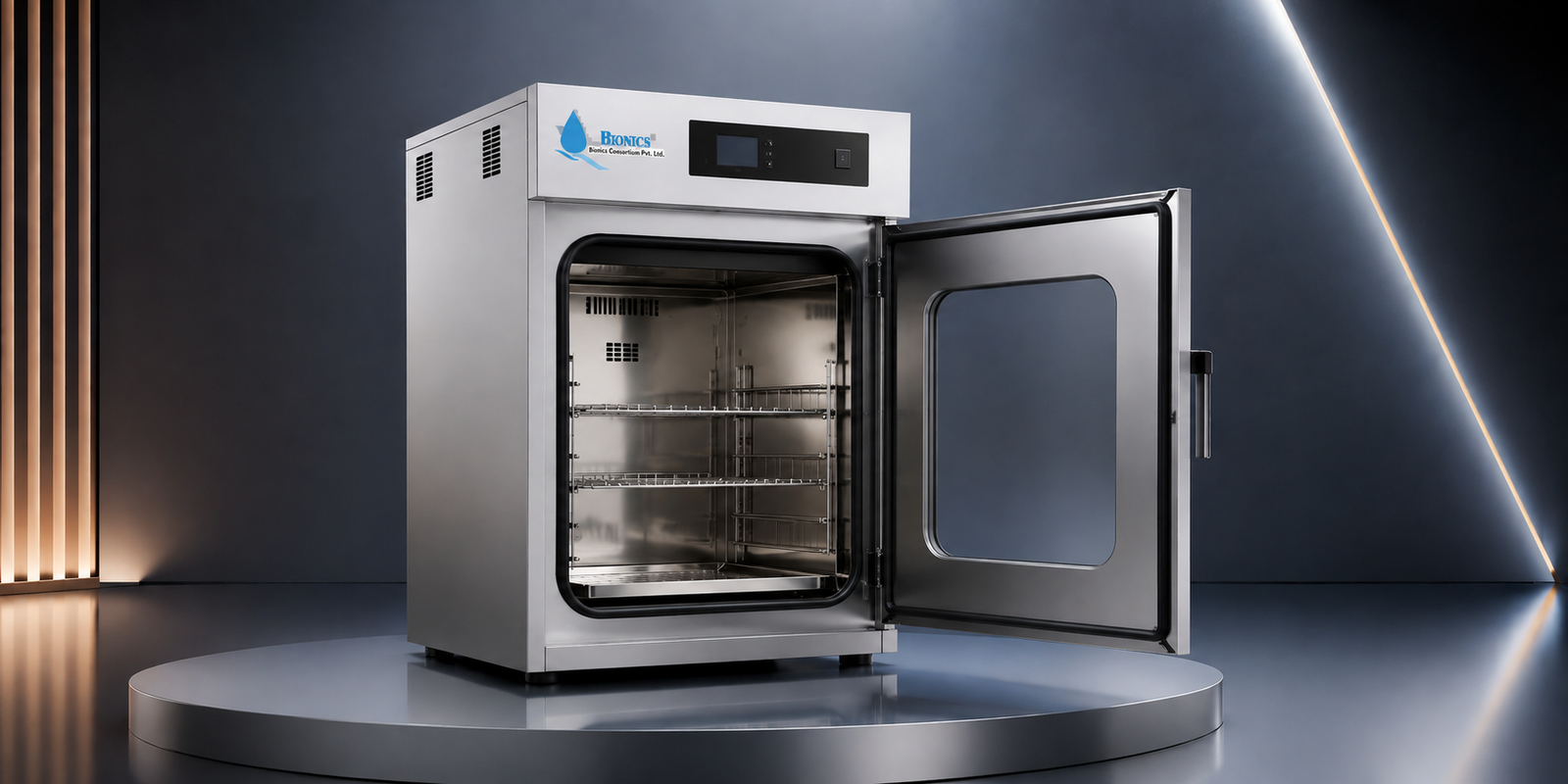
Quick Answer: A hot air oven is a dry heating sterilization and dehydration device which makes use of electrically heated air passed in an insulated chamber in order to kill micro-organisms and dehydrate glassware, metallic instruments and heat stable powders. The standard sterilization temperature is 160°C for 2 hours, 170°C for 1 hour or 180°C for 30 minutes according to the load and applicable pharmacopeia specification. Bionicsro offers hot air ovens for laboratory, pharmaceutical, hospital and industrial applications, catering to the customers from India, Middle East (Saudi Arabia, Oman etc.) and USA.
A hot air oven is a dry-heat sterilization device, distinct from an autoclave, which relies on moist heat under pressure. Instead of steam, a hot air oven uses a heating element to warm air inside a double-walled, insulated chamber, then circulates that air — usually with a motorized fan in forced-convection models — until every point in the load reaches and holds the set temperature for a defined exposure time. Because dry heat penetrates more slowly than steam, hot air oven cycles run at higher temperatures and for longer durations than autoclave cycles achieving an equivalent sterility assurance level.
This makes the hot air oven the standard choice for sterilizing items that steam would damage or that require a completely dry, pyrogen-free finish: glass pipettes, glass syringes, surgical instruments, oils, powders, and glassware used in sterility testing.
A typical hot air oven diagram identifies the following functional parts:
The exact configuration — shelf count, chamber capacity, and controller type — varies by manufacturer and should always be confirmed against the specific model's datasheet rather than assumed from a generic diagram.
The hot air oven working principle is straightforward in concept but precise in execution. Electrical current passes through the heating element, converting electrical energy into heat. In a forced-convection unit, a fan continuously moves this heated air across the chamber and load, equalizing temperature at every shelf level; in a gravity-convection unit, warm air rises naturally while cooler air is drawn toward the heating source, creating a slower, less uniform circulation pattern. A calibrated sensor feeds temperature data back to the controller, which cycles the heating element on and off to hold the set-point within the manufacturer-specified tolerance. Sterilization occurs through protein and enzyme denaturation in microorganisms, a process that — with dry heat — requires sustained exposure at the target temperature rather than a brief spike.
Manufacturer-specified temperature ranges vary by model and application. As a general reference band across laboratory and industrial hot air ovens, chamber temperatures typically span from just above ambient up to 250°C–300°C for standard units, with specialized high-temperature models rated higher. The relevant figure for any purchase decision is the specific model's rated range and its uniformity tolerance (the permitted variation between the hottest and coolest points in the chamber at a given set-point), which should be confirmed on the datasheet rather than assumed from a general range.
Pharmacopeial and standard laboratory references specify dry-heat sterilization as a temperature–time pair, since a lower temperature requires a longer hold to achieve equivalent microbial and pyrogen destruction:
|
Temperature |
Minimum Holding Time |
|
160°C |
120 minutes (2 hours) |
|
170°C |
60 minutes (1 hour) |
|
180°C |
30 minutes |
These figures assume the load has already reached the set temperature throughout — the come-up time to reach set-point is additional and depends on load density, shelf loading pattern, and chamber capacity. For depyrogenation (removal of bacterial endotoxins, not just live organisms) in glassware intended for parenteral use, higher temperatures and/or longer cycles are typically required and should be validated against the applicable pharmacopeia (USP, BP, or IP) for the specific application.
Hot air ovens are used across several sectors:
Demand for validated dry-heat sterilization equipment spans well beyond India — pharmaceutical and hospital procurement teams across the Middle East, including Saudi Arabia and Oman, as well as buyers in the United States, regularly specify hot air ovens meeting ISO and GMP manufacturing standards for regulated facility use.
|
Parameter |
Typical Specification Range |
|
Chamber material |
SS 304 / SS 316 |
|
Outer body |
Mild steel, powder-coated / SS |
|
Temperature range |
Ambient +5°C to 250°C–300°C (model-dependent) |
|
Temperature uniformity |
±1°C to ±3°C (model-dependent) |
|
Circulation type |
Gravity convection or forced convection (fan-assisted) |
|
Controller |
Digital PID / microprocessor-based |
|
Safety |
Independent over-temperature cut-off |
|
Capacity |
Bench-top to floor-standing, multiple litre/shelf configurations |
|
Power supply |
Single-phase, model-dependent load rating |
Exact figures differ by model; request the datasheet for the specific hot air oven under consideration before finalizing a purchase.
Hot air oven price depends on chamber capacity, circulation type (gravity vs. forced convection), controller sophistication (basic digital vs. programmable with data logging), chamber material grade, and compliance documentation (ISO/CE/GMP certification) provided with the unit. Rather than quoting a single figure that would not reflect these variables accurately, Bionicsro provides a model-specific quotation based on the buyer's chamber size, application, and validation requirements.
Bionicsro has been manufacturing laboratory and scientific equipment for 26 years, with a documented history of dispatching autoclaves, ovens, and related sterilization equipment across India and to international markets including the Middle East and Saudi Arabia. Manufacturing and quality documentation is available on request for buyers evaluating equipment for regulated environments.
Contact Bionicsro technical team for a model-specific specification sheet, compliance documentation, and a quotation matched to your chamber size and sterilization validation requirements.
A hot air oven uses dry heat and requires higher temperatures and longer exposure times; an autoclave uses moist heat (pressurized steam) and sterilizes faster at lower temperatures. Items that would corrode, dull, or degrade under moisture (metal instruments, oils, powders) are suited to a hot air oven.
Standard combinations are 160°C for 2 hours, 170°C for 1 hour, or 180°C for 30 minutes, per pharmacopeial reference. The applicable combination depends on the load and validation protocol in use.
No. It is not possible to sterilize liquids in a hot air oven since dry heat cannot be used for that purpose.
Gravity convection ovens use natural air movement while forced convection ovens have a fan.
Come-up time depends on chamber size, load density, and how the load is arranged on the shelves; it is additional to the minimum holding time and should be verified during validation, not assumed.
Glassware, metal instruments, oils, powders, and other heat-stable, moisture-sensitive items.
Depyrogenation is the destruction of bacterial endotoxins, not just live microorganisms. Hot air ovens can perform depyrogenation, but typically at higher temperatures and/or longer cycle times than standard sterilization, per the relevant pharmacopeial validation.
An independent over-temperature cut-off separate from the primary controller is a standard safety requirement, since it protects the load and unit if the main controller malfunctions.
Yes. Bionicsro supplies hot air ovens to laboratory and pharmaceutical buyers across India and internationally, including the Middle East, Saudi Arabia, Oman, and the United States.
Price is determined by chamber capacity, circulation type, controller features, material grade, and included compliance/certification documentation — request a model-specific quotation for an accurate figure.


Connect with us for your business enquiries. Generally, we respond within a day.