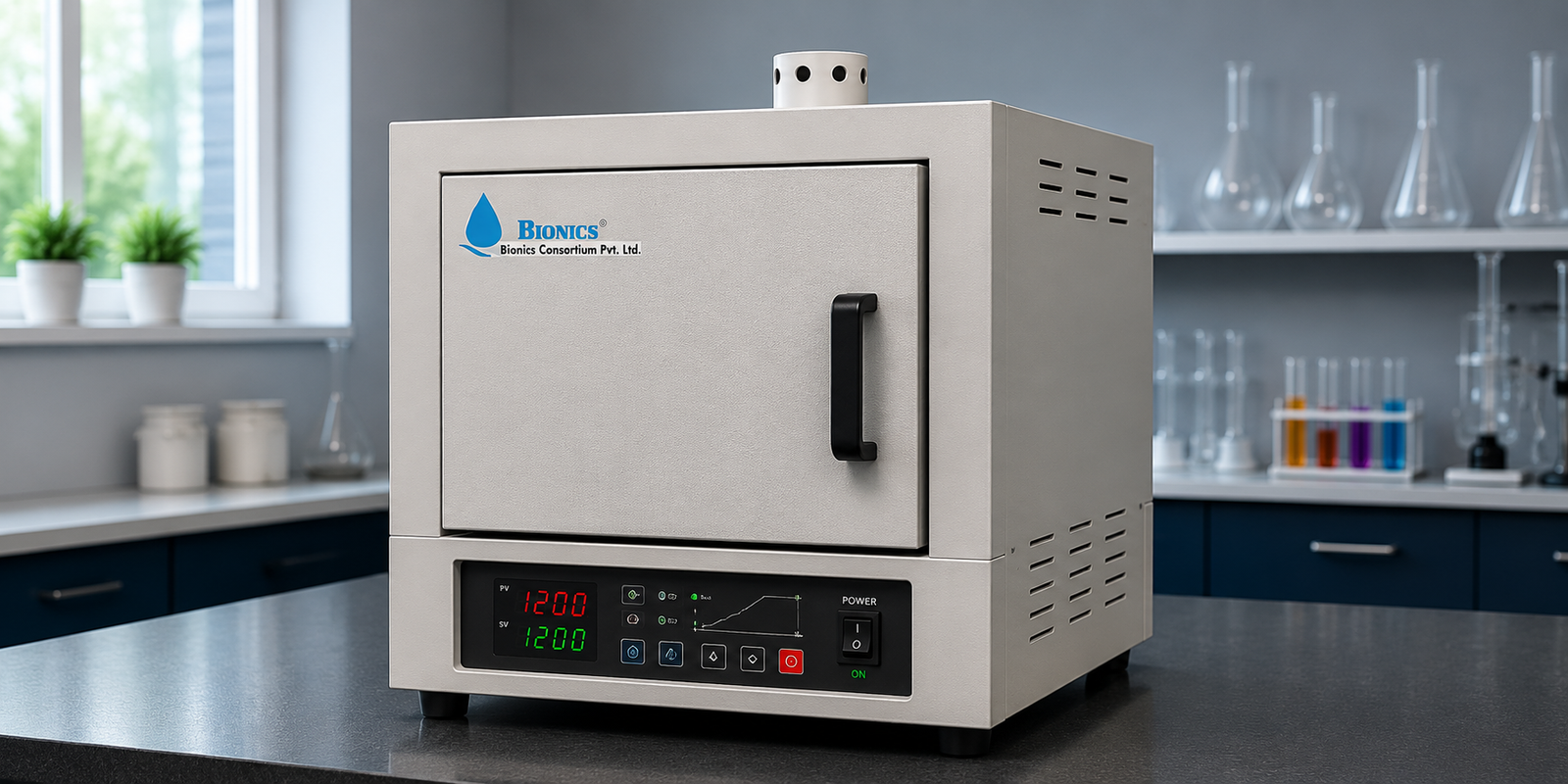
If you've spent any time in a metallurgy lab, a ceramics workshop, or a QC department, you've probably stood in front of one of these at some point. The muffle furnace doesn't get much attention, but it's doing serious work behind the scenes — heat treatment, ashing, sintering, calcination, all of it. This guide walks through how the thing actually works, which specs are worth caring about, what pushes the price up or down, and the questions people tend to ask before they buy one.
Put simply, a muffle furnace is an electrically heated chamber built to keep your sample away from open flame and combustion by-products, so heating stays clean and even — sometimes up to 1600°C. That's why labs reach for it during ash testing, sintering, annealing, and ceramic firing. What you'll pay depends mostly on temperature range, chamber capacity, and the controller fitted to it. And honestly, it pays to buy from an established manufacturer like Bionicsro rather than whoever's reselling the cheapest unit online.
At its core, a muffle furnace is built around one idea: whatever you're heating should never touch the heating elements or the by-products of combustion. The word "muffle" actually refers to that insulated inner chamber — the part that shields your sample so it heats evenly, with no soot and no flame contamination getting in the way. That's precisely why it ends up being the standard tool for ash content work, loss-on-ignition testing, metal heat treatment, and firing ceramics.
Compare that to an open-flame furnace and the difference is obvious. A muffle furnace runs on electrical resistance elements built right into the chamber walls, so there's no combustion happening inside at all. The upshot: cleaner results, and a process you can actually repeat run after run without wondering if today's batch will come out different from yesterday's.
Heat reaches the chamber indirectly, not through a flame touching the sample. Electrical current runs through resistance elements — usually Kanthal wire, though silicon carbide rods show up in higher-temperature units — embedded in or lining the chamber walls. Those elements radiate heat inward, warming the enclosed space rather than exposing anything inside to open combustion.
From there, a digital PID controller takes over. It reads chamber temperature off a thermocouple and manages the ramp, the hold (often called the "soak"), and the cooldown according to whatever cycle you've programmed. Because the sample sits inside a sealed, insulated space, temperature stays uniform throughout the chamber — which is really the whole point. Run it again next week and you should get the same result. A small vent near the top lets fumes and gases escape during heating without throwing off that uniformity.
Looking at a construction diagram tends to make judging build quality a lot easier before you commit to buying. Roughly, here's what's inside:
Once you know this layout, comparing models that look nearly identical on paper gets a lot less confusing.
There isn't just one kind. Furnaces tend to get grouped a few different ways — by heating element, by how you load them, and by the temperature range they're built for.
By heating element, you're really choosing between Kanthal A1 wire-wound furnaces (good up to roughly 1200°C, fine for routine lab work) and silicon carbide or molybdenum disilicide units that push past 1600°C for sintering and heavier research. By loading style, most labs use front-loading box furnaces, though top-loading models tend to suit taller or bulkier samples better. And by application, you've got standard laboratory furnaces built for everyday ashing and LOI testing versus industrial-grade high-temperature furnaces meant for sintering and advanced ceramics work.
Which type makes sense for you really comes down to two things: the ceiling temperature your work demands, and how you're loading and unloading samples day to day.
Specs are what actually decide performance, how long the unit lasts, and whether it fits your work at all.
|
Parameter |
Typical Range/Value |
|
Maximum Temperature |
900°C to 1600°C (model dependent) |
|
Chamber Size |
5 x 5 x 10 inches to 12 x 12 x 24 inches |
|
Heating Elements |
Kanthal A1 (up to 1200°C), Silicon Carbide (up to 1600°C) |
|
Insulation |
Ceramic fiber / refractory brick |
|
Temperature Controller |
Microprocessor-based PID with digital display |
|
Accuracy |
±1°C to ±5°C |
|
Power Supply |
220V single phase or 415V three phase |
|
Heating Rate |
Programmable, typically 1–15°C/min |
|
Body Material |
Mild steel with powder coating / stainless steel |
|
Safety Features |
Over-temperature cut-off, door interlock, earth leakage protection |
Weigh these against what you'll actually be doing with the furnace before you settle on anything. Go too big and you're wasting energy on every run; too small and you'll hit capacity limits faster than expected.
The list of industries using these is longer than most people assume:
It's usually one of the very first instruments an analytical or QC lab buys, mostly because the results it gives are so consistent nobody has a reason to second-guess it.
A handful of questions usually narrow things down fast:
There's no fixed number here — price shifts depending on a handful of variables:
Going with the cheapest option isn't always the smart move. Factor in energy consumption, how often you'll be replacing elements, and whether anyone actually picks up the phone when something breaks.
|
Feature |
Standard Lab Muffle Furnace |
High-Temperature Industrial Furnace |
|
Max Temperature |
Up to 1200°C |
Up to 1600°C+ |
|
Ideal For |
Routine lab testing, ashing, LOI |
Sintering, advanced material research |
|
Heating Element |
Kanthal A1 |
Silicon Carbide / Molybdenum Disilicide |
|
Price Range |
Moderate |
Higher |
|
Chamber Size |
Small to medium |
Medium to large |
|
Best Suited Users |
Colleges, QC labs, small industries |
Research institutes, metallurgy, ceramics manufacturing |
Laid out side by side like this, it's easier to buy for what you actually do rather than overspending on capability you'll never touch, or ending up underequipped for the work in front of you.
A handful of habits keep a muffle furnace both safe and accurate over its working life:
Choosing an established muffle furnace manufacturer over a random reseller isn't just about brand loyalty. Temperature accuracy, insulation quality, and electrical safety all trace back to who actually built the thing. At Bionicsro, every unit passes through precision-calibrated controllers, high-grade insulation, and proper quality checks before it ever leaves the factory. And because production stays in-house, consistency holds up from batch to batch — something that's a lot harder to promise when a supplier is just relabeling someone else's furnace.
There's a longer-term side to this too: genuine spare parts, real technical support, and calibration help whenever you actually need it, not just at the point of sale.
A muffle furnace isn't something you replace every year, so it's worth getting the decision right the first time around. Whether you're after a small lab-type unit or an industrial furnace built for high-temperature work, Bionicsro can put together a custom-designed muffle furnace with full support behind it.
Standard models typically top out somewhere between 900°C and 1200°C. High-temperature versions with silicon carbide elements can push as high as 1600°C.
An oven runs at low temperatures for drying. A muffle furnace runs much hotter and keeps the sample isolated from combustion entirely, which is exactly what ashing, sintering, and heat treatment call for.
It depends on chamber size, max temperature, and controller type — better to get a quotation based on your exact requirement than rely on a general price range.
It depends on chamber size, max temperature, and controller type better to get a quotation based on your exact requirement than rely on a general price range.
Yes in fact, ash content and loss-on-ignition testing are among the top reasons labs buy one in the first place.
That's programmable, generally somewhere between 1°C and 15°C per minute depending on the controller and model.
At minimum, look for an over-temperature cut-off, a door safety interlock, and earth leakage protection.
Yes. Periodic calibration is what keeps the readings accurate, and it matters for both lab accreditation and getting consistent results.
Most established manufacturers, Bionicsro included, cover heating elements and controllers under a standard warranty — worth confirming the exact terms before you order.
Base it on your typical sample volume and batch size. Go too big and you're wasting energy; too small and you'll hit capacity limits fast.


Connect with us for your business enquiries. Generally, we respond within a day.