Quick Answer: There is no fixed muffle furnace price in India. The cost depends on the maximum temperature, chamber size, heating element, controller type and any customisation you need. A small low-temperature unit costs far less than a high-temperature programmable model, so the only reliable figure is a written quote for your exact specification.
Ask three suppliers for a quote and you will often get three very different numbers. Two furnaces that look the same in a catalogue can differ in heating elements, insulation, controller and build quality, and that is where most of the price gap comes from. Bionics Consortium has spent 26 years in laboratory equipment, and the most common buying mistake we see is choosing on price alone. The buyer ends up with a furnace that cannot hold the process temperature, or one that is far more than the lab needs. This guide explains what drives the price, how to read a specification sheet, and what to ask before you place an order.
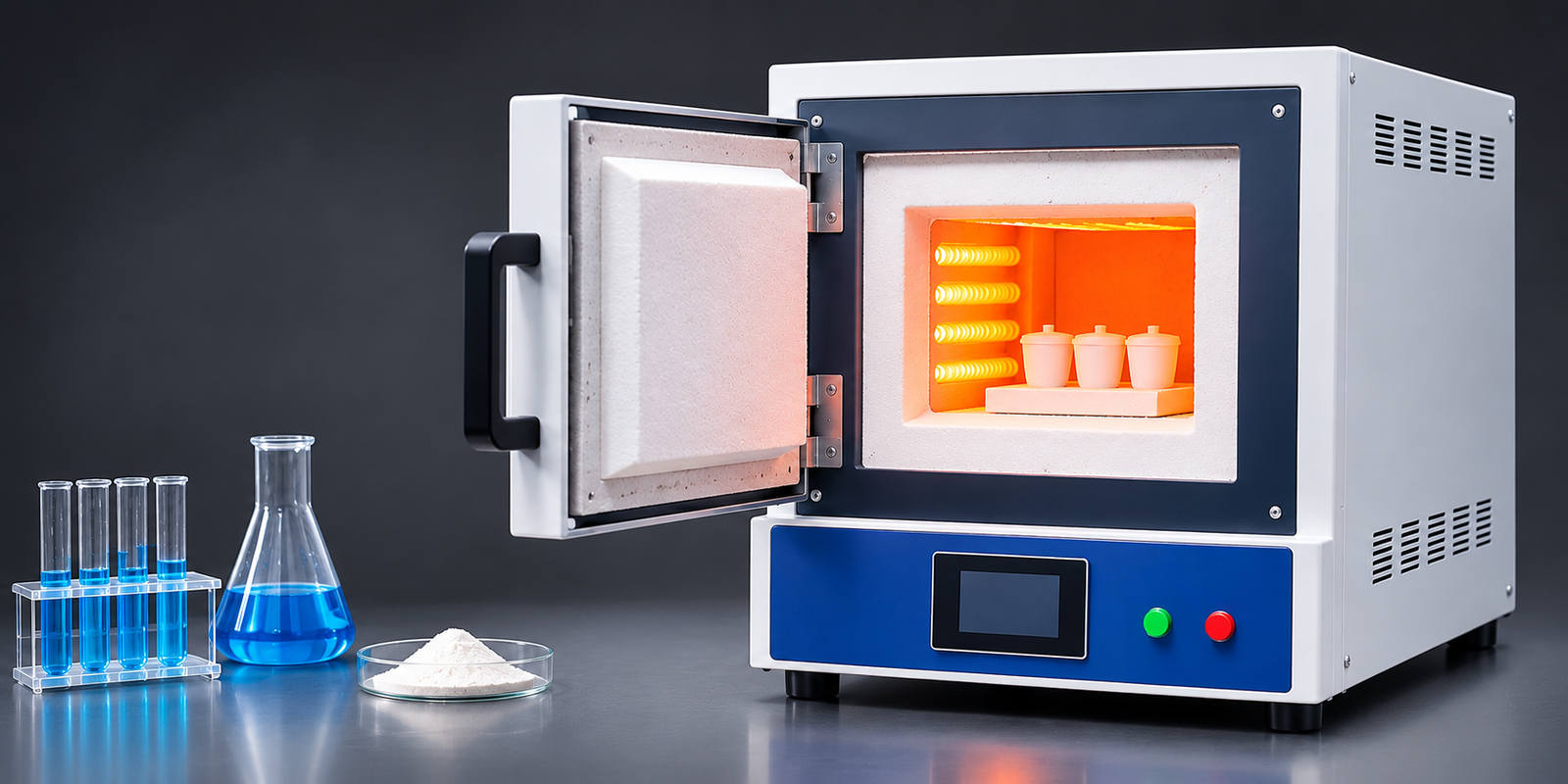
A muffle furnace is an electrically heated, high-temperature chamber that heats samples without exposing them to flame or combustion gases. The "muffle" is the insulated inner chamber that keeps the sample separate from the heating elements.
Laboratories use it for ashing, loss-on-ignition testing, calcination, sintering, heat treatment of small metal parts, and ceramic or glass firing. The appeal is simple: clean, uniform and controllable heat. If you want a broader view of the technology, the muffle furnace overview on Wikipedia is a useful neutral reference.
Cost is the sum of several technical decisions rather than one number. The main drivers are:
Whatever figure you are given, confirm in writing whether it includes taxes, freight, installation and warranty terms.
This is the biggest factor. Higher temperatures need different heating elements, better insulation and sturdier construction, so the cost rises steeply as you move from a 1100°C furnace to a 1600°C or 1800°C one.
The element largely decides how hot the furnace can run and how long it lasts.
|
Heating element |
Typical working range |
Common use |
|
Nichrome / FeCrAl (Kanthal-type) wire |
Up to roughly 1100–1200°C |
Ashing, general lab heat treatment |
|
Silicon carbide (SiC) |
Up to roughly 1400–1500°C |
Higher-temperature sintering and ceramics |
|
Molybdenum disilicide (MoSi₂) |
Up to roughly 1700–1800°C |
Advanced ceramics, materials research |
These are general industry ranges. Exact limits vary by model, so check both the rated maximum and the recommended continuous working temperature, which are not the same thing.
A larger chamber needs more insulation and more element capacity, draws more power and takes longer to heat. Size it for the sample load you actually run, with a sensible margin. Oversizing raises both the purchase price and the electricity bill.
Controllers range from simple single-setpoint units to programmable PID controllers that store multi-step ramp and soak profiles. If your method needs a controlled heating rate, such as a slow ramp for binder burnout, a programmable controller is worth paying for. For routine ashing at a fixed temperature, a simpler one is often enough.
Ceramic fibre insulation heats and cools quickly and is light. Heavier refractory brick suits some applications and can last longer under heavy use. A double-shell body keeps the outer surface cooler, which matters for operator safety. Workmanship is hard to judge from a photograph, so ask for details.
Non-standard chamber dimensions, special doors, gas ports, data logging or tighter temperature uniformity all add cost because the unit is built to order.
When comparing quotes, line the specifications up side by side.
|
Specification |
What to check |
|
Maximum temperature |
Rated maximum and recommended continuous working temperature |
|
Chamber dimensions |
Internal size and volume, not just external size |
|
Heating element |
Type, and whether it is easy to replace |
|
Temperature controller |
PID or programmable, number of segments |
|
Thermocouple |
Type (for example K-type or S-type) matched to your range |
|
Accuracy and uniformity |
Stated tolerance and how it was measured |
|
Insulation |
Material and thickness |
|
Power supply |
Single-phase or three-phase, and rated power |
|
Safety features |
Over-temperature protection, door safety, body insulation |
Temperature uniformity is the line buyers overlook most. A furnace can read 1000°C at the sensor while the corners of the chamber sit noticeably lower, which matters for analytical work.
Start from your process, not from the catalogue.
As a practical rule, choose a maximum temperature comfortably above your working temperature rather than exactly at it. Running a furnace at its limit all day shortens the life of the elements and insulation.
Take two labs as an example. A food-testing lab that runs routine ash content tests at around 550–600°C does not need an extreme-temperature furnace. A well-built unit with a rated maximum well above that, a dependable controller and good ventilation is the sensible choice. A materials lab sintering ceramics at 1500°C is a different case. It needs a silicon carbide or MoSi₂ furnace and a programmable controller to manage ramp and soak steps. The two labs ask for the same type of equipment, but the right specification, and therefore the price, is quite different.
Buyers often confuse the two, so here is a quick comparison.
|
Feature |
Muffle furnace |
Tube furnace |
|
Shape |
Box-like chamber with a front door |
Cylindrical tube |
|
Best for |
Larger or multiple samples, ashing, general heat treatment |
Controlled atmosphere, gas flow, small samples |
|
Sample access |
Easy, open front |
Loaded through the tube ends |
|
Atmosphere control |
Limited unless specially built |
Well suited |
If you need a controlled gas atmosphere, a tube furnace is usually the better tool. If you want to heat several crucibles at once in air, a muffle furnace fits better. You can see the range we build on our muffle furnace , and the wider laboratory furnace range covers tube, atmosphere, vacuum and other types.
Whether you buy from a manufacturer or a supplier, these questions separate a solid quote from a vague one:
A manufacturer can usually customise dimensions and controls and handle service directly. A supplier may offer faster delivery on standard models. Either way, confirm that spares and service support are available in India before you commit.
If you plan to buy a muffle furnace in India, treat it as laboratory equipment you will rely on for years rather than a one-time purchase. A furnace machine that is easy to service, with spares and support within reach, usually saves more over its life than a small discount at the time of ordering. Bionics Consortium is an ISO 9001:2008 certified manufacturer, and its laboratory furnace range includes muffle, tube, atmosphere, vacuum and box furnaces, with custom designs available on request.
Choosing only on price. The cheapest quote often leaves out a programmable controller, good insulation or warranty cover.
Ignoring power requirements. Higher-rated furnaces may need three-phase supply or a dedicated circuit, so check your lab's electrical setup first.
Buying more temperature than you need. Paying for 1800°C capability when your process stops at 900°C wastes budget.
Skipping installation and safety planning. A muffle furnace needs ventilation, heat-resistant placement and clear operating procedures.
Overlooking maintenance. Elements and thermocouples are consumables, so plan for them.
Muffle furnace price is the outcome of several technical choices, not a fixed number. Define your working temperature, sample size and method requirements first, then compare quotes on specifications, service and spare-part availability rather than the headline figure. A furnace matched to your process will generally cost less to run, last longer and give more dependable results.
With 26 years of experience in laboratory equipment, Bionics Consortium can help you shortlist and buy the right muffle furnace machine for your application. Share your required temperature, chamber size and process details and we will prepare a specification-based quote. Our website notes a reply within 48 hours. You can also use our contact form to send your requirement directly.
It depends on maximum temperature, chamber size, heating element, controller and customisation. Compact low-temperature models cost far less than high-temperature programmable ones, so request a quote for your exact specification.
Differences in heating elements, insulation, controller quality, build standards, warranty and service explain most of the gap. Compare specifications, not just totals.
Common models range from roughly 1000°C to 1800°C, depending on the heating element. Choose a rated maximum above your working temperature.
A manufacturer builds the furnace and can usually customise and service it directly. A supplier resells and may offer quicker delivery on standard models.
Match the chamber to your typical sample or crucible load and leave a small margin. Oversizing increases cost and power consumption.
Common uses include ashing, loss-on-ignition testing, calcination, sintering and heat treatment of small samples.
It depends on temperature. FeCrAl wire suits lower ranges, silicon carbide suits mid-to-high ranges, and molybdenum disilicide suits the highest ranges.
Only if your method needs controlled ramp rates or multi-step heating. For fixed-temperature ashing, a simpler controller may be enough.
Lifespan depends on operating temperature, usage frequency and maintenance. Heating elements and thermocouples usually wear out first and can be replaced.
Yes. Many manufacturers can change chamber size, controls and features to suit a specific process, usually at additional cost and lead time.


Connect with us for your business enquiries. Generally, we respond within a day.