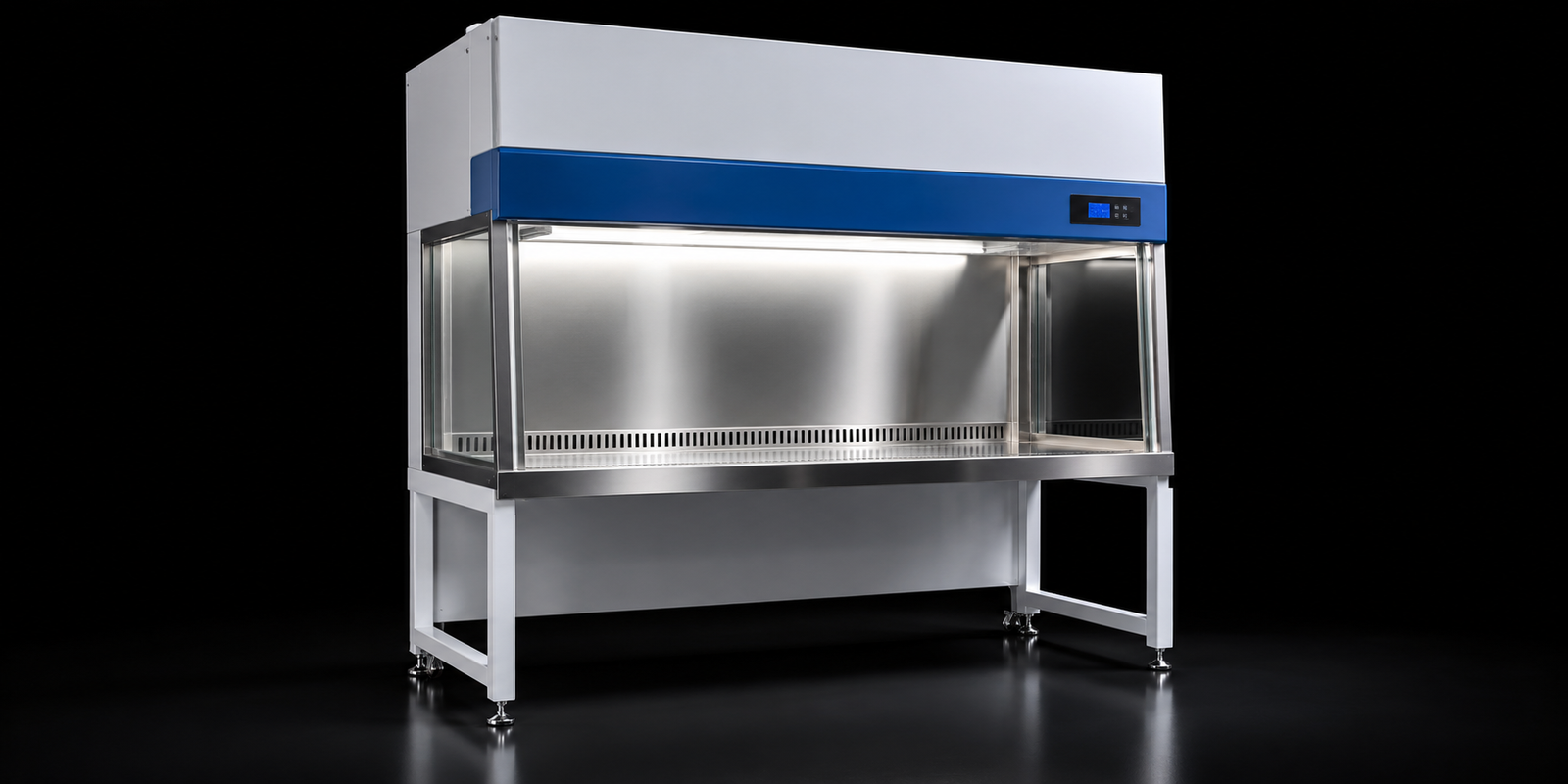
Quick answer: A Laminar Air Flow Cabinet is an enclosed workstation that pushes HEPA-filtered air across the work surface in one steady direction, holding the work zone at ISO 5 (Class 100) cleanliness. It protects the sample, not the operator. Bionics Consortium manufactures vertical and horizontal cabinets and quotes for buyers in India, the Middle East, Indonesia, the Philippines, Australia and New Zealand.
Contamination drifts in on a draft, rides a sleeve, or settles from the ceiling while a plate sits open for ninety seconds. A Laminar Air Flow Cabinet closes that window.
This guide comes from Bionics Consortium, a laboratory and cleanroom equipment manufacturer with 26 years of experience, for buyers who want numbers and test methods instead of brochure adjectives.
A Laminar Air Flow Cabinet (also called a laminar flow hood, clean bench or LAF unit) is a partly enclosed bench with a blower, a pre-filter and a HEPA filter covering the full face of the air outlet. Filtered air leaves as parallel streams at controlled velocity, sweeping particles away from the work zone.
Two points cause most purchasing mistakes. The cabinet cleans the air it supplies, not the room around it. And the air moves toward the operator, so it protects the product only. Work with pathogens, cytotoxic drugs or unknown cultures belongs in a Class II biosafety cabinet, which also filters its exhaust.
The blower pulls room air through a coarse pre-filter, which takes most of the dust and spares the HEPA filter. The air pressurises a plenum, then passes through the HEPA media. Even pressure gives even velocity across the face, and that evenness makes the flow unidirectional.
In a vertical cabinet the filter sits in the ceiling and air moves downward. In a horizontal cabinet the filter sits in the back wall and air travels toward the operator across the bench.
Under EN 1822, an H14 filter removes at least 99.995% of particles at their most penetrating size. The US convention rates HEPA at 99.97% on 0.3 µm particles. The two are not interchangeable, so a quotation should name its standard.
Work from the signed datasheet for your unit.
|
Parameter |
Baseline specification |
|
Cleanliness class |
ISO 5 per ISO 14644-1, at rest |
|
Airflow direction |
Vertical or horizontal |
|
Final filter |
HEPA H14 per EN 1822 |
|
Pre-filter |
Replaceable, G4 class |
|
Mean face velocity |
0.45 m/s, ±20% |
|
Work area width |
610, 915, 1220 or 1830 mm |
|
Body |
Powder-coated mild steel or stainless steel 304 |
|
Blower |
Balanced centrifugal, speed control |
|
Filter monitoring |
Differential pressure gauge |
|
Supply |
230 V, 50 Hz; 110–120 V, 60 Hz for export |
Before you buy a Laminar Air Flow Cabinet, settle these points in order:
Four factors set the figure: width, body material, filter grade and validation paperwork. Ask each seller to write out material, filter standard and blower type before comparing. Bionics Consortium prepares a written quotation for each configuration.
|
Criterion |
Vertical LAF |
Horizontal LAF |
Class II biosafety cabinet |
|
Air direction |
Top to bottom |
Rear to front |
Front inflow, downflow inside |
|
Protects the product |
Yes |
Yes |
Yes |
|
Protects the operator |
No |
No |
Yes |
|
Suited to |
Open vessels, pharma preparation |
Flat work, electronics |
Pathogens, hazardous materials |
Plant tissue culture. Explant transfer and spawn inoculation happen inside these cabinets across India, Indonesia and the Philippines.
Pharmaceutical laboratories. Media preparation and sterility sampling need ISO 5 air. Indian Schedule M and WHO GMP audits expect current test records.
Microbiology, IVF and hospitals. Plate work and reagent preparation need a particle-free zone, including in the Gulf states, Australia and New Zealand.
Regional conditions:
Bionics Consortium is a manufacturer, not a reseller. The person answering your query can speak about the plenum, blower and finish, because the cabinet is built in-house.
Many listings name a filter grade but not its standard. They quote velocity ranges wide enough to include a poorly balanced cabinet. They skip the difference between a laminar cabinet and a biosafety cabinet, the mistake that matters most for safety. They ignore post-installation testing and site conditions outside India.
Tell us your application, preferred width, airflow direction, country and site voltage, and we will send a written quotation stating material, filter standard and blower specification. Contact Bionics Consortium for a quote.
Width, body material, filter grade and documentation. A 4 ft stainless steel unit with H14 filtration costs more than a 2 ft powder-coated one. Ask for a written quote.
Vertical suits open vessels and larger items. Horizontal suits flat work such as plates or electronics. Neither protects the operator.
No. It protects the product, not the operator. Pathogens and cytotoxic drugs need a Class II biosafety cabinet with filtered exhaust.
When the pressure gauge hits the manufacturer's limit, a leak scan fails, or face velocity cannot be restored. Recertify at least annually.
15 minutes with the sash closed and the room empty, then switch it off. UV-C reaches only line-of-sight surfaces.
Mean face velocity of 0.45 m/s, ±20% across the work zone. Certification should measure several grid points, not one spot.
A HEPA leak-test report, airflow readings, an ISO 5 at-rest particle count, the filter grade certificate and electrical details.
Yes. 230 V, 50 Hz suits India, the UAE, Indonesia, Australia, New Zealand and the UK. Saudi Arabia and the Philippines use 60 Hz.
Yes, if the room is draft-free, clean and away from doors and air-conditioning vents. Sterile pharmaceutical work needs a classified background area.
ISO 14644-1 for cleanliness class, ISO 14644-3 for test methods, and EN 1822 for HEPA filter grades.


Connect with us for your business enquiries. Generally, we respond within a day.