Quick Answer
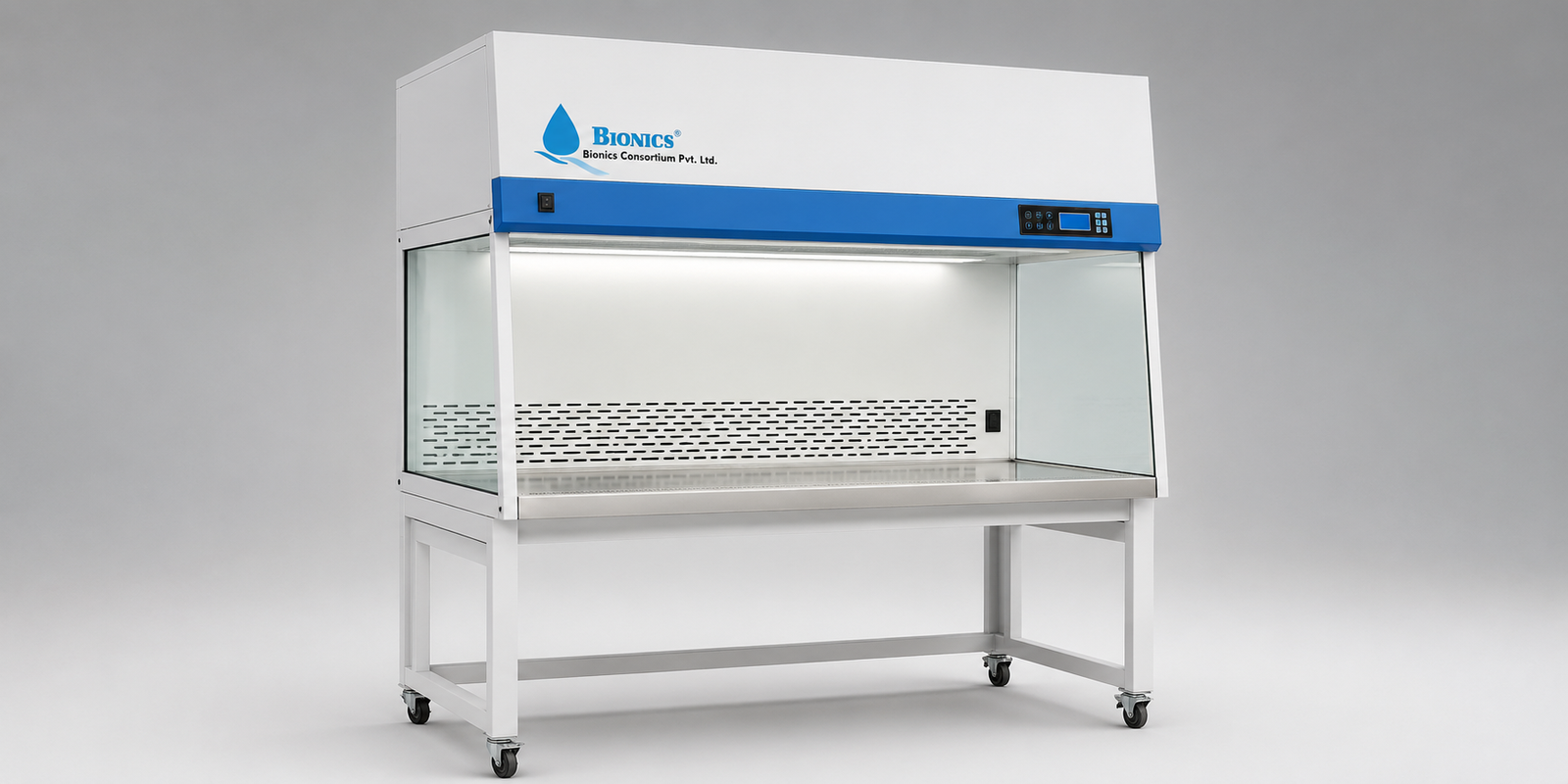
A vertical laminar air flow cabinet is a contamination-control workstation that draws room air through a HEPA filter and pushes it downward, top to bottom, over the work surface in parallel, non-turbulent streamlines. This downward pattern is preferred wherever the work area should be protected from airborne particulates and wherever splashes or vapors should be carried away from the operator's face rather than toward it. It is standard laminar air flow equipment in microbiology labs, pharmaceutical compounding areas, IVF and tissue-culture units, and quality-control labs across pan-India and export markets including the Middle East, Saudi Arabia, the USA, and Oman.
A laminar flow cabinet — also called a laminar hood, laminar flow hood, or laminar air flow chamber — is an enclosed workstation engineered to maintain a Class 100 (ISO Class 5) or better particulate environment at the work zone. Unlike a fume hood, which protects the operator from hazardous fumes, a laminar flow chamber is built primarily for product and sample protection from ambient contamination. The defining feature of any laminar flow cabinet or laminar airflow cabinet is airflow behavior: air does not swirl or mix, it travels in parallel layers at a controlled, uniform velocity — this is what separates true laminar air flow equipment from a simple filtered-air enclosure.
Among the types of laminar air flow, two configurations dominate:
The two configurations are not interchangeable for biosafety purposes, and neither should be confused with a certified biosafety cabinet, which adds operator and environmental protection that a standard laminar flow hood does not provide.
The vertical laminar air flow diagram below is a labelled diagram showing the cabinet's stacked internal parts — from the blower down to the base — so the airflow path is easy to trace at a glance rather than only described in text.
|
Parameter |
Typical Specification Range |
|
Air flow direction |
Vertical (top-to-bottom) |
|
Filtration |
HEPA, 99.97% efficiency @ 0.3 micron (ULPA optional) |
|
Cleanliness class |
ISO Class 5 (Class 100), manufacturer-verified |
|
Face velocity |
Manufacturer-specified for the model/filter |
|
Illumination |
LED or fluorescent, manufacturer-specified lux |
|
UV-C sterilization |
Optional, idle-time decontamination only |
|
Construction |
Powder-coated MS body / SS 304 chamber |
|
Available widths |
2 ft, 3 ft, 4 ft, 6 ft (model-dependent) |
|
Noise level |
Manufacturer-specified, at rated blower speed |
|
Power supply |
220–240V, 50 Hz (export variants available) |
Always confirm figures against the specific datasheet — no single number applies universally across every vertical laminar air flow cabinet or laminar air flow machine.
|
Ambient Ref. Temp. |
Typical Blower Behavior |
Notes |
|
20–25°C |
Stable rated face velocity |
Standard lab HVAC range |
|
26–30°C |
Within tolerance; monitor filter loading |
Common in non-HVAC Middle East/Gulf sites |
|
31–35°C |
May need adjusted blower duty |
Relevant for Saudi Arabia, Oman, high-ambient sites |
|
Above 35°C |
Manufacturer consultation recommended |
Site-specific derating may apply |
This is a reference framework, not a substitute for the manufacturer's tested performance curve for the exact model installed.
Pricing on a laminar air flow chamber price quote is driven by chamber width, filter grade (HEPA vs. ULPA), construction material (mild steel vs. SS 304), UV-C inclusion, and whether the manufacturing facility carries recognized quality and medical-device certifications. Request the filter test certificate and cleanliness-class validation report alongside any quotation — price comparisons without these documents aren't comparing equivalent laminar flow equipment.
Procurement teams repeatedly raise the same points before finalizing a purchase: filter replacement cycle and cost, after-sales service reach (especially for institutions across the Middle East, Saudi Arabia, the US, and Oman ordering from Indian manufacturers), IQ/OQ documentation support, and whether the facility's quality and medical-device compliance credentials actually cover this product category, not just the company as a whole. Verifiable documentation — not just years-in-business claims — is what should carry weight.
Bionicsro brings 26 years of manufacturing experience to vertical and horizontal laminar air flow equipment, laboratory chambers, and related laminar flow chamber and laminar air flow machine ranges, built under a quality-managed, medical-device-compliant process. Units are dispatched pan-India and to export markets across the Middle East, Saudi Arabia, the USA, and Oman, with documentation support for institutional procurement.
Need a vertical laminar air flow cabinet sized and specified for your facility? Talk to Bionicsro's technical team for a model recommendation, filter test certificate, and export-ready quotation.
Vertical pushes air downward from the ceiling onto the work surface; horizontal pushes it forward toward the operator. Vertical is generally preferred where contaminants should move away from the breathing zone.
No. A laminar flow cabinet protects the sample from the environment; a biosafety cabinet also protects the operator and environment from the sample.
99.97% at 0.3 microns is the standard reference point; confirm the exact figure on the manufacturer's filter test certificate.
Depends on usage intensity and ambient dust load — there's no single universal interval; follow manufacturer guidance for the specific filter.
Only where the specific unit is rated and certified for that use; general-purpose cabinets aren't automatically suitable.
Typically ISO Class 5 (Class 100) at the work zone when properly installed and maintained.
UV-C is optional, for idle-time decontamination only — never a substitute for HEPA filtration during active work.
Common widths run 2 ft to 6 ft, with depth and height varying by model.
Yes — pan-India and to Saudi Arabia, the wider Middle East, the USA, and Oman, with documentation support for customs and institutional validation.
Look for current ISO 9001, CE/MDD, and GMP certification scoped to the manufacturer's laboratory equipment category, and ask for certificate numbers and validity dates directly.


Connect with us for your business enquiries. Generally, we respond within a day.