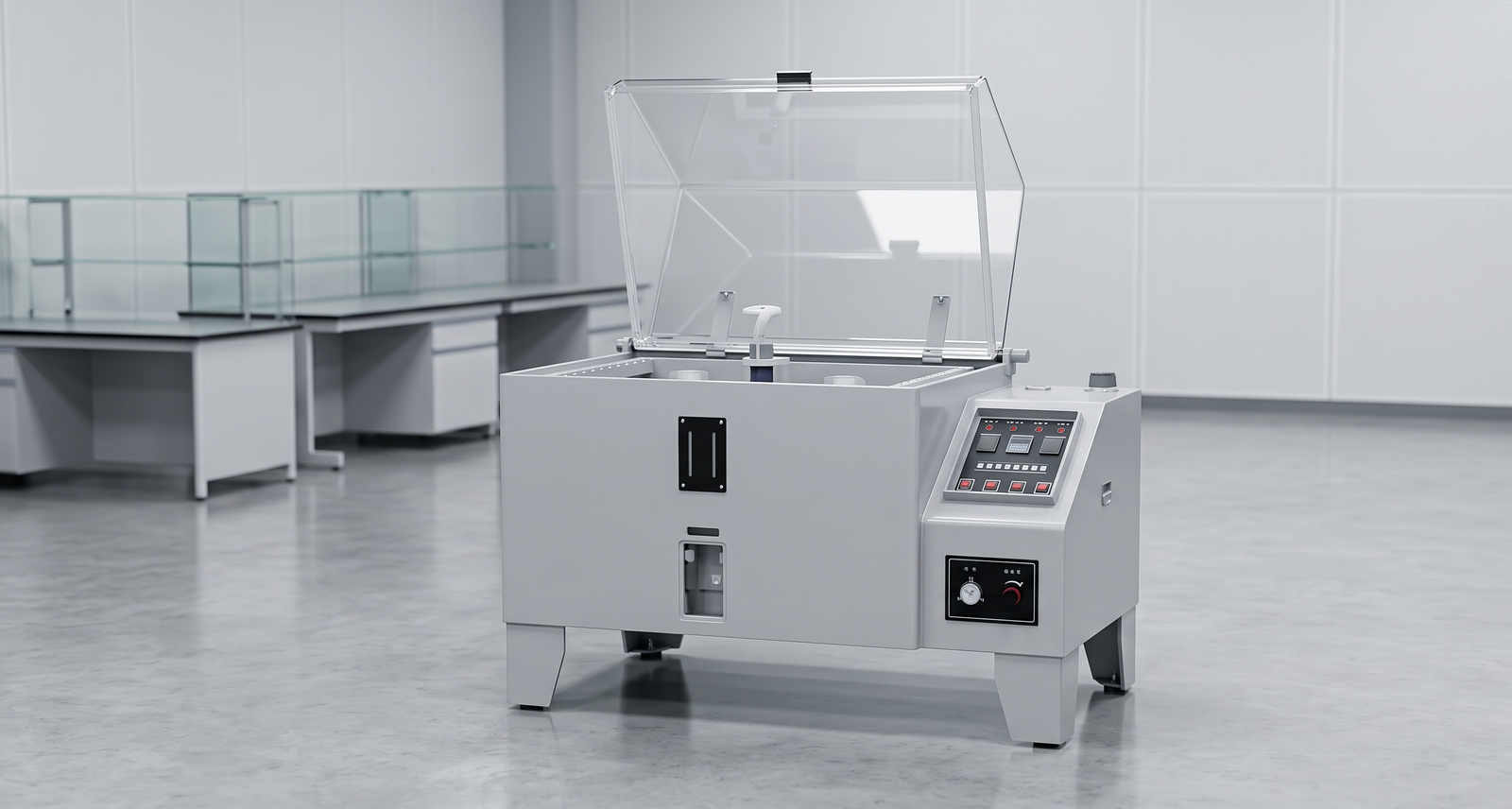
Salt spray chamber price is usually the first thing buyers search for, but after technical discussion starts, most companies realize the machine cost is only one part of the decision. The bigger concern is whether the chamber will keep giving stable corrosion testing results after months of regular operation. That’s where many low-cost machines start creating trouble.
Some buyers contact us after facing repeated coating rejection issues. Some already purchased a chamber earlier from another supplier and later struggled with fog inconsistency, leakage near the chamber lid, or controller fluctuation during long testing cycles. In a few cases, the acrylic top started turning yellow after continuous exposure and heating. These are not brochure-level problems. These are actual factory floor issues people face after installation.
A salt spray test chamber works continuously in a corrosive environment. Internally, every fitting, nozzle, sealing section, and controller component is under stress. So while comparing quotations, checking only chamber capacity or outer appearance is not enough.
Most industrial buyers are not looking for theory. They want clarity on practical things.
How stable is the fog distribution?
Will the chamber body survive long-term use?
Are spare parts available locally?
What happens if the controller fails after warranty?
How difficult is calibration support?
Will installation support be provided?
How much operator involvement is required?
Honestly, this is where many buyers make mistakes. They compare only the salt spray test chamber price and ignore operational stability. Later the machine starts requiring repeated adjustments just to maintain testing conditions properly.
A corrosion testing machine should reduce production uncertainty, not create another maintenance issue inside the quality lab.
This question comes in almost every enquiry discussion.
One supplier quotes a very low amount. Another quotation looks much higher even for similar chamber sizes.
The difference usually comes from construction quality and internal component selection.
Some salt spray chamber manufacturers use thinner body material to reduce manufacturing cost. Some use ordinary local fittings which start deteriorating faster inside corrosive environments. In cheaper machines, nozzle assemblies often clog more frequently because internal filtration and fog circulation are not properly balanced.
We have also seen cases where chamber sealing starts leaking after a few months because low-grade rubber material was used around the lid area.
Price looks lower initially, but maintenance becomes expensive later.
Imported PID controllers also create differences in pricing. Stable controllers cost more, but they hold temperature and chamber conditions better during long-duration testing. Cheap controllers may work fine initially, then start fluctuating after continuous operation.
This becomes a problem especially in automotive and coating industries where repeatability matters.
Many buyers now specifically ask whether the salt spray test chamber supports ASTM B117 or ISO 9227 testing conditions. This usually comes up in automotive, export, coating, and plating industries where corrosion reports are part of vendor approval.
But in practical use, standards support is not only about mentioning the name in a brochure. The chamber should maintain proper fog collection, temperature stability, and salt concentration during long testing cycles. Otherwise repeatability becomes difficult.
Most suppliers won’t explain this properly during the quotation stage.
Fog collection inconsistency is one of the most common complaints. One side of the chamber receives heavier deposition while the other side stays comparatively lighter. This affects testing reliability.
For instance, nozzle choking can be considered as one of the problems that this equipment might face. It is caused by salt deposits within the nozzles owing to poor maintenance process design.
Secondly, the issue of acrylic canopies needs to be addressed. Thick canopies will not crack when heated and opened.
Lastly, there is the issue of calibration.
Some companies buy from suppliers who later cannot provide timely onsite calibration or technical support. During customer audits or internal QC inspections, this creates unnecessary panic.
Local spare availability matters more than most people think.
In regular factory operation, chambers often run continuously for long hours. This is where low-grade machines usually start showing problems.
Some common issues buyers report are uneven fog deposition, nozzle choking, compressor instability, acrylic top cracking, and leakage near chamber sealing sections. In a few cases, temperature fluctuation starts appearing after long operation cycles.
These problems are not visible during trial runs. They usually appear after months of actual testing.
Automotive vendors use salt spray corrosion test chamber systems almost routinely now. Coated brackets, zinc-plated components, suspension parts, clamps, fuel line hardware — everything goes through corrosion testing before approval.
Fastener manufacturers are another major segment. Export buyers often ask for corrosion resistance reports before shipment clearance.
Powder coating companies use salt spray test equipment to compare coating batches and evaluate surface preparation quality.
Metal finishing industries also depend heavily on reliable testing because plating failure directly affects customer complaints.
Electronics enclosure manufacturers are increasingly using these chambers too, especially for outdoor cabinets and industrial hardware exposed to moisture-prone environments.
|
Parameter |
Specification |
|
Chamber Capacity |
108L / 250L / 450L / 1000L |
|
Chamber Type |
Salt Spray Corrosion Test Chamber |
|
Controller Option |
PID / PLC Touchscreen |
|
Temperature Range |
Ambient to 55°C |
|
Spray Pressure |
0.7 to 1.2 kg/cm² |
|
Power Supply |
230V AC |
|
Chamber Construction |
Corrosion-resistant body structure |
|
Fog Collection System |
Adjustable collection arrangement |
|
Safety Protection |
Low water cutoff and overload safety |
|
Test Support |
Industrial corrosion testing applications |
This discussion happens regularly.
Some buyers assume PLC systems are always necessary. Not really.
For standard corrosion testing requirements, a good PID-controlled chamber works properly. Smaller labs and hardware manufacturers often prefer this setup because operation remains simple and maintenance is lower.
PLC touchscreen systems become useful when testing schedules are more complex or automation is required.
But honestly, some suppliers oversell automation features even where they are not practically needed.
Selection should depend on testing volume, operator handling capability, and reporting requirements. Not just trend-based comparison.
Most companies do not think much about calibration during machine purchase. The issue starts later during customer audits or internal quality inspections.
We have seen buyers struggle because their existing supplier could not provide onsite calibration support on time. Sometimes even small things like controller verification or fog collection checking get delayed.
A salt spray corrosion test chamber should not only run properly. Testing readings should also remain reliable over long-term use.
During machine purchase, everyone focuses on delivery and pricing.
After installation, service response becomes the main concern.
We have seen customers struggling because their existing supplier stopped responding properly after warranty. In some cases, spare parts were unavailable locally and the machine remained stopped for days.
That creates production delays inside testing labs.
A salt spray test chamber is not equipment you buy and forget completely. Periodic maintenance, calibration support, nozzle cleaning, compressor inspection, and fog verification are part of long-term operation.
Machine downtime during customer testing schedules can become very frustrating.
That’s why after-sales support should always be discussed before purchase, not after breakdown.
|
Comparison Area |
Industrial Grade Chamber |
Ordinary Low-Cost Chamber |
|
Fog Stability |
More uniform deposition |
Uneven fog distribution |
|
Chamber Sealing |
Better long-term sealing |
Leakage issues common |
|
Controller Stability |
Better long-duration holding |
Temperature fluctuation possible |
|
Acrylic Top Quality |
Heavy-duty structure |
Yellowing and cracks possible |
|
Calibration Support |
Easier support availability |
Delayed response |
|
Spare Availability |
Better local support |
Difficult sourcing |
|
Operator Dependency |
Less manual adjustment |
Frequent monitoring required |
|
Internal Fittings |
Corrosion-resistant arrangement |
Faster deterioration |
Many operators assume these machines require very little attention. Actually, regular maintenance makes a big difference in long-term performance.
The nozzles need to account for cleaning their nozzles since they hold salt particles, which continue to accumulate over time.
Consistency in air pressure, clean chambers, and fog measurement is another serious challenge.
Another challenge that faces the operator is that he cannot prepare accurate salt solutions sometimes.
It is usually ignored in the training sessions.
A properly maintained chamber performs much better over years compared to a neglected machine.
Delivery timelines depend on chamber size and customization level. Standard models move faster, while larger chambers or PLC-based systems require additional production time.
Installation support also matters.
Compressed air connection, drainage arrangement, power supply condition, water quality — all these affect machine operation. Proper operator training during installation helps reduce handling mistakes later.
Even sample placement inside the chamber affects test repeatability. Overloading the chamber or placing components incorrectly changes fog circulation patterns.
Small operational details matter in corrosion testing.
Not every buyer needs the highest-priced system. At the same time, selecting purely on lowest quotation often creates future problems.
The better approach is checking practical operational reliability.
Ask suppliers about:
These questions give a much clearer picture than brochures.
Bionicsro works with companies that need practical corrosion testing setups without unnecessary complications. Some customers need basic testing systems. While other machines require continual use to remain at their designated quality requirements, the right chamber will depend on usage rather than only the designated usage.
In case you want to make comparisons among the manufacturers of salt spray chambers or get quotations for salt spray testing chamber prices, you will be able to easily forward your testing sample and period using Bionicsro. It usually helps buyers avoid a lot of unnecessary issues later.
The cost of this machine depends on the size of the chamber, the control unit, and the testing method.
These industries include coating, making automobile parts, plating, and fastener.
We encounter problems because of clogged nozzles, the flow of fog, and temperature change in the chamber.
So that there can be uniformity in the testing of corrosion within laboratories and industrial setting.
Because we give accurate test results, good customer service.


Connect with us for your business enquiries. Generally, we respond within a day.