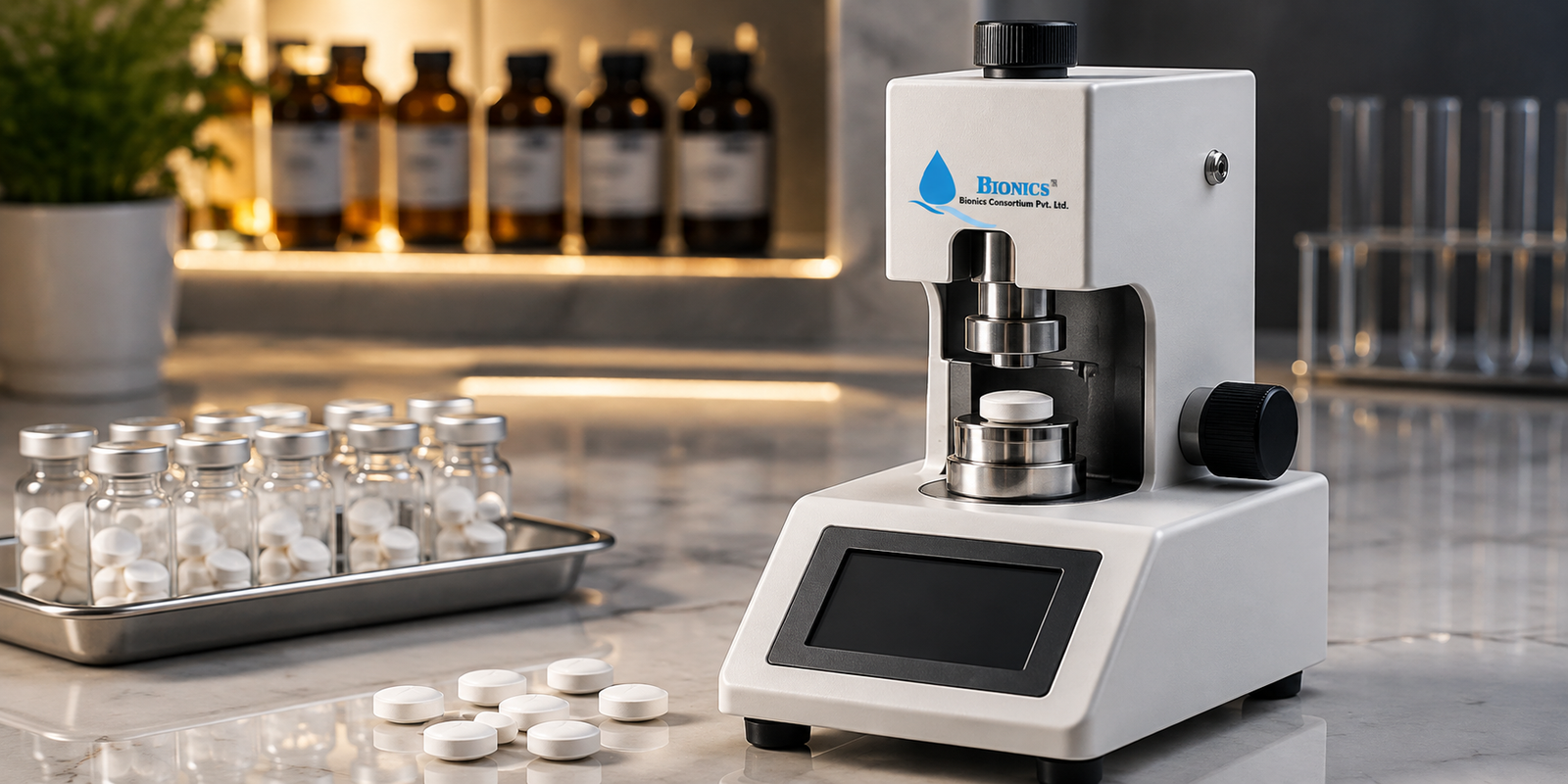
Drop a tablet. Some survive. Some don't — they crumble on impact, no drama needed. That difference isn't luck. It's physics, and it's exactly what a hardness tester is built to measure.
Anyone who's spent real time in pharmaceutical manufacturing or QC already knows this: a tablet's strength can quietly decide whether a batch passes or gets sent back. Understanding the tablet hardness tester principle properly is the difference between catching a problem early and explaining a rejected batch to someone who's not going to be happy about it.
At Bionicsro , we hear some version of the same question almost weekly: "How does the machine actually know the exact moment a tablet is going to crack?" Good question, honestly. Worth asking before you buy or operate one of these. So let's get into it — no jargon dump, just the mechanics, why it actually matters, and how to pick the right instrument.
Strip the branding away and it does one job: tells you how much force a tablet can take before it breaks. Some people call it a hardness testing machine. Others say crushing strength tester. Same instrument either way. The result shows up in Newtons (N), kilograms-force (kgf), or Strong Cobb units (SCU) — whichever your SOP happens to specify.
Why does this matter beyond "the tablet broke"? Because hardness sits right in the middle of in-process quality control during compression. Too soft, and tablets chip or crumble during coating and packaging — sometimes before they even leave the compression room. Too hard, and disintegration slows down, which drags bioavailability down with it. Neither outcome is good. Hardness testing is how you catch the drift before it turns into a documented deviation.
Here's the mechanism in one line: a tablet sits between two jaws — one fixed, one moving — and force builds gradually until the tablet gives way. That's the tablet hardness tester principle, stripped to its bones.
But "gradually until it gives way" skips over what's actually happening. So, step by step:
One thing worth remembering: manual, motorized, fully automatic — doesn't matter which one's in front of you. The underlying physics never changes. What changes is precision, repeatability, and how much of the process gets automated so you're not the weak link in the measurement.
Ask five people for a tablet hardness tester name and you'll probably get five slightly different answers. Here's the actual breakdown:
Numbers help more than adjectives when you're actually deciding what to buy. Here's how the categories stack up, plus a rough sense of tablet tester price in India for each tier:
|
Tester Type |
How It Works |
Accuracy |
Data Output |
Indicative Price (India) |
Fits Best For |
|
Manual Hardness Tester |
Screw-driven force, dial reading |
Moderate — varies by operator |
Manual reading only |
₹15,000 – ₹40,000 |
Small labs, teaching setups, tight budgets |
|
Motorized Hardness Tester |
Motor-controlled jaw speed |
Good, more consistent |
Analog or digital display |
₹40,000 – ₹90,000 |
Mid-size QC labs, steady daily volume |
|
Digital/Automatic Hardness Tester |
Load cell + microprocessor |
High, operator-independent |
Digital, printer/USB export |
₹90,000 – ₹2,50,000 |
GMP-compliant labs, high sample counts |
|
Multi-Function Instrument |
Combined hardness/weight/thickness testing |
Very high, fully automated |
Software-linked, 21 CFR Part 11 ready |
₹2,50,000+ |
Large-scale production, centralized QC |
Take these as a starting point, not a quote — actual pricing moves depending on brand, calibration paperwork, and support terms. Want a real number? Just ask Bionicsro directly. We'll give you a straight answer, not a range that dodges the question.
Hardness rarely stands alone as a data point. It's tangled up with a few other things regulators — and formulators — actually care about:
USP, IP, and BP all list hardness — or "resistance to crushing" if you want the pharmacopeial phrasing — as a standard test. For any GMP facility, this isn't a nice-to-have. It's baseline.
A few practical things worth thinking through before committing:
Searching for a tablet tester online right now? Don't stop at comparing price tags. Calibration support, warranty length, how fast a vendor actually responds when something breaks — all of that matters just as much once the machine's sitting on your bench. Tablet tester price shifts a lot depending on manual versus motorized versus fully digital, and brand reputation plays a bigger role in that number than most people expect going in.
For labs shopping in India, tablet tester price in India spans a wide range — entry-level manual units on one end, fully automated multi-parameter systems on the other. The right choice comes down to your testing volume and how strict your compliance obligations actually are. Bionicsro covers that whole spectrum, whether you're running a two-person QC bench or a full production floor.
Choosing a tablet hardness tester isn't really about ticking boxes on a spec sheet. It's about finding an instrument that fits how your lab actually runs day to day — one that keeps batches compliant without adding friction to the workflow. Bionicsro manufactures and supplies a full range of pharmaceutical testing instruments, including hardness testers and humidity test chambers, built for labs that can't afford to get this wrong.
Have questions about which model fits your lab?
Reach out to Bionicsro today for straightforward guidance, honest pricing, and help choosing the right instrument for your laboratory. Contact Us to discuss your requirements.
It applies steadily increasing compressive force between two jaws until the tablet cracks, recording the exact force at that breaking point.
Newtons (N), kilograms-force (kgf), or Strong Cobb units (SCU) — whichever your lab's SOP specifies.
Newtons (N), kilograms-force (kgf), or Strong Cobb units (SCU) — whichever your lab's SOP specifies.
It confirms a tablet survives handling and packaging intact, while still breaking down properly once it's actually taken.
It confirms a tablet survives handling and packaging intact, while still breaking down properly once it's actually taken.
Yes, very much. Overly hard tablets can dissolve slower than expected. Tablets that are not hard enough may break up before they even should.
Not directly. A humidity test chamber is used for stability studies, however, humidity over time can actually affect the hardness of a tablet
Throughout the compression process at regular intervals.
Compression force, punch condition, granule properties, moisture content, and binder levels — often several of these together, not just one.
Start with testing volume, then accuracy and compliance needs, then decide if multi-function testing is worth the extra spend. Price should be the last filter, not the first.


Connect with us for your business enquiries. Generally, we respond within a day.