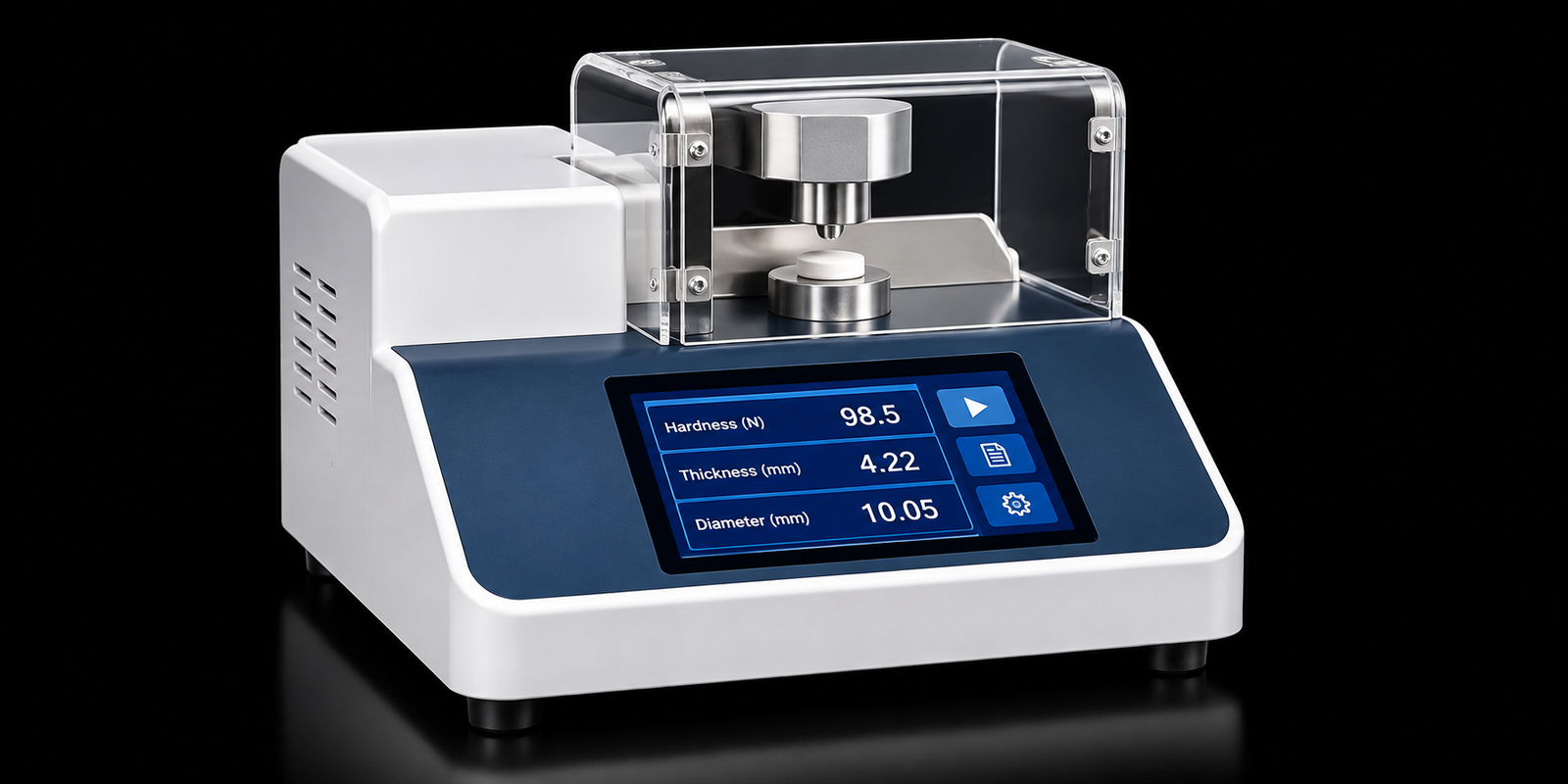
Quick Answer: A tablet hardness tester crushes a tablet between two platens and records the force at which it breaks, shown in kP, N, or SCU. The reading tells you whether a tablet can survive coating, packing, and transport without being so hard that it releases the drug too slowly.
Anyone who has worked a tablet press knows hardness drifts. A small change in granule moisture or compression force, and a batch that looked fine in the morning starts chipping by afternoon. The tablet hardness tester catches this early, usually before the problem reaches the packing line.
This guide covers how the test works, which specifications matter, how the types compare, and what to ask a supplier. To see our models first, visit our tablet hardness tester.
It is a bench or in-line instrument that applies a steadily increasing load to a tablet until it fractures. One platen stays fixed, the other moves, and a load cell records the peak force at breakage.
Strictly, the instrument reports breaking force, also called crushing strength. "Hardness" is the everyday word and the one buyers search for, so both appear here. Results are shown in kilopond (kP), newton (N), or Strong-Cobb Units (SCU), depending on the lab's SOPs.
Hardness is a window into how the tablet was made.
Labs read hardness alongside thickness, diameter, weight, friability, and disintegration.
Most instruments use diametral compression, meaning the tablet is squeezed across its diameter.
Orientation matters more than people expect. Oblong, capsule-shaped, and scored tablets can sit several ways, and each position can give a different number. Write the orientation into the method so analysts get comparable results. USP general chapter <1217> Tablet Breaking Force makes the same recommendation.
|
Type |
How it works |
Best for |
Trade-off |
|
Manual |
Force applied mechanically by the operator |
Basic checks, few samples |
Operator-dependent; slower |
|
Motorized (digital) |
Motor moves the platen at a set speed |
Routine QC labs |
Usually hardness only |
|
Automated / multi-parameter |
Measures hardness, thickness, diameter, often weight |
High-volume QC, in-process checks |
Higher cost; needs method setup |
Your choice depends on sample volume, traceability needs, and data integrity practices such as ALCOA+. For electronic records, the FDA's Part 11 scope and application guidance explains how the agency approaches 21 CFR Part 11.
When comparing a tablet hardness tester machine, these datasheet lines tell you the most.
|
Specification |
What to look for |
Why it matters |
|
Measuring range |
Covers your weakest and strongest tablets |
Readings near the limits are less dependable |
|
Accuracy and resolution |
Clearly stated, with a calibration method |
Auditors will ask |
|
Test speed |
Fixed or adjustable, documented |
Speed affects the recorded force |
|
Tablet size range |
Smallest and largest supported |
Matters for mixed product lines |
|
Units |
kP, N, SCU selectable |
Matches your SOPs and pharmacopoeia |
|
Data handling |
Printer, USB, export, audit trail |
Supports data integrity |
|
Calibration |
Traceable, with certificate |
Needed for qualified equipment |
Figures vary between models, so always confirm against the current datasheet of the exact model.
A tablet hardness tester for laboratory use is judged a little differently from one beside a press.
|
Test |
What it measures |
Question it answers |
|
Hardness |
Force to fracture the tablet |
Is it strong enough? |
|
Friability |
Weight lost after tumbling |
Will it chip during handling? |
|
Disintegration |
Time to break apart in fluid |
Will it break down as designed? |
A tablet can pass friability and still break down too slowly, which is why labs run all three. Drug release is checked separately, using dissolution testing equipment.
No honest supplier can quote one price without knowing the model. Cost mainly depends on:
When comparing quotes, match the scope: same range, same documentation, same warranty. A cheaper offer without calibration support can cost more over the instrument's life.
If you want to buy a tablet hardness tester in India, remember that the purchase does not end at delivery. Support afterward shapes how well the instrument serves you. Ask any manufacturer or supplier:
Bionics Consortium has 26 years in laboratory testing instruments, and these points reflect the questions buyers raise most often. For model-specific specifications and availability, ask for the datasheet through our contact.
To speed up a quote, have ready your tablet types and size range, expected breaking force range, sample volume, data requirements, and applicable pharmacopoeia.
A tablet hardness tester is a small instrument with a large role in quality control. Match the measuring range to your products, decide how much automation and traceability you need, and confirm that calibration and service will be there after installation. Compare specifications like for like, and treat technical support as part of what you are buying.
Need a tablet hardness tester manufacturer or supplier to discuss your testing needs? Share your tablet details and request a quotation through our contact .
Request a quote or datasheet today.
It measures the force needed to break a tablet.
Kilopond (kP), newton (N), and Strong-Cobb Units (SCU).
Hardness is crushing force. Friability is weight lost during tumbling.
Follow your quality system and the manufacturer's guidance.
Yes, within its size range, with consistent orientation.
Automation, parameters, load cell range, software, documentation, and service.
Motorized gives better repeatability; manual suits occasional checks.
USP <1217> and Ph. Eur. 2.9.8.
Measuring range, accuracy, speed control, size range, and data handling.
The datasheet, calibration certificate, qualification documents, warranty, and service details.

Connect with us for your business enquiries. Generally, we respond within a day.