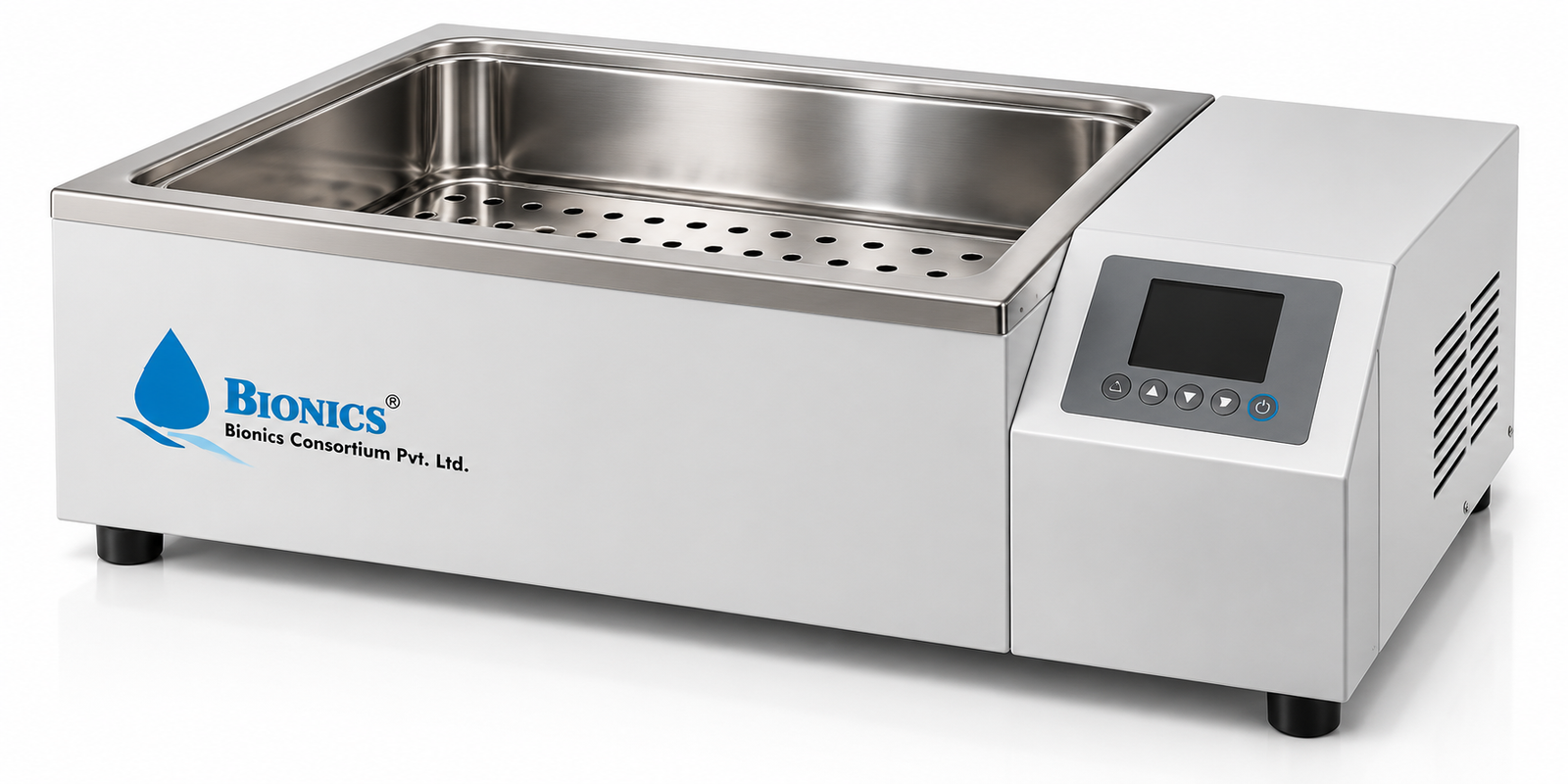
A water bath heats and holds samples at a stable temperature using a controlled water reservoir instead of an open flame or dry heating element. Most units run anywhere from ambient up to 100°C. Labs reach for one whenever contamination-free heat matters more than speed — warming reagents, thawing samples, incubating enzymes or microbial cultures. Good digital models hold their set point within ±0.1–0.5°C.
Almost every microbiology, pharma QC, food-testing, or teaching lab has one running quietly somewhere. It's not exciting equipment, but it does something few alternatives manage as well: spreading heat evenly through water so a sample gets to temperature and stays there, without scorching, uneven evaporation, or fire risk.
Bionics Consortium builds its water baths as precision instruments, not commodity tanks — stable temperature control, corrosion-resistant tanks, and manufacturing consistency that matters when one failed batch means redoing an entire assay. Below: what a water bath is, how it actually works, which specs matter, and how to pick between models — plus where most existing buying guides leave gaps.
At its core, it's a container — stainless steel or a similarly corrosion-resistant material — filled with water and thermostatically held at a set temperature. Samples go straight into the water or sit in a rack, absorbing heat gradually and evenly.
A hot plate or heating mantle can't match that evenness. A water bath surrounds the sample in a near-uniform thermal medium, which is why it's still the default for temperature-sensitive biological and chemical work, even in labs that also own dry block heaters.
The physics is simple; the engineering that keeps it stable isn't. A resistive heating coil raises the water temperature. A thermistor or RTD reports the actual temperature back to the controller, which cycles the heater on and off — or modulates power via PID control on better units — to hold the set point.
Water's high specific heat is exactly why it's used here instead of air: it absorbs and releases heat slowly and evenly. A shaking water bath adds a motor driving a reciprocating or orbital platform, keeping flasks in gentle continuous motion — necessary for enzyme kinetics or bacterial cultures, where a static bath lets concentration gradients build up.
Push a bath toward its upper range — a true hot water bath near boiling — and lid design and insulation start to matter a lot more. Evaporation and thermal gradients increase sharply as you approach 100°C. That precision gap is one of the clearer differences between entry-level and industrial units, and it's rarely mentioned on competitor product pages.
|
Parameter |
Typical Range / Detail |
|
Capacity |
5 L to 100+ L (bench-top to floor-standing) |
|
Temperature range |
Ambient +5°C to 100°C (up to 200°C with oil-bath conversion on some models) |
|
Temperature stability |
±0.1°C to ±0.5°C, depending on controller grade |
|
Tank material |
304 or 316L stainless steel (316L preferred for saline or corrosive samples) |
|
Heating element |
Sheathed immersion or under-tank resistive coil |
|
Control type |
Digital PID with LED/LCD display, or analogue dial on basic models |
|
Safety features |
Over-temperature cutoff, low-water alarm, earth-leakage protection |
|
Shaking mechanism |
Reciprocating or orbital, adjustable 20–200 rpm |
|
Power supply |
220–240V/50Hz (India, Middle East, GCC) or 110–120V/60Hz (North America) |
|
Standards compliance |
Manufactured to ISO-certified quality processes; CE-marked configurations available for export |
Specifications vary by model — request a datasheet for your exact configuration.
Work through these in order — not price first:
|
Criteria |
Standard (Static) |
Shaking Water Bath |
Industrial/High-Precision |
|
Typical capacity |
5–20 L |
10–30 L |
30–100+ L |
|
Temperature stability |
±0.5°C |
±0.2–0.5°C |
±0.1°C |
|
Best for |
Reagent warming, thawing, general incubation |
Enzyme assays, cell/bacterial culture, extraction |
Pharma QC, stability testing, high-throughput labs |
|
Control type |
Analogue or basic digital |
Digital, adjustable rpm |
PID digital, data logging on select models |
|
Tank material |
304 stainless steel |
304 or 316L |
316L |
|
Price band |
Entry-level |
Mid-range |
Premium |
Water bath uses go well beyond simple heating:
Deployment context matters as much as the spec sheet. Gulf-region labs generally need 220–240V/50Hz units, and 316L tanks earn their keep given ambient humidity and, in coastal cities, chloride exposure. US buyers typically need 110–120V/60Hz compatibility and UL-listed configurations for import. Across every export market Bionics Consortium serves — Pan-India, the Middle East, Saudi Arabia, Oman, the USA — having CE-marked configurations and compliance paperwork ready ahead of time shortens customs clearance and procurement review, which smaller suppliers often can't manage quickly.
Bionics Consortium designs and manufactures its own laboratory heating equipment, including water baths, for research, clinical, and industrial QC labs across Pan-India, the Middle East, Saudi Arabia, Oman, and the USA. Because it's the manufacturer — not a reseller — the spec sheet reflects the tank fabrication, controller calibration, and quality checks done in-house, not marketing copy over a third-party OEM unit. Products are built to ISO-certified quality standards, and export configurations (voltage, plug type, compliance paperwork) are set per destination market rather than defaulted to one region.
Most pages currently ranking for "water bath" split into two types: reference-style pages that explain the concept but skip specs, pricing, or buying guidance entirely, and distributor catalog pages that list dozens of SKUs with almost no explanation — useful only if you already know exactly what you need. A few manufacturer sites lead with trust signals (decades in business, certifications) but go thin on working principle, tank-material trade-offs, or a real FAQ addressing what buyers actually ask. This guide tries to close those gaps in one place: an honest working-principle explanation, a full spec table, a criteria-first buying process, and geography-specific compliance notes.
Whether you're speccing a new lab, replacing equipment for compliance reasons, or placing an export order, Bionics Consortium's technical team can help match capacity, tank material, and control precision to your protocol — and provide the compliance paperwork your destination market needs. Contact Bionics Consortium for a quotation, datasheet, or demonstration.
Stable, even heating for incubating cultures, warming reagents, thawing samples, and running temperature-sensitive reactions where open flame or dry heat risks uneven results or contamination.
Just above ambient up to 100°C in most units. Above that, labs typically switch to an oil or sand bath, since water boils at 100°C at standard pressure.
Just above ambient up to 100°C in most units. Above that, labs typically switch to an oil or sand bath, since water boils at 100°C at standard pressure.
Distilled or deionized water is strongly recommended — tap water leaves mineral scale on the heating element and tank walls, which hurts efficiency and accuracy over time.
PID-controlled digital units typically hold ±0.1°C to ±0.5°C of set point, tighter than basic analogue-dial models.
Price tracks capacity, control precision, and whether shaking is included — entry-level static units cost less; high-precision or large shaking models cost more.
316L is more resistant to chloride corrosion; this is important if you use saline buffer solutions or work in humid conditions.
Yes, because calibration will ensure that the display temperature matches real temperature in the tank.
Generally yes, since there's no open ignition source — but never exceed the flash point of whatever bath fluid is in use.
Generally yes, since there's no open ignition source — but never exceed the flash point of whatever bath fluid is in use.


Connect with us for your business enquiries. Generally, we respond within a day.