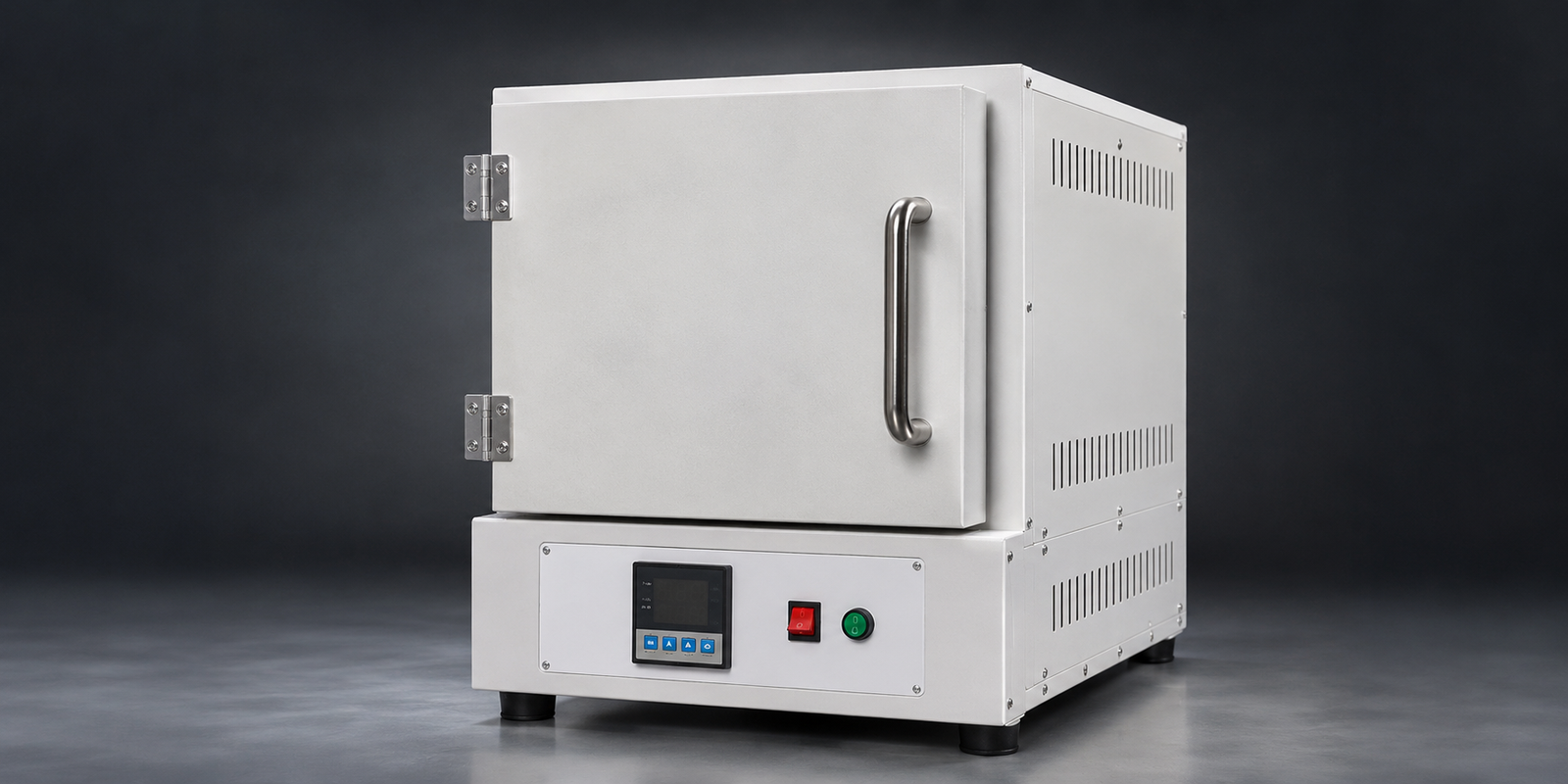
This Muffle Furnace Manufacturer Guide in India is written for lab managers, researchers and procurement teams who want to choose the right furnace with confidence. A muffle furnace looks simple from the outside: an insulated box that gets very hot. In practice, the difference between a furnace that serves a lab for fifteen years and one that drifts, cracks or fails within two usually comes down to decisions made before the purchase order. This guide walks through those decisions the way an experienced manufacturer would explain them to a first-time buyer: what a muffle furnace is, how to read specifications, what drives price, and how to judge a supplier.
By Bionics Consortium, 26 years of experience in laboratory equipment
A muffle furnace is an electrically heated chamber used to heat samples to high temperatures while keeping them separate from the heating elements and from combustion gases. The "muffle" is the insulated inner chamber that isolates the sample, which keeps results clean and heating uniform. For a general technical background, see the Wikipedia overview of the muffle furnace.
In a laboratory, this machine is typically used for ashing, loss-on-ignition tests, gravimetric analysis, calcination, sintering of small samples, annealing and general heat treatment. Industries such as ceramics, metallurgy, glass, cement, food testing, pharmaceuticals and environmental testing rely on it daily.
Electric heating elements warm the chamber walls. Insulation (refractory brick or ceramic fibre) keeps heat inside. A thermocouple measures temperature, and a controller, usually PID-based, switches power to hold the set point. Because the sample sits in a closed chamber rather than in a flame, there is no direct contact with fuel or exhaust.
The right type depends on your temperature, sample size and process.
|
Type |
Use |
Check |
|
Standard lab |
Ashing, LOI |
Size, max temp |
|
Programmable |
Multi-step cycles |
Program steps |
|
High-temperature |
Sintering, ceramics |
Element, insulation |
|
Box or chamber |
Large loads |
Door, floor load |
|
Atmosphere |
Oxidation-sensitive samples |
Gas-tight design |
Specifications are where most buying mistakes happen. Ask for each of the following in writing, and compare them against the muffle furnace range of any manufacturer you shortlist.
Maximum temperature is not the same as continuous working temperature. Running a furnace at its limit constantly shortens element and insulation life. As a practical habit, choose a model whose maximum is comfortably above your regular working temperature.
Element material largely sets the temperature ceiling and cost. As a general industry guide:
|
Element |
Approx. limit |
Fit |
|
Kanthal-type or nichrome |
~1100–1200 °C |
Routine lab work |
|
Silicon carbide |
~1400–1500 °C |
High-temperature work |
|
MoSi2 |
~1700–1800 °C |
Sintering, ceramics |
These are general ranges. Exact limits depend on the manufacturer's design, so confirm them for the specific model.
Check internal dimensions, not just the stated litre capacity, and make sure your largest crucible or sample tray fits with space around it for air circulation.
A digital PID controller is standard. Programmable controllers allow ramp and soak profiles. Thermocouple type should match the temperature range, and calibration should be traceable.
Ceramic fibre heats and cools faster and is lighter. Refractory brick is robust and has higher thermal mass. Ask about door design, outer body finish and over-temperature protection.
Confirm single-phase or three-phase requirements and the rated load before installation, so your wiring and MCB are sized correctly.
Price varies widely, and any quote that ignores your application should be questioned. The main drivers are:
A low upfront price can become expensive if elements fail early or spares are hard to find. Compare total cost of ownership, not just the invoice.
There is a real difference between a manufacturer, a trader and a reseller. A manufacturer controls design, build quality and spares. A trader may offer wider brand choice but less technical depth. Use the checklist below.
|
Check |
Why |
|
In-house manufacturing |
Accountability |
|
Years in the field |
Stability |
|
Certifications |
Consistency |
|
Test reports |
Audits |
|
Spares and service |
Less downtime |
|
Customisation |
Special samples |
|
Warranty terms |
Protection |
If your institution buys through tender, expect to supply technical compliance statements and installation references. Reputable manufacturers can provide these without delay.
Most premature failures trace back to handling rather than manufacturing. Good habits include:
|
Feature |
Muffle |
Tube |
|
Shape |
Box |
Tube |
|
Best for |
Ashing, larger loads |
Atmosphere, small samples |
|
Atmosphere control |
Limited |
Easier |
|
Loading |
Front door |
Tube ends |
With 26 years of experience in the laboratory equipment field, Bionics Consortium approaches furnace selection as an application question first and a product question second. When we advise a buyer, we start with the sample, temperature profile and workload, and only then discuss models. We encourage every buyer, whether they choose us or not, to request written specifications and test documentation from any supplier they consider.
Not sure which specification fits your application? Share your process details through our contact form and our team will help you shortlist a suitable muffle furnace, with a written quotation on request.
Choosing a muffle furnace is easier when you work backwards from the process. Define your temperature, sample and workload, insist on written specifications, compare total cost rather than headline price, and assess the supplier's service as carefully as the furnace. A well-specified furnace from an accountable manufacturer will quietly do its job for years, and that is exactly what a laboratory needs.
It heats samples to high temperatures in an isolated chamber for ashing, loss-on-ignition tests, gravimetric analysis, calcination, annealing and sintering.
Standard laboratory models commonly reach about 1100 to 1200 °C. Higher-temperature models using silicon carbide or MoSi2 elements can go well beyond that. Always confirm the exact range for the specific model.
Start with your maximum working temperature, sample size, hold times and atmosphere. Then compare element type, insulation, controller and warranty across suppliers.
Maximum temperature, heating element type, chamber size, controller sophistication, customisation and after-sales support are the main factors.
A manufacturer controls design and spares and can customize. A supplier may offer more brand choice. Either can work if they provide written specifications and service support.
Laboratory ovens typically operate at much lower temperatures. A muffle furnace is built for very high temperatures with different insulation and heating elements.
PID is a control method that adjusts heater power continuously to hold the set temperature steadily, reducing overshoot and fluctuation.
Life depends on operating temperature, usage frequency, handling and maintenance. Running below the maximum rating and avoiding thermal shock extends element and insulation life.
Many manufacturers can adjust chamber dimensions, temperature class, controller type, gas ports and safety features. Confirm feasibility and cost in writing.
Request the technical specification sheet, warranty terms, calibration or test report, applicable certifications, electrical requirements and installation instructions.


Connect with us for your business enquiries. Generally, we respond within a day.