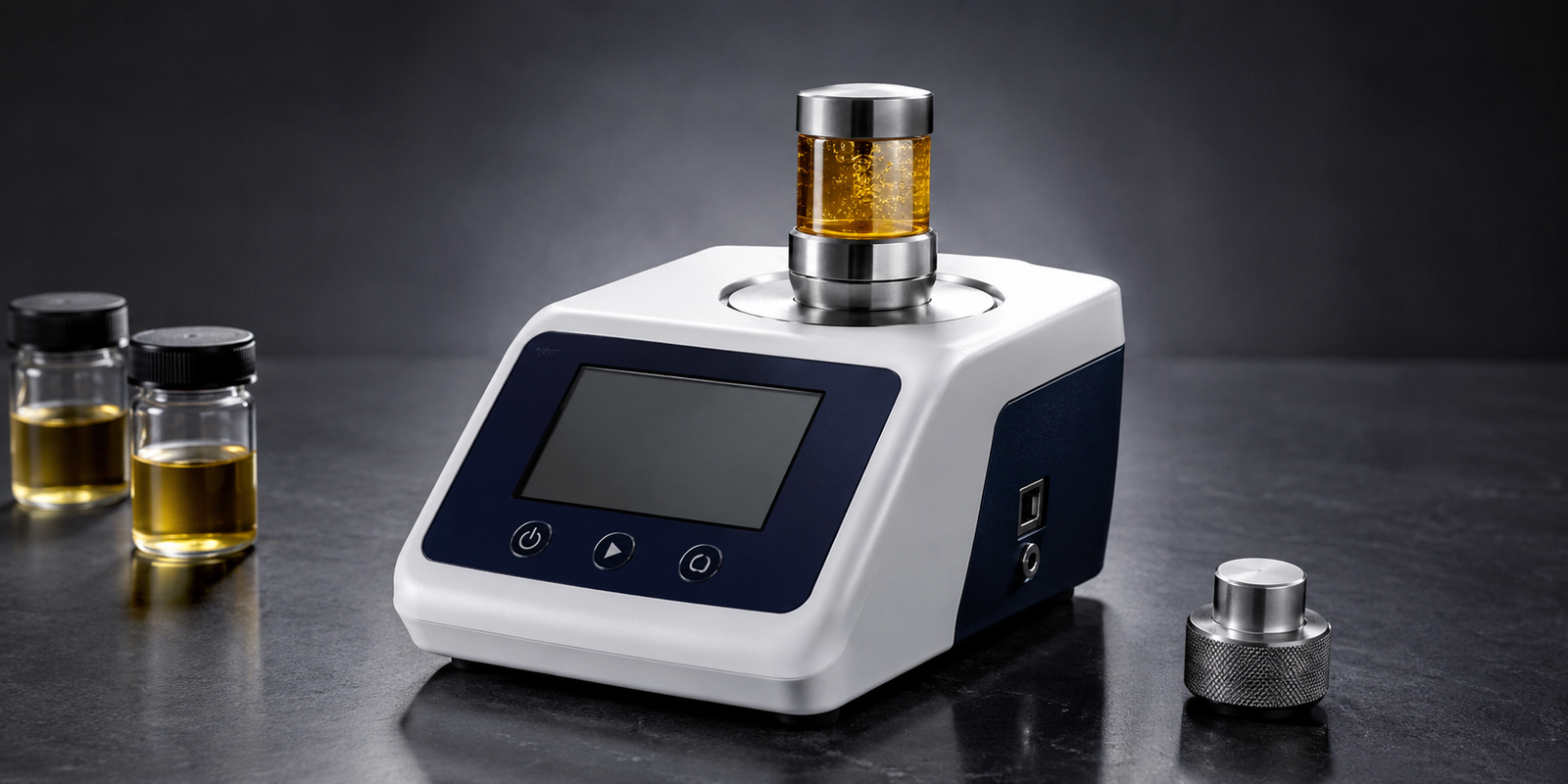
A transformer can run fine for months, then develop insulation faults for no obvious reason. A hydraulic system can seem normal right up until seals and bearings wear out faster than expected. Often the culprit is water, dissolved quietly in the oil. That's the gap an oil moisture meter closes.
Checking oil for water content used to be a job for specialists. That's changing — quality-control staff, maintenance engineers, and procurement managers across Indian industries are now expected to understand oil moisture measurement well enough to ask the right questions before buying.
An oil moisture meter estimates how much water is in a sample of lubricating, hydraulic, insulating, or process oil. Instruments get there differently — some use capacitance sensing, others relative humidity or saturation-based detection, and a few other electronic methods.
A basic moisture meter for oil gives a rough indication; a proper oil moisture analyzer is built for repeatable results. If you're tracking trends across weeks or months, repeatability matters more than any single reading.
Worth noting: an oil moisture meter isn't a replacement for laboratory-grade Karl Fischer titration when a decision needs absolute precision. Field instruments earn their keep through routine monitoring; lab testing remains the reference point when a result can't afford to be wrong.
The operation of an oil moisture meter involves the use of a sensor that determines the moisture content in the oil. Depending on the model of the instrument, the sensor either detects changes in the electrical properties or moisture conditions in the oil. Then the readings are displayed after processing the results of sensing.
It is essential to conduct sampling correctly for getting accurate results. Other factors that may affect the measurement accuracy include the type of oil, temperature, condition of the sensor, and calibration.
Water enters oil systems more easily than expected — condensation inside a tank, a worn seal, a compromised breather, or careless handling in storage and transport. Once in there, consequences build up quietly: insulating oils lose dielectric strength, raising breakdown risk; lubricating oils oxidize faster and form sludge or acids; metal parts corrode; and the protective oil film weakens.
This is why moisture testing works best as a preventive habit rather than a reaction to failure. Catching a rising trend early is almost always cheaper than the aftermath.
Power utilities check transformer oil regularly, since moisture directly affects insulation and transformer life. Manufacturing plants running presses, moulding equipment, or rolling mills monitor hydraulic and gear oils to prevent premature wear. Fleet and automotive teams test engine and transmission oils on a schedule. Oil marketing and processing companies run batch-level checks before product ships, and independent labs depend on equipment that stays accurate and calibrated.
Accuracy isn't only about the instrument.
Oil type and viscosity matter more than expected. Mineral, synthetic, transformer, hydraulic, and gear oils behave differently under testing, so check compatibility against the manufacturer's specifications.
Sample handling trips people up constantly. A contaminated container, humidity exposure, or careless collection introduces errors no instrument can compensate for.
Measurement range and repeatability deserve attention. Ask for repeatability data — how consistent readings are on the same sample tested repeatedly — rather than chasing a headline accuracy number.
Calibration isn't optional or one-time. An analyzer needs periodic verification against reference standards, and many buyers in India also need calibration certificates for audit purposes.
Specifications differ by model and manufacturer, so rather than list fixed numbers, here are the parameters worth asking about on any datasheet.
|
Parameter |
Why It Matters |
What to Ask |
|
Sensing principle |
Determines which oils/moisture forms it detects |
Capacitance, RH/saturation, or other? |
|
Compatible oil types |
Sensors aren't validated across every oil |
Which oils has this model been validated on? |
|
Measurement range |
Must match your process's moisture levels |
Does the range fit my application? |
|
Repeatability |
Shows consistency across repeated tests |
Is repeatability data available? |
|
Response time |
Affects throughput for batch testing |
How long does one measurement take? |
|
Operating temperature |
Performance can shift with temperature |
What conditions is it rated for? |
|
Power source |
Field vs. bench suitability |
Battery, mains, or both? |
|
Calibration interval |
Drives maintenance cost |
How often, and is a certificate provided? |
|
Documentation |
Required for ISO/internal audits |
Manual, datasheet, calibration certificate included? |
|
Warranty & support |
Shapes total cost of ownership |
What's covered, for how long? |
Ask Bionicsro — or any manufacturer in India — for this information directly. Numbers not confirmed on an official datasheet shouldn't be relied on for procurement decisions.
A few questions separate a good purchase from a mismatched one: What oils will you actually test? What measurement range do you need — enough to be useful, not so much you're overpaying? What after-sales support comes with it, since calibration services and spare sensors matter more over the years than day-one price? Does the documentation match what your quality system requires? And what's a realistic price for the specification you need — worth getting detailed quotations rather than comparing headline numbers.
Pricing shifts with sensing technology, measurement range, build quality, and after-sales support included. A lower upfront price doesn't always mean lower total cost — calibration, servicing, and longevity all factor in. Total cost of ownership is a more useful comparison than price alone.
Bionicsro, operating under Bionics Consortium, works in oil testing instruments for Indian industrial and laboratory buyers. If you're comparing manufacturers, judge them on documented specifications, calibration support, and how responsive their after-sales service actually is — not marketing language. Ask directly for datasheets and calibration information before deciding.
Contact Bionicsro for product specifications, calibration information, application guidance, and a quotation based on your testing requirements.
The moisture meter for oils tests for moisture in lubricating, hydraulic, transformer, and process oils.
This will depend on several factors such as the type of instrument, sensors, and methods used. There isn't a general figure that applies to all instruments.
Instruments in the field are best suited for regular monitoring and identifying trends. Laboratory techniques such as Karl Fisher titration have remained the standard reference method.
Moisture in oil lowers the dielectric strength of insulating oils, increases oxidation and the formation of sludge, promotes corrosion, and reduces the effectiveness of oil films on machines.
This will depend on equipment criticality and maintenance schedule. In most cases in India, it is incorporated into the existing maintenance intervals rather than done in ad-hoc manner.
No. Mineral, synthetic, transformer, hydraulic and gear oils are different and need to be checked for compatibility with the measuring instrument according to specifications.
Again it depends on your specific application. You need to estimate the moisture range produced by your process and match it with the rating of the instrument.
The first thing is proper sample handling because contamination of the container or exposure to a humid environment can distort results even if you use a high quality instrument. Also, calibration and oil type are important.
There are many factors affecting price – measuring principle, measurement range, quality of the construction and after-sales service. You need to request a quotation from suppliers.
Check oil compatibility, measurement range, repeatability, response time, calibration needs, documentation, warranty, and after sales service. It is also good to ask for a datasheet and information regarding calibration from the company prior to buying the equipment.


Connect with us for your business enquiries. Generally, we respond within a day.