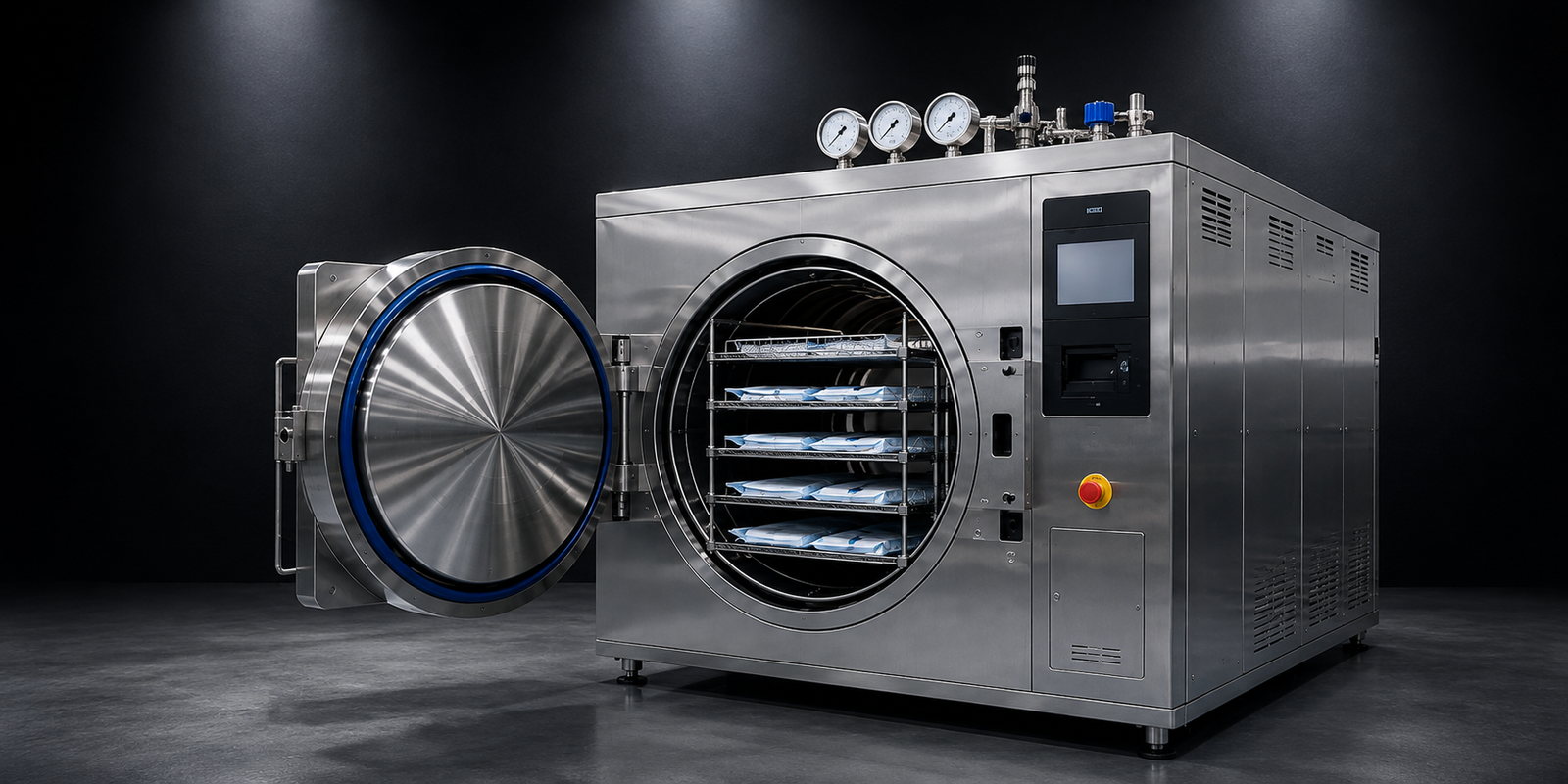
Trapped air is the enemy of sterilization. A wrapped instrument tray or a hollow cannula can hide small air pockets that steam can't push through on its own. A pulse vacuum sterilizer solves this by cycling the chamber through repeated vacuum draws until the air is gone and steam has a clear path to every surface.
This is why the equipment shows up wherever contamination risk has zero tolerance: hospital CSSDs, diagnostic labs, pharmaceutical production lines, and device manufacturing plants. Facilities upgrading their sterile processing setups increasingly choose a pulse vacuum autoclave over gravity-based units, mainly because results are more predictable.
A pulse vacuum sterilizer removes air from the chamber through several vacuum pulses, then introduces pressurized steam. This gives even, thorough sterilization for wrapped instruments and hollow devices — why hospitals, labs, and pharmaceutical facilities depend on it.
It's a steam sterilizer, but not the passive kind. Instead of filling the chamber with steam and letting gravity push air out the bottom, it cycles between vacuum and steam injection several times before the holding phase begins, with each pulse chasing out more trapped air.
That's a meaningful difference for complex loads. Gravity units work fine for simple, unwrapped items, but a pulse vacuum autoclave is needed for surgical instruments, rubber goods, and hollow-bodied devices — loads where air has somewhere to hide.
The cycle opens with a vacuum draw, pulling air out of the chamber, then steam pulses in and out repeatedly, each round clearing more residual air. Once the chamber is effectively air-free, saturated steam pressurizes it to a set temperature, generally 121°C to 134°C, and holds there for the required time.
A vacuum-assisted drying phase closes the cycle, leaving instruments dry and ready to use. That sequence is what separates real pulse vacuum equipment from basic sterilizers, and why hospital CSSD sterilizer equipment has moved in this direction.
Deeper steam penetration means more consistent outcomes — the headline benefit, and why gravity units have fallen out of favor beyond simple loads. Mixed loads, wrapped packs, textiles, and hollow instruments all get handled without workarounds.
Cycles also finish faster, since air removal isn't left to chance, and the drying stage actually works, avoiding the wet-pack issues common in sterile processing.
Hospitals. CSSDs cycle surgical trays, linens, and reusable instruments daily.
CSSD teams depend on validated, repeatable cycles to stay compliant with infection-control protocols.
Laboratories use a laboratory pulse vacuum autoclave for glassware, culture media, and biohazard waste.
Pharmaceutical manufacturers rely on pharmaceutical-grade steam sterilizers for components and equipment, since contamination can shut down a batch.
Device manufacturers run finished products through terminal sterilization before packaging.
|
Feature |
Pulse Vacuum Sterilizer |
Gravity Sterilizer |
|
Air Removal |
Active, multi-pulse |
Passive, gravity-driven |
|
Load Suitability |
Wrapped, porous, hollow items |
Simple, unwrapped items |
|
Cycle Time |
Shorter |
Longer, less predictable |
|
Steam Penetration |
Deep and even |
Weak on complex loads |
|
Drying |
Strong, vacuum-assisted |
Basic |
|
Typical Setting |
Hospitals, labs, pharma plants |
Small clinics, simpler needs |
A spec sheet only tells part of the story:
Capacity — Undersized units create bottlenecks at peak hours, so match chamber size to real daily volume.
Automation — Touchscreen controls and programmable cycles reduce operator error.
Certifications — Check compliance with internationally recognized standards such as EN 285 and the ISO 17665 Steam Sterilization Standard.
Safety Features — Pressure interlocks, over-temperature protection and door locking should be standard features.
Material Quality — The chamber and piping should be stainless steel medical grade for years of cycling.
Energy Efficiency — More than you might expect, insulation and steam generation efficiency have an impact on running costs.
After-sales Service — Equipment will eventually need servicing and response time is as important as build quality.
Manufacturer Reputation — Stick to established manufacturers with a proven track record; they are the safer bet.
There's no flat number here. Price depends on chamber capacity, automation level, build materials, and bundled accessories. A large horizontal unit for hospital CSSD use costs more than a compact lab model, given the added engineering.
Installation requirements and documentation and warranty terms also have an impact on the figure. Getting a quote based on your actual load volume at your facility is a good idea, rather than taking a number you’ve seen online.
Bionicsro has built its reputation by working directly with hospitals, labs and pharmaceutical manufacturers, and that experience is evident in the design of its horizontal pulse vacuum sterilizers – based on real-world CSSD workflows, not just theoretical specs.
As one of the more established horizontal pulse vacuum sterilizer suppliers, the company customizes chamber size, automation, and configuration to match each buyer's space, with support continuing through installation and after-sales service.
For buyers weighing several medical grade autoclave manufacturers, that combination tends to matter more than any single spec on paper.
Most cycles fall between 30 and 60 minutes including drying, depending on load type.
Some models include liquid-cycle settings to prevent boil-over, but it's not standard on every unit.
Cycles typically run 121°C to 134°C, adjusted for load type and sterility assurance level.
Larger horizontal models are more common in hospital settings, but compact models are available.
We do Bowie-Dick and leak checks daily as a matter of course and full validation per the appropriate regulations.
Checks on gaskets, cleaning out of filters, inspections of steam traps, periodic servicing expected.
Yes most units require dedicated steam, water and drainage connections plus groundwork.
Meet accepted standards for sterilization and pressure vessel safety.
Size of chamber, automation, materials, documentation and complexity of installation are all factors to consider.


Connect with us for your business enquiries. Generally, we respond within a day.