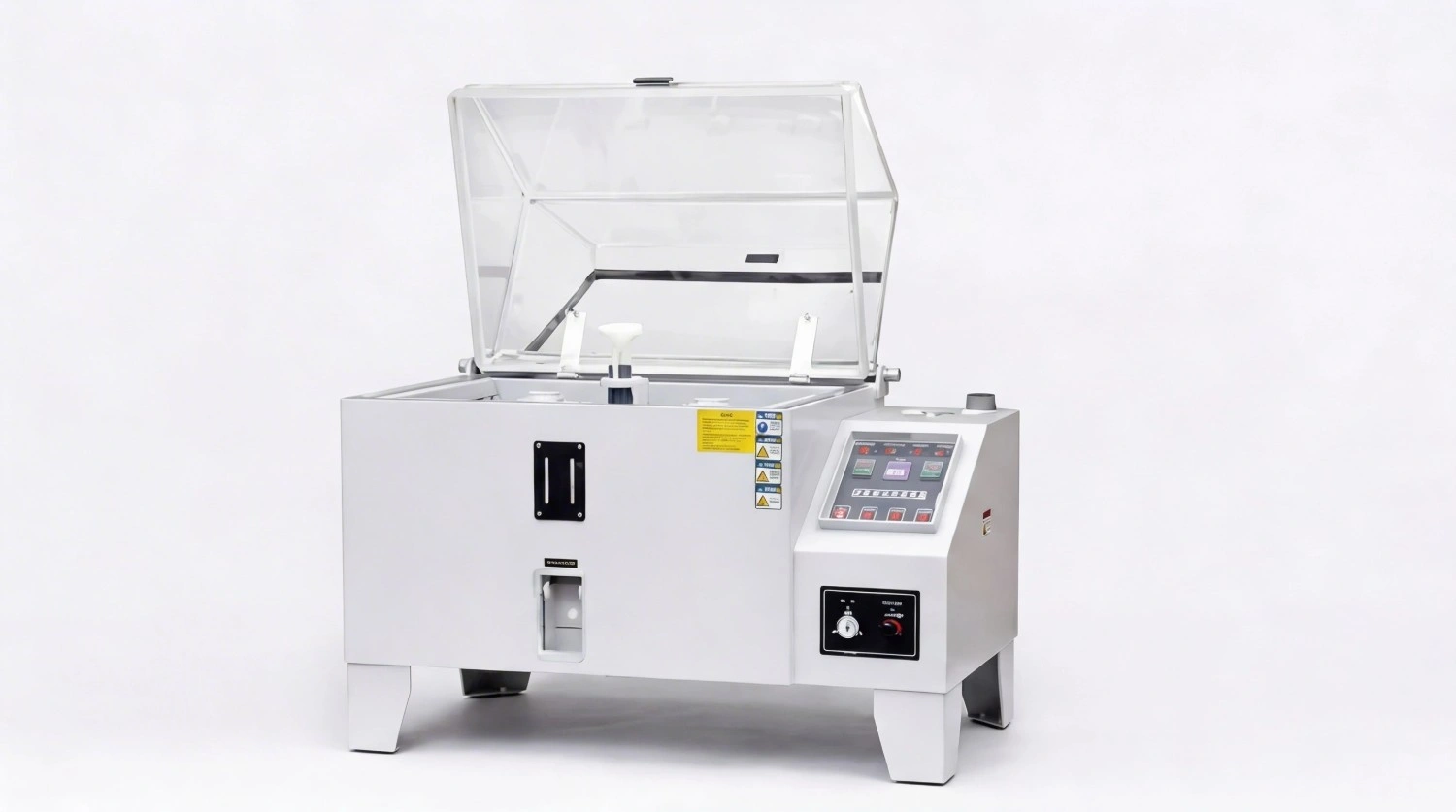
In automotive, construction, and marine applications, rust is a serious problem that affects various industries silently. Over time, metals and coated materials begin to degrade from chemicals or salty environments due to exposed moisture. Maintenance is important for the best performance with minimal cost. This machine provides the best testing material with accuracy and a quick response and meets standards with the best quality. Many industries depend on the Salt Spray Test Chambers to control the performance for better results. For this, the Bionics Consortium is perfect for you.
To measure the rust resistance of materials and coatings, the best testing machine is a salt spray chamber because this machine provides the best accuracy with great performance. It creates a controlled environment where a fine mist of salt solution is continuously sprayed onto test samples. The purpose of this machine is to provide the best result with accuracy to industries so that they work without any rust. Now, many industries depend on the Salt Spray Test Chambers to check consistency, durability, and compliance with international standards.
To deal with metal and coated components, the use of the salt spray chamber is very important for any industry. Without proper testing, products may fail before their time, and this can lead to safety risks and financial losses.
With these advantages, expand the range of salt spray for continuous use.
Trivia
Some coatings can withstand over 1000 hours of salt spray without rusting.
Salt spray testing follows globally recognized standards to give regular and reliable results. Here are two important standards.
ASTM B117
ASTM B117 is one of the oldest and most widely used salt spray testing standards. It focuses mainly on normal salt spray testing.
This standard is commonly used for general rust testing and comparison of coatings.
ISO 9227
ISO 9227 accepts an international standard that offers more flexibility. It includes multiple test methods depending on the applications.
ISO 9227 is often preferred for industries requiring more advanced and application-specific testing.
Bionics Consortium is a company that deals with the provision of high-quality environmental test chambers and laboratory equipment. As a company that highly values innovation and accuracy, Bionics develops and produces sophisticated testing systems serving numerous industries, including pharmaceuticals, electronics, automobiles, and research laboratories. We have been providing this service to industries for more than 25 years with ISO certification. The company has a diverse product line that includes salt spray chambers, environmental chambers, laboratory chambers, Humidity Chambers, and laboratory indicators, among other related products. All the products are designed to provide accurate, reliable, and consistent performance to ensure that clients obtain optimal testing performance. The customer-oriented strategy and emphasis on quality have made Bionics remain a reliable partner to the companies that want reliable and efficient laboratory solutions.
Trivia
The fog inside the chamber is so fine that it looks like cloud mist.
Here is the comparison table of ASTM B117 and ISO 9227 with the features:
| Feature | ASTM B117 | ISO 9227 |
|---|---|---|
| Test Methods | NSS only | NSS, AASS, CASS |
| Flexibility | Limited | High |
| Application | General testing | Advanced applications |
| Global Acceptance | Widely used | Internationally standardized |
| Complexity | Simple | Moderate to advanced |
Different salt spray tests are used based on the material and the environment it will face.
This is the most common test. It uses a normal (neutral) salt solution and is used for basic corrosion testing.
It is mostly used for decorative coatings. To make corrosion happen fast, the test uses a little acidic solution to make corrosion happen faster.
This is a stronger and faster test. It is used for high-quality coatings that need quick and tough testing.
It includes a cycle of salt spray, drying, and humidity to copy real-life conditions. Also, this is the real thing.
Modern salt spray chambers are designed with advanced features to check accurate and repeatable results.
Top Salt Spray Chamber Manufacturers focus on durability and precision while designing these systems. Choosing equipment from reliable Salt Spray Chamber Manufacturers provides long-term performance and accurate testing results.
Trivia
Salt spray testing can simulate years of corrosion in just a few days or weeks.
It is important to follow the correct testing procedure and maintain standard parameters for accurate results.
Here are the parameter table and value of salt spray.
| Parameter | Typical Value |
|---|---|
| Temperature | 35°C |
| Salt Concentration | 5% NaCl |
| pH Level | 6.5 – 7.2 |
| Test Duration | 24 to 1000+ hours |
| Spray Pressure | 0.7 – 1.2 bar |
Receive consistent performance with proper maintenance and increase the life of the equipment.
For accurate testing with long-term reliability, selecting the right salt spray chamber is important.
The Salt Spray Chamber Price is also important, and this also depends on features, size, and automation levels. For better decisions, you can compare the Salt Spray Chamber Price with the different suppliers and make cost-effective choices without compromising the quality.
Here is the related topic you might be interested in:
Environmental Test Chamber—Definition, Uses & Types
Trivia
Temperature control is crucial—just a few degrees' difference can affect results.
For checking durability and material rust condition, salt spray testing is very important. The industries can easily meet global quality standards. 1. ASTM B117 2.9227. When you invest in the right testing machines, you receive the product's performance and reduce the long-term cost. It helps you to make better decisions and achieve reliable results when you understand the methods, features, and selection criteria.
For sourcing the high-quality salt spray testing chambers and other related products. Contact us now.
Salt spray test chambers are used to evaluate the corrosion resistance of materials and coatings by exposing them to a controlled salt mist environment. This process helps manufacturers understand how products will perform in harsh conditions. It is widely used to test metals, coatings, and finishes before they are approved for industrial or commercial use.
Salt spray testing is commonly used in the automotive, marine, construction, aerospace, and electronics industries. These sectors rely on corrosion testing to ensure product durability and safety. By simulating real-world environmental conditions, companies can identify weaknesses early and improve product quality before releasing them into the market.
Several factors influence performance, including temperature, salt concentration, pH levels, and spray pressure. Proper calibration and maintenance are essential to ensure accurate results. Even small variations in these parameters can affect the outcome, so maintaining consistent testing conditions is crucial for reliable corrosion evaluation.
The duration of a salt spray test can range from 24 hours to over 1000 hours, depending on the material and testing requirements. Short tests are used for quick comparisons, while longer durations help evaluate long-term corrosion resistance. The test length is usually defined by industry standards or specific product requirements.
Several factors influence performance, including temperature, salt concentration, pH levels, and spray pressure. Proper calibration and maintenance are essential to ensure accurate results. Even small variations in these parameters can affect the outcome, so maintaining consistent testing conditions is crucial for reliable corrosion evaluation.
Choosing the right chamber depends on factors such as size, compliance with ASTM and ISO standards, automation features, and durability. It is also important to consider long-term support and maintenance services. Comparing features along with budget helps ensure you select a chamber that meets both performance and cost requirements.


Connect with us for your business enquiries. Generally, we respond within a day.