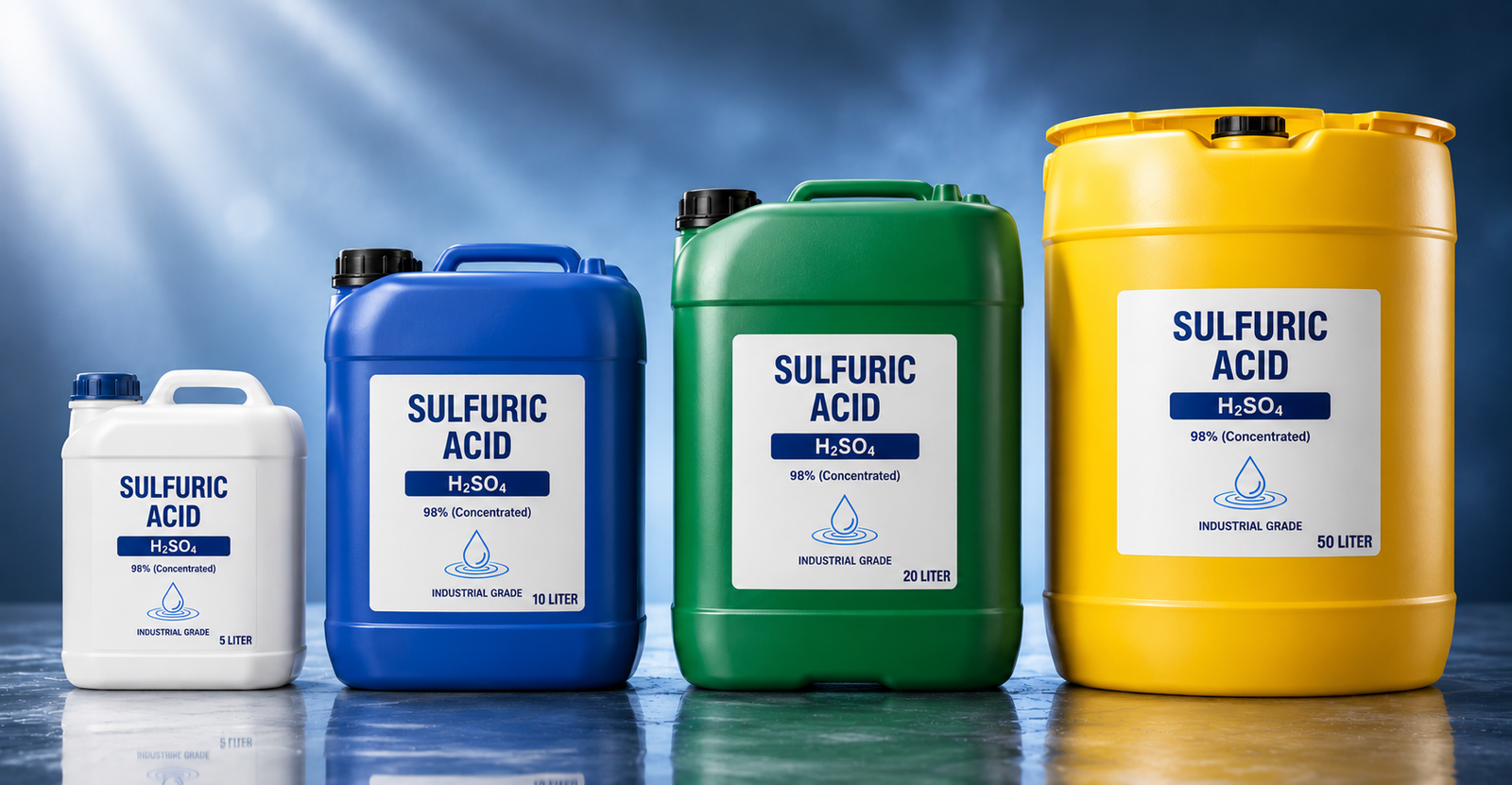
Sulfuric acid is among the most extensively used industrial chemicals globally. In fertilizer production, gasoline production, water treatment, and battery manufacturing processes, among others, the use of sulfuric acid becomes critical for industries in the current age. Learning about sulfuric acid uses, sulfuric acid formula, laboratory chemicals. sulfuric acid properties, concentrated sulfuric acid, sulfuric acid density, and sulfuric acid applications will assist industries to become more efficient and effective.
Sulfuric acid (H₂SO₄) is a very strong mineral acid that is highly corrosive and industrially significant. This is a colorless and odorless liquid, which is made up of hydrogen, sulfur, and oxygen. The production of this substance worldwide exceeds 250 million metric tons per year; hence, it is referred to as "King of Chemicals."
Sulfuric acid has the formula:
H₂SO₄ Sulfuric acid
The chemical formula of sulfuric acid has:
2 Hydrogen atoms (H)
1 sulfur (S) atom
4 O Oxygen Atoms
The properties of sulphuric acid are important for industrial applications.
|
Property |
Value |
|
Chemical Formula |
H₂SO₄ |
|
Molecular Weight |
98.079 g/mol |
|
Appearance |
Colorless liquid |
|
Boiling Point |
337°C |
|
Melting Point |
10°C |
|
Solubility |
Completely soluble in water |
|
Density |
1.84 g/cm³ |
These sulfuric acid properties make it valuable in numerous industrial processes.
The sulfuric acid density of concentrated sulfuric acid is roughly:
1.84 g/cm³ at 25°C
The density is very significant in chemical dosing, quality control, storage, and process control in industries.
Concentrated sulfuric acid generally has 95% to 98% H₂SO₄.
Due to these characteristics, the concentrated sulfuric acid finds wide application in chemical manufacturing and water treatment plants.
Some of the major applications of sulfuric acid include the following:
Thus, the applications of sulfuric acid make it one of the most important industrial chemicals.
The most important use of sulfuric acid is that of water treatment.
Uses of sulfuric acid are as follows:
These are the few uses of sulfuric acid.
Used for the production of phosphoric acid, superphosphates fertilizers, and ammonium sulfates.
Assists in fuel purification and improves gasoline by alkylation process.
Acts as the electrolyte in lead-acid batteries.
Used for making detergent, dyes, acids, and chemicals.
Utilized in the processing of metals such as rust removal from steel.
Used in leaching of ores.
Oleum is then diluted to make concentrated sulfuric acid.
Proper handling is essential because sulfuric acid is highly corrosive.
About BionicsRO
BionicsRO is engaged in providing latest industrial water treatment solutions like RO Plants, ETP Plants, STP Plants, DM Water Plants, Water Softeners and Chemical Dosing Systems.
This versatile mineral acid plays a crucial role in manufacturing, water treatment, energy storage, and chemical processing industries worldwide. Its wide range of uses, excellent chemical properties and importance in the manufacturing industry makes it an essential component in any industry.
In need of the latest water treatment solutions?
BionicsRO provides you with customized RO Plants, ETP Systems, STP Plants, DM Water Plants and Chemical Dosing Systems.
Contact BionicsRO now for a complimentary consultation and know which is the best water treatment solution for your organization.
Some applications of sulfuric acid include fertilizers production, water purification, oil refining, batteries manufacture, and chemicals manufacture.
The sulfuric acid chemical formula is H?SO?.
The formula for sulfuric acid is H?SO?.
The density of concentrated sulfuric acid is 1.84 g/cm³.
Sulfuric acid is corrosive, acidic, dehydrating, and reactive.
Concentrated sulfuric acid is 95 percent to 98 percent sulfuric acid by weight.
Uses include pH control, alkalinity reduction, RO pretreatment, wastewater treatment.
These are the fertilizer, chemical, mining, petroleum, pharmaceutical, textile and water treatment industries.
Due to its production volume that shows industrialization and its use in several industries.
corrosion-resistant storage tanks


Connect with us for your business enquiries. Generally, we respond within a day.