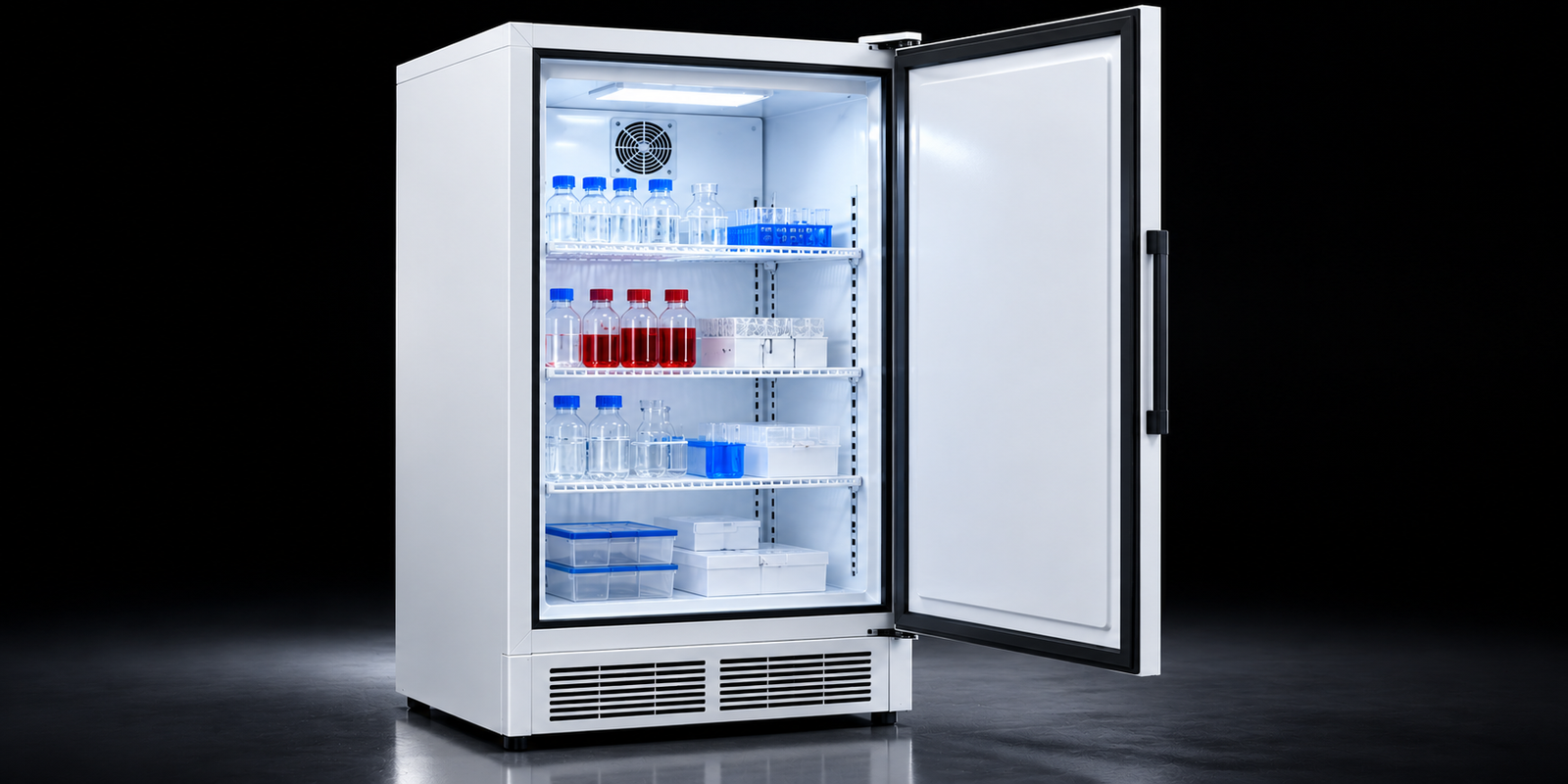
Quick answer: A laboratory refrigerator is a purpose-built cold storage unit that holds reagents, media, vaccines and samples at a controlled 2 °C to 8 °C, with tight temperature uniformity, alarms and monitoring that a domestic refrigerator does not offer. Bionics Consortium manufactures laboratory refrigerators for research, quality control, hospital and academic laboratories. For an accurate quotation, specify capacity, cooling type, door type, voltage and what you will store.
Lose a shelf of reagents to a warm pocket, or a batch of media to an overnight compressor fault, and the purchase price stops being the main cost. This guide is written for the person approving the purchase: what a Laboratory Refrigerator is, how it works, which specifications matter, and what to ask a Laboratory Refrigerator manufacturer before ordering.
A laboratory refrigerator is a vapour-compression cooling unit that holds a defined temperature, normally 2 °C to 8 °C, across the whole usable interior, not just near the sensor. It differs from a household unit in four ways: a calibrated digital controller, air circulation or insulation that limits variation between shelves, alarms for out-of-range conditions, and construction suited to cleaning and lockable access.
Typical contents are buffers, enzymes, antibodies, culture media, diagnostic kits and vaccines. Sub-zero items need a freezer, and flammable solvents need a spark-free design.
A closed vapour-compression loop does the cooling. The compressor raises refrigerant pressure, the condenser rejects heat to the room, and the refrigerant then expands through a capillary or expansion device and evaporates, absorbing heat from the cabinet. The controller cycles the compressor around the setpoint.
Two details separate good units from basic ones:
Hydrocarbon refrigerants such as R600a and R290 are common in this class. Confirm the refrigerant on the datasheet for your model.
Values below are usual configurable ranges for this equipment category. Confirm final figures on the datasheet and quotation.
|
Parameter |
Typical specification |
|
Storage temperature |
2 °C to 8 °C (setpoint commonly around 5 °C) |
|
Cooling method |
Static or forced-air |
|
Capacity |
Undercounter to upright multi-door; chosen by usable litres |
|
Controller |
Microprocessor, digital display, programmable alarm limits |
|
Alarms |
High/low temperature, door ajar, power failure, sensor fault |
|
Refrigerant |
Hydrocarbon (R600a or R290), per model |
|
Insulation |
CFC-free polyurethane foam |
|
Interior / exterior |
Stainless or coated steel interior; powder-coated or stainless body |
|
Doors and shelves |
Solid or glass, lockable; adjustable shelving |
|
Monitoring options |
Data logger, chart recorder, USB/serial output, remote alert (model dependent) |
|
Power supply |
Single-phase; 230 V, 50 Hz for India; other supplies on request |
Work through these points before requesting a quote.
Price depends on capacity, cooling type, door type, controller and alarm level, data logging, interior material and spark-free construction. Compare written quotations against one identical specification sheet.
These are generic categories, not named competitor products.
|
Criteria |
Basic static |
Forced-air digital |
Pharmacy / vaccine-grade |
Spark-free |
|
Best for |
Small labs, light use |
Busy research and QC labs |
Vaccines, regulated stock |
Flammable reagents |
|
Cooling |
Static |
Fan-assisted |
Fan-assisted |
Static or fan-assisted, sealed electricals |
|
Uniformity |
Moderate |
Better |
Best of standard range |
Depends on design |
|
Alarms |
Basic |
Full set |
Full set, often logged |
Full set recommended |
|
Relative cost |
Lowest |
Mid |
Higher |
Highest |
Pan-India. Most laboratories run on 230 V, 50 Hz single-phase supply, but heat, humidity and voltage variation are the real stress points. Specify ventilation clearance and a stabiliser.
Middle East (Saudi Arabia, Oman, UAE). High summer ambient temperature increases compressor duty, so ask for the model's ambient rating. Saudi Arabia commonly uses 220 V at 60 Hz, with 127 V in some areas. State local supply when ordering.
USA. Supply is typically 120 V at 60 Hz, which changes compressor and controller selection.
For exports, confirm Incoterms, sea-freight packing and customs documents in the quotation.
Bionics Consortium positions itself as the manufacturer, which decides who answers technical questions, who supplies spare parts and who stands behind the warranty. Add verified facts only:
Request the datasheet, test report, manual, warranty terms and calibration guidance from any supplier, including us.
Check that a supplier states the temperature range with uniformity data, gives capacity and dimension tables, explains cooling type, covers flammable storage, lists voltage options for your country, includes maintenance notes and real buyer answers, and proves it manufactures the equipment. This page covers those points so you can decide without chasing basics.
Verify temperature against a calibrated probe at least annually. Clean interiors and gaskets regularly, keep a log of readings and alarms, never store food or drink inside, and let the unit stabilise before loading stock.
To buy a Laboratory Refrigerator that fits your workflow, send us your required capacity, storage temperature, cooling type, door preference, supply voltage and country of installation. We will reply with a datasheet and written quotation for the exact model; applicable certificates and documentation are available on request. Contact Bionics Consortium to discuss your requirement or arrange a technical call.
It stores reagents, vaccines, culture media, test kits and biological samples at a controlled 2 °C to 8 °C, using calibrated controls, alarms and even airflow.
Set it between 2 °C and 8 °C, with a working setpoint near 5 °C. Always follow the temperature printed on the reagent label.
A laboratory unit offers tighter uniformity, a calibrated controller, alarms and lockable doors. A domestic unit allows wider swings and may have sparking parts.
Only in a spark-free refrigerator built for flammable storage. Standard units can ignite solvent vapour.
Price depends on capacity, cooling type, door type, alarms, logging and spark-free construction. Ask the manufacturer for a written quotation against your exact specification.
Measure current storage volume and add free space for airflow. Undercounter models suit small benches; upright models suit shared or QC labs.
Forced-air gives more even temperature and faster recovery, suiting busy labs. Static cooling is simpler for small, lightly used cabinets.
India uses 230 V, 50 Hz. Saudi Arabia commonly uses 220 V, 60 Hz; the USA uses 120 V, 60 Hz. State your local supply when ordering.
Check temperature against a calibrated probe at least yearly. Clean interior and gaskets regularly, and vacuum the condenser coil every few months.
Confirm the seller manufactures the unit. Ask for the datasheet, uniformity test data, warranty terms, spare-part availability and local service coverage.


Connect with us for your business enquiries. Generally, we respond within a day.