Quick Answer
A vacuum tray dryer is a drying system that removes moisture from powders, granules, and pastes under reduced pressure, so water evaporates at a much lower temperature than in a normal oven. Less heat means no scorching, no oxidation, and no loss of the active compound you're trying to protect.
If you're here because a batch keeps coming out discolored, under-potent, or inconsistent from your current dryer, this is very likely the fix. If your material handles heat just fine, you don't need to spend the extra money — a conventional dryer will do.
Nobody searches for a vacuum tray dryer out of curiosity. Almost every buyer we talk to starts from one specific frustration: a product that's sensitive to heat, and a current drying method that's quietly damaging it batch after batch.
Maybe it's a herbal extract that loses its color and potency every time it sits in a hot air oven for too long. Maybe it's an API that starts degrading past a certain temperature, and QA keeps flagging batches. Maybe it's a fine chemical powder that oxidizes the second it's exposed to open air for hours. The symptom is different every time, but the underlying question is always the same: is there a way to dry this without cooking it?
That's the exact gap a vacuum tray dryer fills. Dropping the pressure inside a sealed chamber lets moisture evaporate at 40–70°C instead of 100°C+, and because the chamber stays closed, there's no air stream carrying oxygen across the product either. Lower heat plus no oxidation is usually the combination that finally stops the batch failures.
Not every heat-sensitive product actually needs a vacuum system — sometimes a slower conventional cycle at reduced temperature solves it just fine, and a vacuum tray dryer is overkill you'll pay for unnecessarily. It genuinely makes sense when at least one of these is true for you:
Your product starts degrading, discoloring, or losing potency somewhere below 80°C — most APIs and botanical actives fall into this range. Your material can't tolerate airflow or agitation, only paste-like or sticky products that a fluid bed or hot air dryer physically can't handle well. Or you're operating under GMP and need a documented, low-contamination process with an audit trail, which a vacuum system gives you far more cleanly than an open tray oven.
If none of that describes your situation, it's worth telling your supplier that upfront — a good manufacturer will say so rather than sell you a system you don't need.
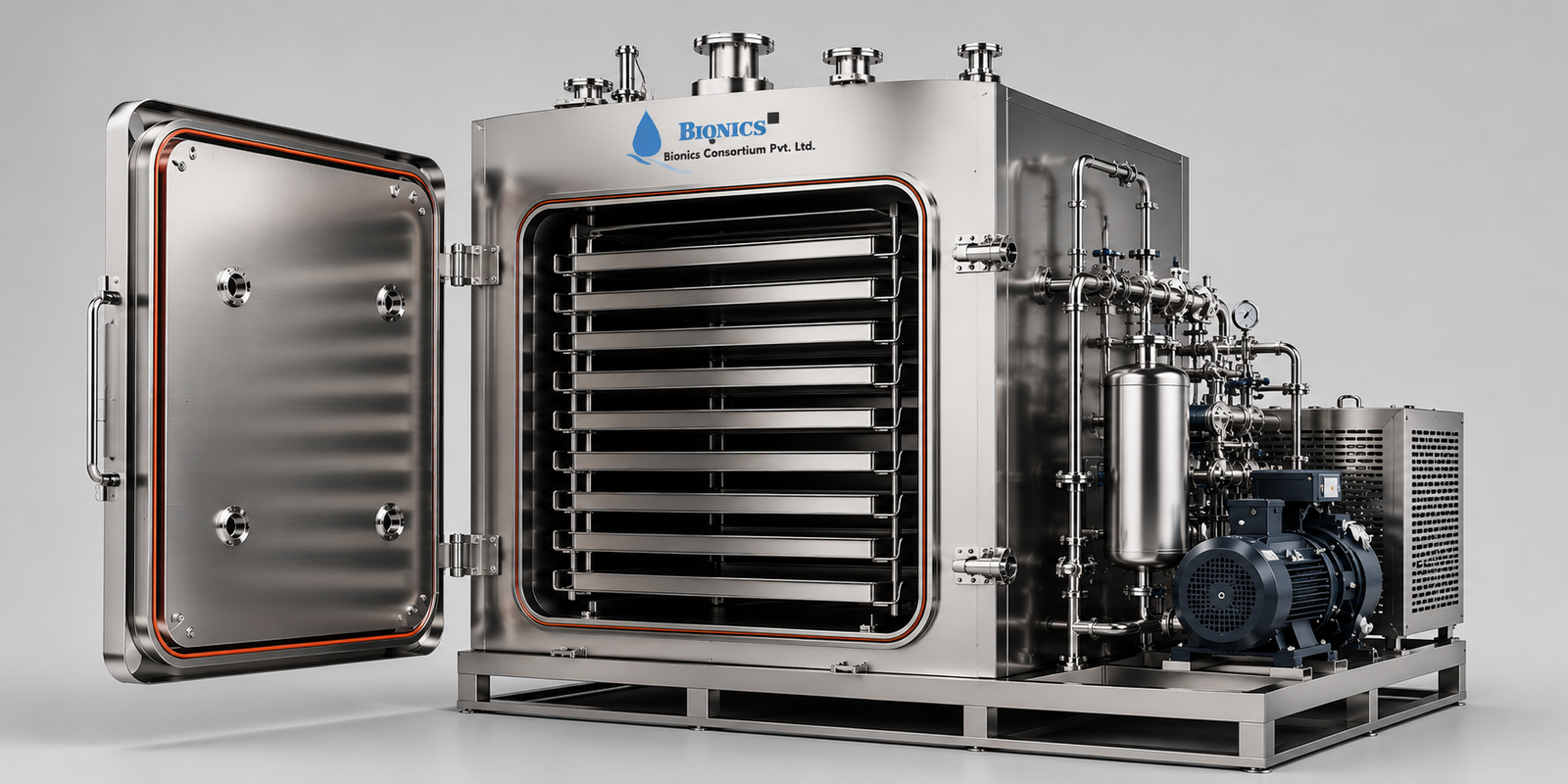
Picture a sealed steel chamber with a stack of hollow shelves inside, each one carrying hot water through it like a radiator. You load wet material onto trays, slide them onto the shelves, seal the door, and pull a vacuum. Because pressure drops, the moisture in your product boils off at a much lower temperature than it would in open air.
Heat reaches the product by conduction — straight from the shelf into the tray — not by blowing hot air across it. That's the detail that actually protects the product: no air stream to oxidize the surface, and no open exposure letting contamination or dust in. This is also the answer most engineers are looking for when they dig into the working principle before defending the choice internally.
The cycle, in practice, looks like this:
Cycles typically run 4 to 10 hours, with shelf temperature held around 40–70°C — comfortably under the point where most sensitive compounds start breaking down.
A pattern we run into constantly: a client has been running a hot air tray dryer for years, and a newer, more delicate product line starts failing QA — discoloration, lower assay values, inconsistent moisture readings across the same batch. The instinctive fix people try first is cutting the drying time short, which just leaves the product under-dried. The real fix is almost always lowering the temperature, and that's only practical once you're under vacuum.
The other mistake we see constantly on the buying side: people under-spec the vacuum pump to save money upfront. It almost never actually saves anything — an undersized pump means longer cycles and higher energy cost per batch, and that gap usually erases the initial savings within a year. It's a small line item on a quote that quietly decides whether the dryer runs smoothly for a decade or needs constant service calls.
|
Parameter |
Standard Model |
Notes |
|
Tray Capacity |
12 to 96 trays |
Sized to your batch, not the other way around |
|
Chamber Material |
SS 316 / SS 304 |
SS 316 for anything pharma-grade |
|
Heating Medium |
Hot water or steam |
Conduction heating through hollow shelves |
|
Operating Temperature |
40°C to 90°C |
Set via PLC or manual controller |
|
Vacuum Level |
Up to 700 mmHg |
Liquid ring vacuum pump |
|
Cycle Time |
4–10 hours |
Varies with moisture load |
|
Controls |
PID / PLC with HMI |
Cycle logs for audit trail |
|
Compliance |
GMP, cGMP, WHO, USFDA-ready |
DQ/IQ/OQ docs supplied |
Our compliance benchmarks are built around WHO's published good manufacturing practice guidelines for pharmaceutical equipment, which is the reference most regulatory auditors check against.
This is usually the last comparison buyers make before committing, so here it is side by side.
|
Factor |
Vacuum Tray Dryer |
Conventional Tray Dryer |
|
Drying temperature |
Low, 40–70°C |
High, 80–150°C |
|
Best for |
Heat-sensitive, high-value material |
Bulk, heat-stable product |
|
Oxidation risk |
Low — sealed chamber |
Higher — open air exposure |
|
Running cost per batch |
Better for small/medium runs |
Better at large continuous volumes |
|
Contamination control |
Tighter, closed system |
Looser, open trays |
|
Typical buyer |
Pharma, nutraceutical, R&D labs |
Food processors, bulk chemical plants |
|
Upfront cost |
Higher |
Lower |
If you're also weighing a fluid bed dryer: that moves air through the product rather than resting it on trays, which is faster for free-flowing granules but unusable for pastes or anything that can't tolerate agitation. A vacuum tray dryer wins specifically when your material can't handle heat, airflow, or both.
At this stage most buyers aren't debating whether they need one anymore — they're deciding who to buy it from, and that's where the real risk sits.
Confirm your actual batch size before anything else; an oversized chamber takes longer to pull uniform vacuum and wastes energy running partial loads. Check the contact material — SS 316 if you're pharma-regulated, SS 304 is fine otherwise — because this isn't something you can retrofit later. If you're under GMP, ask directly whether IQ/OQ/DQ documentation ships as standard, since getting it after installation is far more expensive and slower. And ask about the service network specifically — vacuum pumps and door gaskets need periodic attention, and a supplier who can't reach you regionally becomes a real cost two or three years in, no matter how good the initial price looked.
We build every unit in-house, pressure-test it, and validate it against IQ/OQ protocols before it leaves the shop floor. Our engineers handle installation on-site and stay on for servicing afterward — which is really why most of our repeat orders come from existing clients buying a second or third unit rather than shopping around again.
Still not sure if a vacuum tray dryer is the right fit for what you're drying? Talk to the Bionicsro engineering team — we'll tell you honestly if you need one, before we talk configuration.
If your material starts degrading, discoloring, or losing potency below roughly 80°C, or can't tolerate airflow at all, a vacuum system almost always solves it. If it's heat-stable, a conventional dryer is cheaper and just as effective.
Yes, with explosion-proof electricals and nitrogen purging built in. Bionicsro configures these on request for solvent-based processing.
Typically 4 to 10 hours, depending on starting moisture content, tray loading density, and your target residual moisture spec.
Yes, we offer 12 to 24 tray lab-scale models specifically for pilot batches before anyone commits to full production capacity.
Mainly vacuum pump oil checks, door gasket inspection, and periodic condenser cleaning — roughly a monthly task for units running continuously.
Yes. Installation, commissioning, and full IQ/OQ/DQ documentation are handled by our team so the unit is audit-ready from day one.


Connect with us for your business enquiries. Generally, we respond within a day.