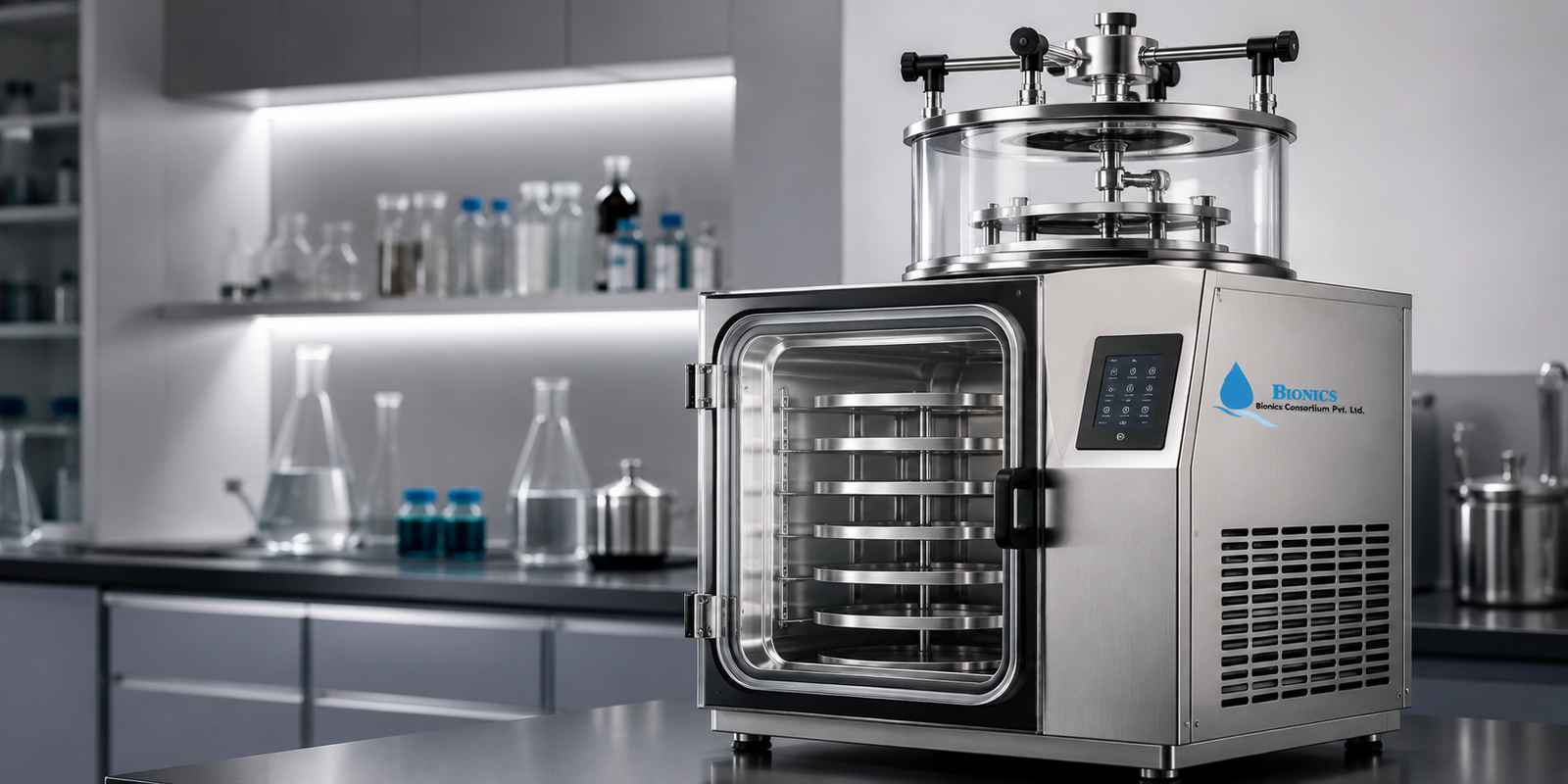
Most labs don't think much about their freeze dryer until it stops behaving the way it used to — a cycle that used to finish overnight now runs long, or a batch comes out patchy. Buying the right laboratory freeze dryer the first time avoids a lot of that. For research labs, biotech startups and pharmaceutical R&D teams in India, the decision affects sample consistency and how easily the lab scales later, which matters more in practice than who quoted the lowest price. This guide covers what a laboratory freeze dryer actually does, which specifications are worth comparing closely, and what to ask freeze dryer manufacturers before signing off on a quotation.
A laboratory freeze dryer — sometimes called a lyophilizer — takes a frozen sample and pulls moisture out under vacuum, so the ice turns straight into vapour instead of melting first. That's sublimation, and it's why freeze-dried material holds its structure so much better than anything dried with heat. You'll find these machines across pharmaceutical research, biotechnology, microbiology and materials science labs — anywhere a sample needs to come out stable, dry and easy to reconstitute later.
There are three stages, and each one does something different. Freezing comes first — the sample cools below its eutectic or collapse point until it forms a solid ice structure. Rush it, and the sample can collapse once drying starts. Primary drying is where most of the time goes: chamber pressure drops, shelf temperature is held steady, and the ice sublimates into vapour that travels to the condenser and refreezes there. Secondary drying finishes the job — shelf temperature is nudged up slightly to pull out whatever bound moisture remains, until the product hits its target final moisture level.
How well a lab controls vacuum stability, condenser capacity and shelf temperature uniformity through all three stages is usually what separates a repeatable cycle from an inconsistent one.
The vacuum pump is one of the vital components that determine the performance of freeze drying. In the comparison of laboratory freeze dryers, one needs to look at the type of pump used, the ultimate vacuum, and the pump down speed. Oil sealed pumps need frequent oil changes, while dry pumps minimize the problems of oil contamination. The pump size also needs to be appropriate in relation to the chamber volume and vapor load.
A vacuum freeze dryer keeps temperature-sensitive material intact in a way heat-based drying can't. Biological samples, vaccines, proteins and microbial cultures tend to degrade under heat, but they hold up well through sublimation and rehydrate quickly and predictably afterward.
Some specifications matter more than others depending on your application. Here's what each one actually tells you, and what to ask a supplier instead of guessing.
|
Specification |
Why It Matters |
What Buyers Should Check |
|
Condenser temperature |
Determines vapour-capture efficiency in primary drying |
Achievable temperature under load |
|
Condenser capacity |
Limits ice collection before performance drops |
Capacity vs. typical batch water content |
|
Shelf temperature range |
Affects which materials can be processed |
Min/max range and ramp rate |
|
Vacuum range/control |
Impacts sublimation rate and consistency |
How vacuum is measured and logged |
|
Chamber capacity |
Determines usable sample volume |
Usable shelf area, not just chamber size |
|
Shelf dimensions/configuration |
Affects tray/vial fit and even drying |
Shelf count, spacing, flexibility |
|
Refrigeration system |
Drives condenser performance and pull-down time |
Compressor type, pull-down time |
|
Control system |
Determines cycle repeatability |
Programmable recipes, alarms, remote monitoring |
|
Data logging |
Needed for documentation |
Parameters logged and export format |
|
Construction material |
Affects durability and cleanability |
Chamber/shelf material grade |
|
Stoppering (if applicable) |
Needed for in-chamber vial closure |
Included or optional |
|
Electrical requirements |
Affects installation planning |
Exact voltage, phase, load |
|
Service and maintenance |
Affects uptime and total cost |
Service intervals, parts availability, response time |
|
Factor |
Freeze Drying (Lyophilisation) |
Conventional Vacuum Drying |
|
Drying mechanism |
Sublimation of ice under vacuum |
Evaporation under vacuum and heat |
|
Product structure |
Preserved, minimal shrinkage |
Often collapses or shrinks |
|
Heat-sensitive material |
Well suited |
Limited suitability |
|
Rehydration |
Fast, near-original structure |
Slower, less predictable |
|
Process time |
Longer |
Generally shorter |
|
Typical use case |
Pharma, biologics, research samples |
Non-sensitive, bulk materials |
Before you even ask for a quotation, have clear answers ready on: what the sample or material is and how it reacts to temperature, your typical and maximum batch size, what containers you'll actually use (vials, trays, bottles, or bulk), how much shelf area you'll need now and later, your target final moisture level, and what the installation site offers in space, power and ventilation. Vague answers here tend to get vague recommendations back.
As far as formulation development is concerned, one needs to know the collapse temperature or the eutectic temperature of the product prior to choosing the operating parameters. The freeze dryer needs to be able to offer enough control for the product to stay within proper boundaries, which can help minimize the chance of product collapse.
Mention that buyers should look for:
This makes the article more useful for R&D and formulation-development teams, rather than just someone comparing machine sizes.
A manufacturer that answers these with specifics, rather than general assurances, is usually the safer bet long-term.
|
Factor |
Laboratory Freeze Dryer |
Industrial Freeze Dryer |
|
Typical application |
Research, formulation development |
Commercial-scale production |
|
Batch size |
Small to moderate |
Large |
|
Throughput |
Lower |
Higher |
|
Space requirement |
Compact, benchtop or small floor unit |
Larger dedicated facility |
|
Process development |
Primary use case |
Scaled from lab-developed cycles |
|
Automation |
Basic to moderate |
Typically higher |
|
Installation complexity |
Relatively simple |
Utilities planning, layout, validation |
|
Maintenance |
Simpler, less frequent |
More involved, scheduled programs |
|
Investment |
Lower upfront cost |
Higher capital investment |
|
Ideal buyer |
Research labs, biotech startups |
Pharma and contract manufacturers |
Before the machine arrives, confirm electrical load, cooling requirements for the refrigeration system, ventilation and floor space — ambient conditions can genuinely affect condenser and vacuum performance, especially without tight climate control.
Once running, the vacuum system, refrigeration circuit and seals need regular attention to stay reliable. Ask suppliers upfront how often maintenance is needed, whether trained service staff are nearby, and how quickly spare parts arrive. A machine that's hard to service locally will cost you in downtime, no matter how good the original price looked.
State factors affecting laboratory freeze dryer price including:
Then state the critical factor from the perspective of the buyer:
The lowest quote may not be the cheapest overall for the life of the laboratory freeze dryer. Pump maintenance, spares, energy consumption and downtime are also part of the laboratory freeze dryer price comparison.
Bionics Consortium Pvt. Ltd. (BionicsRO) works with laboratories on freeze-drying equipment selection, application-based configuration, installation support and after-sales service — starting from the sample and the process, not the machine, before recommending specifications to match.
A laboratory freeze dryer isn't a purchase you make once and forget — it's equipment your lab will rely on for years, so the specifics matter more than the sticker price. Matching condenser performance, shelf configuration, vacuum control and after-sales support to your actual sample and workflow is what separates equipment that just runs from equipment you can depend on.
If you're evaluating a laboratory freeze dryer for your facility, share your sample type, batch size and process requirements with the Bionics Consortium (BionicsRO) team for guidance suited to your application.
Removing moisture from temperature-sensitive samples via sublimation, for pharma, biotech and microbiology work.
It sublimates ice under vacuum instead of evaporating water with heat, which is gentler on sensitive materials.
It sublimates ice under vacuum instead of evaporating water with heat, which is gentler on sensitive materials.
It depends on batch volume, container type and shelf area — check usable shelf area, not total chamber size.
How much ice the condenser can collect before performance drops; it should match your typical batch water content.
Yes — commonly for formulation development, stability studies and small-batch trials.
Yes — commonly for formulation development, stability studies and small-batch trials.
Documented condenser performance, warranty terms, spare parts availability, installation support and a maintenance schedule.
Confirmed electrical load and phase, adequate ventilation, floor space, and stable ambient conditions.
Confirmed electrical load and phase, adequate ventilation, floor space, and stable ambient conditions.


Connect with us for your business enquiries. Generally, we respond within a day.