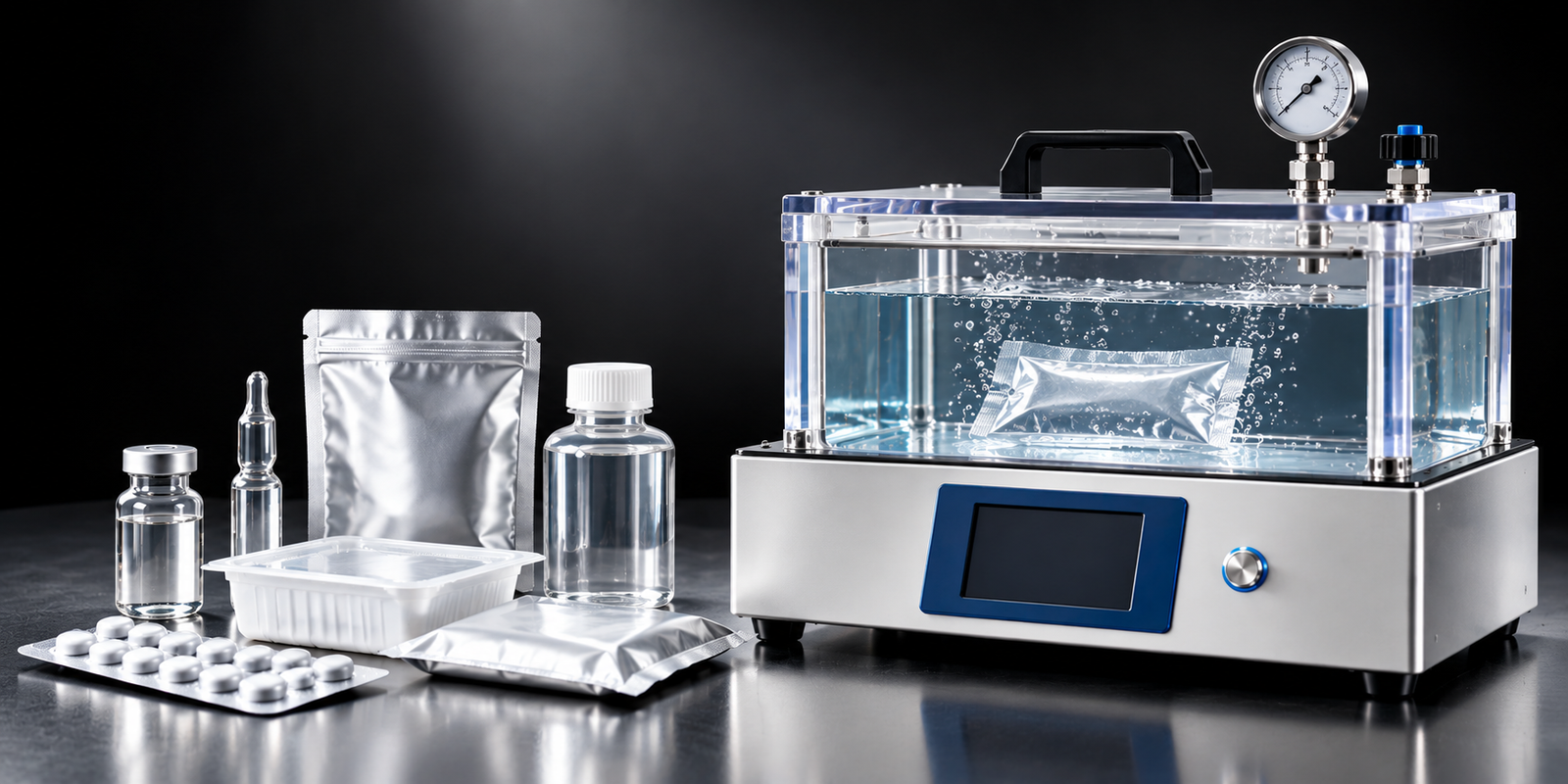
A good seal is not one that appears good. Pinholes in vial closures or weak seals of pouches or micro-cracks in plastics may spoil a batch of products or make a batch fail the audit. However, none of them is visible to naked eyes. Leak test equipment is used to find such defects before a product is shipped to a customer.
In the article, you will find information about the purpose of the equipment, basic differences between various leak testing methods, specs that have to be considered and questions that have to be asked to a manufacturer before purchase. This is the opinion of Bionics Consortium. The company is active in the laboratory equipment business for 26 years.
A leak test apparatus is used for determining if gas or fluid is leaking out of a sealed container, package or assembly that should not be leaking. This is accomplished by applying a differential pressure or vacuum to the sample and visually or by measurement determining the tightness of the seal.
The words leak tester, leak test machine and leak testing equipment are often used interchangeably.
Choosing a method comes before choosing a model, because each method detects different leak sizes and suits different samples.
|
Method |
Typical Sample |
Result Type |
Complexity |
|
Vacuum chamber (bubble emission) |
Pouches, bottles, containers |
Visual pass/fail |
Low |
|
Pressure decay |
Rigid, non-porous parts |
Quantitative |
Medium |
|
Vacuum decay |
Rigid and semi-rigid packages |
Quantitative |
Medium |
|
Dye penetration |
Blister packs, vials |
Visual, often destructive |
Low |
|
Helium mass spectrometry |
Critical sealed components |
Quantitative |
High |
The sample is placed in a clear chamber, usually filled with water, and a vacuum is applied. A leaking sample releases a stream of bubbles The method is simple and visual and hence popular for flexible packaging. However, the method is dependent on operator’s eye and is best for gross leaks.
Pressurizes the sample and looks for a pressure decrease. Vacuum decay does the opposite: it evacuates a chamber around the sample and looks for a rise in pressure. Both lead to measurable results and vacuum decay is non-destructive.
Dye tests are inexpensive and typically destroy the sample. Helium mass spectrometry can detect very fine leaks, but needs specialist equipment and expertise, so is usually used only for demanding applications.
If audits or validation are applied to your results, first determine the standard governing them. Some commonly cited examples are:
ASTM D3078 Bubble emission leak detection method for flexible packaging
ASTM F2096 – Method for Detecting Gross Leaks in Medical Packaging by Internal Pressurization
ASTM D4991: Vacuum method for leak testing of empty rigid containers
ASTM F2338: Non-destructive leak testing of packages by vacuum decay
USP <1207> — Package Integrity Testing of Sterile Products
Standards are updated periodically so check the current edition and your own regulatory requirements before buying.
Specifications depend on your samples, so compare these parameters rather than relying on a model name.
|
Specification |
Why It Matters |
|
Chamber size and shape |
Must fit your largest sample with room for fixtures |
|
Chamber material |
Transparent material is needed for visual bubble tests |
|
Vacuum range and control |
Decides which methods you can run and how repeatable they are |
|
Gauge or sensor type |
Digital sensors generally improve readability and repeatability |
|
Hold-time control |
Needed when your method specifies a set duration |
|
Sample fixtures |
Stop samples from floating or shifting during the test |
|
Build materials |
Should tolerate your cleaning agents and test liquids |
|
Calibration provisions |
Gauges and sensors should be calibratable and traceable |
Ask the supplier for the actual values for the exact model you are considering, and get them in writing.
There are certain important considerations when choosing equipment for quality control or research laboratory which generally take precedence over all else :
Your methodology requires you to use vacuum bubble test equipment. You can not replace it with pressure decay test equipment.
In case you will be testing a variety of packages, ensure that the chamber and fixtures can accommodate all of them.
Provide for repeatability. The ability to provide constant vacuum pressure levels and times for a test.
Visual methods rely on human observation and thus the standardization of the process reduces the variation amongst people.
Cost estimate that does not take into account your needs must be questioned. These are the primary considerations for the price of leak test apparatus: test technique, chamber size and material, automation extent, data collection system, accessory tools, fixture and seal replacements, customized solution to your samples, installation and training.
The most economical apparatus is not necessarily the least expensive in the long term. Poor repeatability could result in retesting, batch rejection or audit failure. Provide identical requirement sheets to each provider in order to have equal comparison of quotations.
When considering buying a leak test apparatus in India, some questions need to be asked in order to distinguish a reliable partner from a reseller:
If it asks about your samples and standards and recommends appropriate model
Documentation, calibration procedure and training are included with the unit
Experience plays a key role here. More than 26 years' experience with Bionics Consortium proves that a lot of problems with equipment are related to the misfit between instrument and
Let us know what you are testing and which standard you adhere to and we will assist you in determining the equipment suited for your needs before you seek a quotation. Visit our Contact Us page or write to us directly.
Phone: +91 91111 65391, +91 91555 15915 (Monday to Saturday 9:30 am – 6:30 pm)
Sales email: sales@bionicsro.com
Address: Bionics Consortium Pvt. Ltd., 153, Shakti Apartment, Ashok Vihar Phase 3, Delhi-110052
The importance of a leak test system is in delivering results that can be trusted and justified. Begin by specifying the methodology, the sample and the standard to use. Then compare specifications, support and cost. Customers who define such parameters at the outset usually get suitable equipment.
They verify whether there is a tightness of sealed vessels, packaging or parts using pressure or vacuum test methods and checking for any leakage.
The words are commonly used interchangeably. “Apparatus” usually describes simple lab test sets up while “machine” is used more for automated devices.
There is no single best testing method. It depends on the sample type, the size of the leak you have to find and the standard you follow.
It depends on the method, the size of the chamber, the automation and accessories. Discuss your needs, compare written estimates.
Check the chamber size and its materials, vacuum level and control, type of the gage or sensor, hold-time control, fixtures and calibration.
Usually yes, depending on the chamber size and fixtures for different types of samples, but consult with the manufacturer for each specific package format.
It depends on the test


Connect with us for your business enquiries. Generally, we respond within a day.