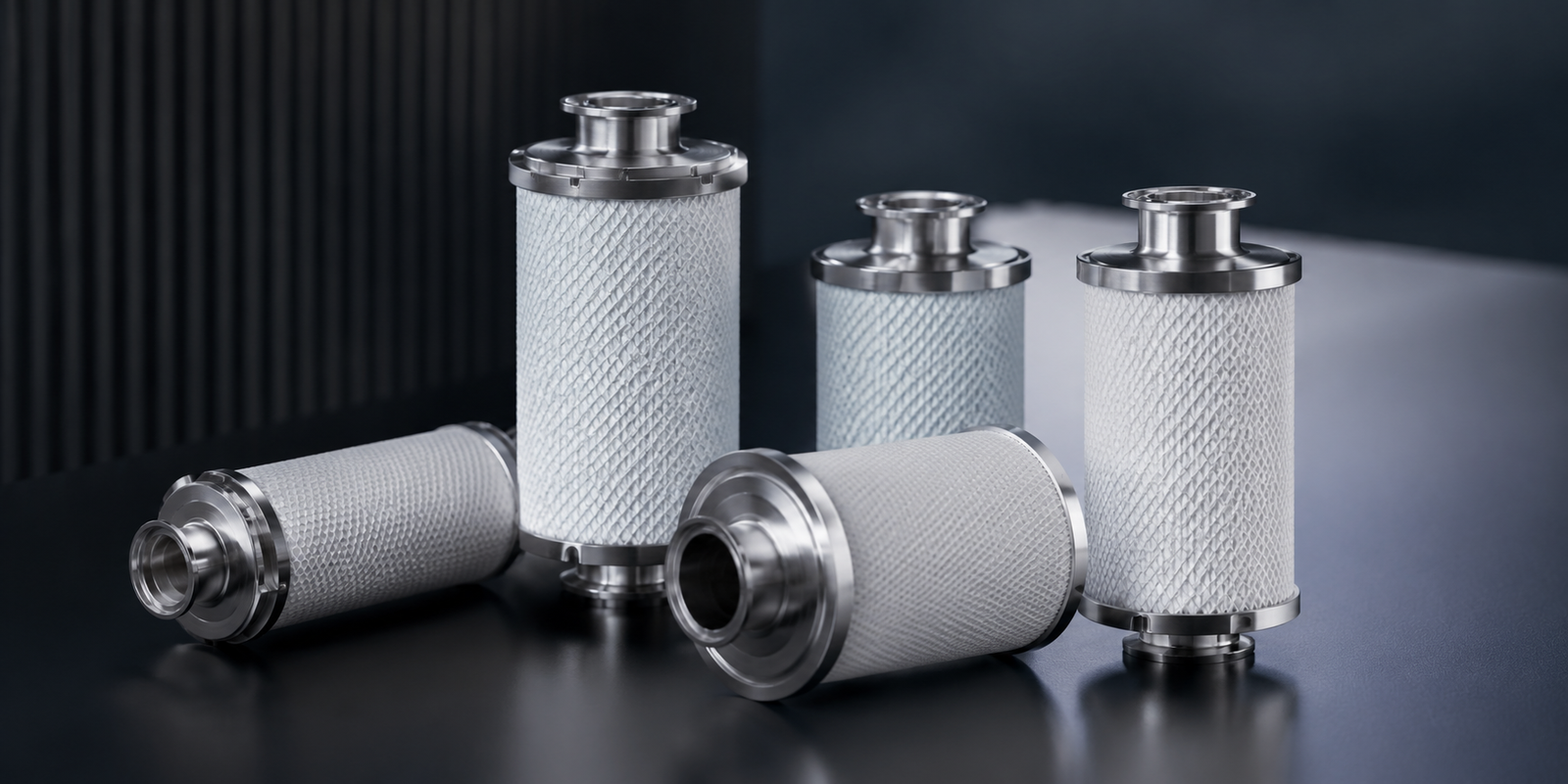
A vacuum pump that keeps pulling in particulates, or one that fails sooner than it should, usually points to something overlooked: the lyophilizer filter. When it's undersized, incompatible, or missing, you end up with pump wear, contamination risk, and repairs nobody budgeted for. For pharmaceutical, biotech, and laboratory buyers in India sourcing or replacing one, getting this right the first time saves trouble later.
It's the part sitting in the vacuum pathway, catching particulate, moisture carryover, or process residue before it reaches the vacuum pump. Depending on the machine, you'll find it near the condenser outlet, along the vacuum line, or right at the pump inlet. There's no "standard" lyophilizer filter that fits everything — the right type, material, and rating depend on your lyophilizer model, the pump attached to it, and what you're freeze-drying, whether pharmaceutical, biological, food, or research material.
Pump protection is the big one — particulate or moisture getting into the pump affects oil quality and wears down parts faster. Powdery products throw off fine particles during sublimation, and that debris shouldn't end up in your pump. A properly filtered system runs cleaner, needs fewer surprise service calls, and holds more stable vacuum levels. Pharmaceutical and biological work generally demands tighter contamination control than general lab use.
The water vapor sublimes from the frozen product to the condenser where it gets trapped as ice. The leftover gas proceeds further to the vacuum line towards the pump, and it is here that the filtration process takes place by capturing the particulates that somehow managed to make it past the chamber and condenser stages.
The lyophilization process works on the principle of sublimation, meaning the change from frozen form to vapor without passing through the liquid state, done under controlled vacuum and temperature. Three stages are involved here:
Freezing when the product freezes to the ice crystals.
Sublimation (primary drying) with the help of vacuum and controlled temperature where ice is turned into vapor.
Desorption (secondary drying) at increased temperature where bound moisture is removed.
The filtration is more important in the last two stages.
Product Chamber → Condenser → Vacuum Line → Filter/Protection Stage → Vacuum Pump
Exactly where it sits changes by manufacturer — some build it in near the chamber outlet, others at the pump inlet. Check your machine's documentation before ordering.
|
Specification |
Why It Matters |
|
Filter type & rating |
Determines pump protection and system cleanliness |
|
Material |
Must withstand vacuum, temperature, chemical exposure |
|
Connection size |
Must match your vacuum line exactly |
|
Vacuum compatibility |
Wrong rating restricts flow or fails under vacuum |
|
Temperature range |
Cycles involve varying thermal conditions |
|
Flow capacity |
Affects pump-down speed and cycle efficiency |
|
Maintenance & replacement |
Impacts downtime and long-term serviceability |
None of these are fixed across the board — they depend on your machine and manufacturer, so confirm rather than assume.
Start with your lyophilizer model and the pump it's paired with. Think about what you're processing — powders demand more filtration than liquids or solids. Check connection dimensions, make sure the material holds up chemically and thermally, and ask about maintenance needs and replacement availability. Supplier support matters more than people expect. Weigh total ownership cost rather than sticker price — buying on price alone is probably the most common way people end up with a filter that doesn't fit.
The usual ones: picking on price alone, not checking machine or pump compatibility, ordering the wrong dimensions or connection type, using a material unsuited to the application, skipping the replacement-availability question, assuming any filter fits any lyophilizer, and not asking the supplier to confirm compatibility before buying.
|
Component |
Main Function |
|
Filter |
Protects vacuum system from particulate |
|
Vacuum Pump |
Creates and maintains vacuum for sublimation |
|
Condenser |
Captures sublimated water vapor as ice |
|
Product Chamber |
Holds product/shelves during freezing/drying |
|
Vacuum System |
Complete assembly for low-pressure operation |
Capacity, chamber and condenser configuration, the vacuum pump, automation level, materials, application requirements, accessories, filtration, and after-sales support all factor in — which is why there's no single number that applies across machines. Compare total ownership cost, not just what you pay upfront.
That comes down to the vacuum pump's type and manufacturer specification — no one oil works across every machine. Stick to the pump manufacturer's documented grade and maintenance schedule.
Depends on the application and configuration. Nitrogen shows up often for controlled backfilling after drying, mainly to protect moisture-sensitive products, but it isn't required for every lyophilizer. Check your process protocol to be sure.

Configurations vary by manufacturer, so treat this as a general reference.
Look out for visible contamination, physical damage, a drop in vacuum performance, or increased pressure drop where measurable. Manufacturer recommendations take priority over any general rule, since contamination load varies by what you're processing — there's no single interval that works everywhere.
BionicsRO works with laboratories, pharmaceutical companies, and biotech firms to identify the right filter and component solutions for their setup — from understanding the application to guiding selection, technical compatibility, and after-sales support. If you're evaluating a [Lyophilizer Machine] or sourcing [Laboratory Equipment], BionicsRO can help match the right filtration to what you need.
Machine model, filter location, dimensions and connection type, filtration rating, material and vacuum compatibility, operating temperature, replacement availability, and supplier technical support.
Need help selecting or replacing a lyophilizer filter? Whether you're swapping out an existing filter, unsure about compatibility, or evaluating a new lyophilizer altogether, [Contact BionicsRO] with your machine model, application, and required specifications.
The component in the vacuum path that catches particulates before it reaches the pump. Exact type depends on the machine and manufacturer.
Freeze-drying through sublimation under vacuum — common in pharma manufacturing, biological preservation, research, and food processing.
It will help protect the vacuum pump and other system components from particulates.
It needs to match your model, pump, and application; check dimensions and materials; ensure availability through the supplier.
There’s no set interval – it depends on its contamination, wear and tear, performance, and manufacturer recommendations.
There are three steps: freezing, primary drying (sublimation) and secondary drying (desorption).
Sublimation — ice turns straight into vapor under controlled vacuum and temperature, no liquid phase involved.
Whatever the vacuum pump manufacturer specifies — varies by pump type.
Depends on the application; nitrogen shows up often for backfilling, but isn't required everywhere.
Depends on capacity, configuration, automation, and application needs — compare total ownership cost rather than one figure.


Connect with us for your business enquiries. Generally, we respond within a day.