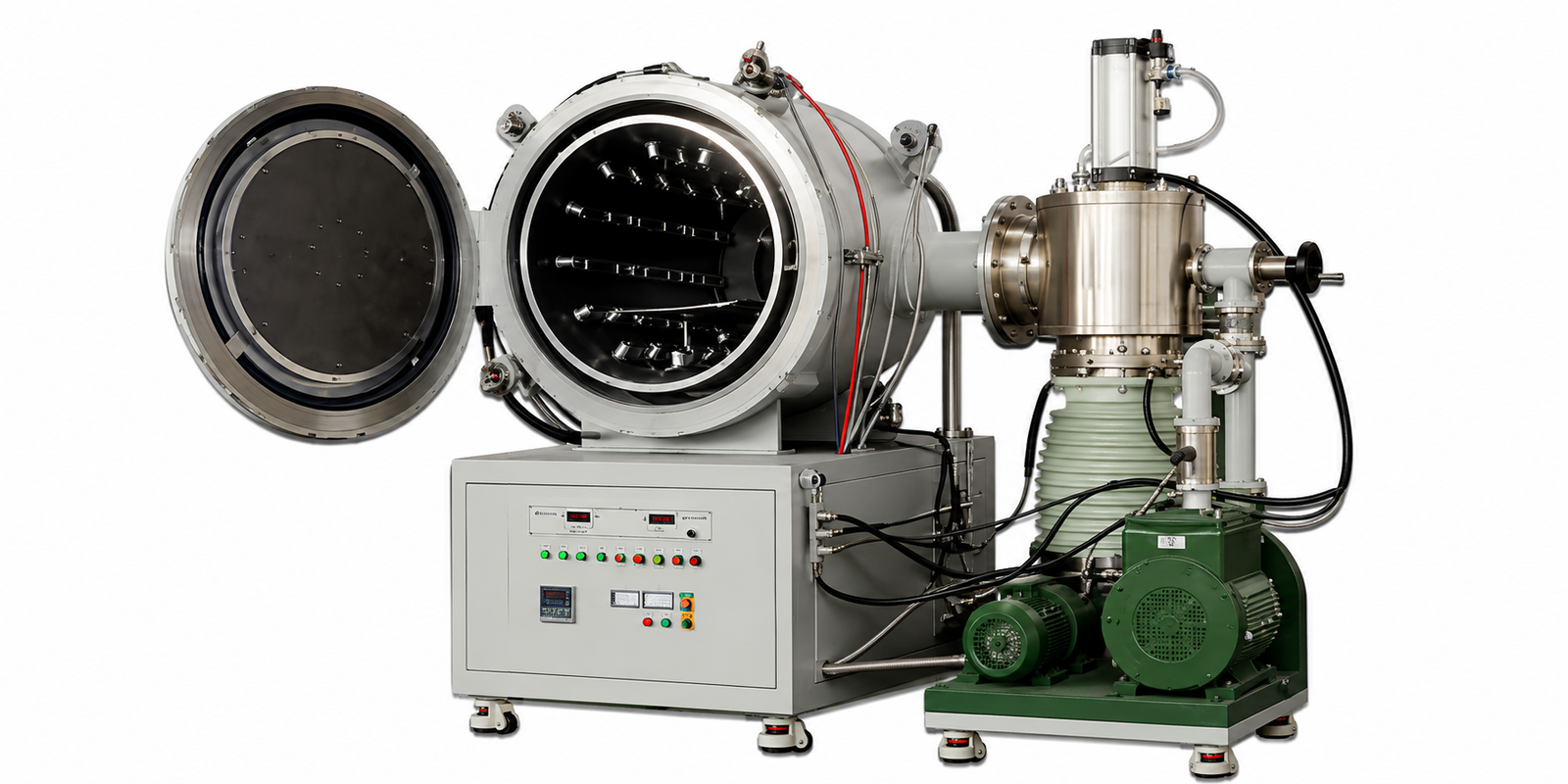
Furnace brazing sits in an odd spot between welding and soldering — close enough that people mix it up on a spec sheet, different enough that doing so ends in a failed joint. If you need to join dissimilar metals without melting the parent material, or specify a process that repeats cleanly across thousands of units, this is where it earns its keep. Here's what happens inside the furnace, where it shines, and how to pick the right variant for a given part.
At its core, furnace brazing melts a filler alloy — one with a lower melting point than the parts being joined — and pulls it into a tight joint gap by capillary action, inside a controlled-atmosphere or vacuum furnace. The base metals stay solid throughout. That's what separates it from welding, and why brazed parts come out with so little distortion.
Key takeaway: the joint forms through capillary flow of a filler alloy, not by fusing the parent metals.
Three things need to line up. The gap has to be narrow enough — usually 0.025 to 0.25 mm — for surface tension to pull filler through by capillary action. The surfaces need to be clean and oxide-free so the filler actually wets and bonds. And the furnace atmosphere — hydrogen, dissociated ammonia, nitrogen, or a hard vacuum — has to keep oxygen away long enough that oxides never form. Get that right and flux often isn't needed at all.
Filler goes in beforehand as rings, paste, foil, or wire, before the assembly enters the furnace as a batch load or on a conveyor for continuous production.
|
Type |
Atmosphere |
Typical Use Case |
|
Vacuum furnace brazing |
Vacuum (10⁻³ to 10⁻⁵ torr) |
Aerospace components, titanium, reactive metals |
|
Hydrogen atmosphere brazing |
Pure or dissociated hydrogen |
Stainless steel, electronic assemblies |
|
Nitrogen atmosphere brazing |
Inert nitrogen |
Copper and brass assemblies, general fabrication |
|
Continuous belt furnace brazing |
Often exothermic gas |
High-volume automotive and HVAC production |
|
Batch furnace brazing |
Vacuum or inert gas |
Low-to-medium volume, complex geometries |
Belt furnaces are built for throughput on repetitive parts. Vacuum batch furnaces trade speed for tighter control, which matters most on complex or reactive-metal assemblies.
Done well, furnace brazing gives clean joints with no flux residue, several joints brazed on one part in a single cycle, very little distortion, and reliable repeatability once dialled in. It handles combinations welding struggles with — steel to copper, for instance — without leaving a visible bead.
The trade-offs: furnaces cost a lot upfront, clearances need tight fixturing or the joint won't fill properly, oversized or one-off parts don't fit the economics, and the wrong filler can embrittle the base metal.
Aerospace uses vacuum brazing heavily for titanium and nickel-superalloy assemblies. Automotive plants lean on belt furnaces for heat exchangers, EGR coolers, and turbocharger parts. Electronics manufacturers use hydrogen-atmosphere brazing for hermetic seals, and HVAC producers braze copper joints in coils and manifolds at real volume. Medical device makers use it wherever corrosion resistance and a clean finish matter.
The material combination is relatively straightforward in that stainless steel uses nickel/silver alloy for its filler material, carbon and alloy steels use copper base filler material, while copper alloys use phosphor/copper or silver filler. Vacuum furnace brazing is used for titanium and nickel superalloys to prevent oxidation, while aluminum requires a more controlled atmosphere and specialized filler material. Detailed information regarding filler material selection and metallurgy of brazing is provided by the ASM International Brazing Resources. The combination of different metals is among the biggest advantages of brazing.
Match the filler to the base metal rather than reusing whatever's on hand. Keep clearances consistent across a run, not just within tolerance on paper. Watch the dew point in atmosphere furnaces — it drifts quietly and takes joint quality with it. Let fixtures accommodate thermal expansion, and check any new joint design metallurgically before full production.
Most problems trace back to the same handful of causes: rushed cleaning, too much filler covering a bad fit, skipped atmosphere checks, and filler chosen by price over compatibility.
Volume and material sensitivity usually settle it. Simple, high-volume parts in copper or steel belong on a belt furnace. Complex or reactive-metal assemblies — titanium aerospace brackets, for instance — justify a vacuum batch furnace. When unsure, a joint design review with a specialist costs far less than reworking tooling later. Atmosphere monitoring, robotic fixturing, and pre-engineered filler pastes are all becoming more common as additive manufacturing produces more parts that need brazing onto machined ones.
Furnace brazing earns its reputation on consistency. Get the joint design and atmosphere control right, and it delivers the same result run after run — exactly what matters wherever distortion, dissimilar metals, or multi-joint assemblies are part of the job.
If you're weighing furnace brazing for a new or existing component, our technical team can help you work through joint design, material compatibility, and production volume before you commit to tooling. Contact us to request a quotation, talk through your requirements, or speak directly with our brazing engineers — we'll help you figure out whether it's the right fit and how to get the most reliable results from it.
Welding fuses the base metals themselves, while furnace brazing melts only a filler with a lower melting point that flows into the joint by capillary action. That means far less thermal distortion, and it opens up metal combinations welding can't easily handle — though the joint usually carries less raw strength than a full weld.
It depends on the filler, but the furnace is generally set 25–100°C above the filler's liquidus point. Silver-based fillers often braze around 600–800°C, while nickel-based fillers on stainless steel or superalloys can need 1000–1200°C.
Yes — it's one of the process's strongest selling points. Steel-to-copper and steel-to-brass are routine, provided the filler suits both base metals and the joint design allows for their differing thermal expansion.
Usually not. A vacuum or well-controlled reducing atmosphere suppresses oxide formation on its own, so flux becomes unnecessary. Some atmosphere furnaces that can't hit low enough oxygen levels still use it for certain metals.
Most joints sit between 0.025 mm and 0.25 mm. That range is what lets capillary action draw the filler through properly — go outside it and you risk voids or incomplete filling.
Aerospace, automotive, HVAC, electronics, and medical devices are the heaviest users. Aerospace tends toward vacuum brazing for titanium and superalloys, while automotive and HVAC favour belt furnaces for higher-volume copper and steel work.
A well-designed one can exceed the strength of the filler metal itself and, in shear, get close to the base material's strength. Clearance control, filler choice, and surface cleanliness all drive the result.
Usually one of: inadequate cleaning, wrong clearance, poor atmosphere control letting oxidation creep back in, or a filler that doesn't suit the base metal chemistry. Any of these can leave voids or weak wetting.
It is, but it’s not as easy as brazing steel or copper. The oxide film reformulates quickly on aluminium so that you have to have a very controlled atmosphere and temperature. You will probably need to use an aluminum-silicon filler metal.
Vacuum furnace braze is good for reactive metals, such as titanium, as well as any job where there is a need for maximum cleanliness – as in aerospace applications. Atmosphere furnace brazing, using hydrogen or nitrogen, is typically less expensive for steel, copper, and stainless steel.


Connect with us for your business enquiries. Generally, we respond within a day.